
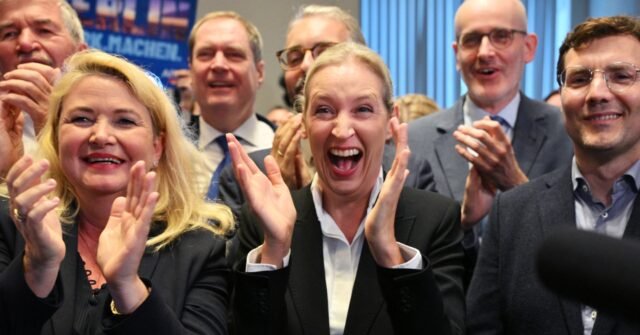
Germany’s anti-mass-migration Alternative for Germany (AfD) is projected to finish first in another state election, less than a month after its breakthrough victory in Saxony-Anhalt, according to exit polls reported Sunday.
Initial projections from German public broadcaster ZDF put the AfD in the lead in Mecklenburg-Western Pomerania, with Die Welt reporting that the party is on track to take 38 percent of the vote. The left-wing Social Democratic Party (SPD) followed at 36.5 percent, according to the same outlet.
The result, if confirmed by the final count, would mark the second time in under a month that the AfD has topped a state-level vote — a striking shift in a country where the party spent years confined to the political margins.
A Blow to Merz — and a Test of His Coalition
Chancellor Friedrich Merz responded to the projections by acknowledging the scale of the defeat. In an address to the nation Sunday evening, he called the Mecklenburg-Western Pomerania result a “disaster,” but insisted he would not step down.
“Change takes strength. Not all of it will be applauded. In some areas the results will only appear after some time. We take on this responsibility, I take on this responsibility because I want to move our country forward,” Merz said, according to Breitbart’s account of the address.
The chancellor reportedly spent the afternoon in crisis talks at CDU headquarters in Berlin, working to shore up support from senior party figures for his continued leadership.
For Merz, the stakes go beyond one state. His Christian Democratic Union (CDU) is currently hovering near the five percent threshold required to enter the Mecklenburg-Western Pomerania state parliament. Falling short would compound the damage from Saxony-Anhalt and further weaken his standing within his own party.
The CDU’s troubles have been mounting for months. Since taking office 16 months ago, Merz’s approval ratings have steadily eroded, with his disapproval rate hitting a record 85 percent after last month’s Saxony-Anhalt elections, according to the reporting.
That figure surpasses the previous record held by former Chancellor Olaf Scholz, whose disapproval rate stood at 76 percent before last year’s elections, when his SPD was resoundingly rejected by voters.
Division on the Left, Momentum on the Right
Sunday’s vote also shuffled the deck in Berlin, where Die Linke (The Left) is projected to win the city election with 26 percent, followed by the CDU at 20 percent.
In Mecklenburg-Western Pomerania, both Die Linke and the CDU are currently on course to clear the five percent threshold needed for seats in the state parliament — though that could change as the count continues through the evening.
Merz’s difficulties have been compounded by his decision, following the Saxony-Anhalt defeat, to form a coalition with the election-losing SPD rather than working with the AfD, which he has branded beyond the pale. That arrangement — the so-called firewall against cooperation with the populist party — has left the CDU dependent on a partner that opposes lower government spending, tax cuts, and reduced immigration, all priorities for much of the German public.
The result, as Breitbart frames it, is a situation where the election losers remain in power while the largest vote-getter is shut out — a dynamic that has fueled the AfD’s rise on the right.
At the national level, the AfD now leads the CDU by 27 percent to 20 percent, and appears positioned to continue consolidating power in the states.
AfD Claims a Mandate — and Calls for Merz to Go
AfD co-leader Tino Chrupalla hailed what he called a “sensational result” in Mecklenburg-Western Pomerania, saying the outcome “clearly gave the AfD a mandate to govern.” He also said Chancellor Merz should resign and provide some “relief” to the country.
But a mandate to govern is not the same as a path to power. The SPD may be in a position to form a minority coalition government that would keep the AfD out of the state government — a scenario that also appears possible in Saxony-Anhalt.
That possibility underscores the central tension in German politics at the moment: the AfD’s growing share of the vote, and the determination of the established parties to prevent it from translating that support into governing authority.
For now, Merz is making clear he intends to stay and fight, even as the walls close in. Whether his party — and his coalition partner — will let him is another question, one that the final count in Mecklenburg-Western Pomerania and the coming weeks in Berlin may soon answer.
Source: www.breitbart.com — https://www.breitbart.com/europe/2026/09/20/germanys-afd-projected-to-win-second-state-election-this-month-chancellor-merz-refuses-to-resign-after-defeat/