

What happens to a society once the political fever finally breaks? That’s the question at the heart of a new essay in American Thinker, where columnist Christopher Chantrill argues that the vocabulary we use to describe human society has been hijacked, and that the right needs an entirely new word for what comes after leftism.
Chantrill’s piece, published September 28, begins with a confession: he got “his knickers in a twist” reading Stu Cvrk’s essay “Individualism vs. Collectivism” at American Greatness — not because he disagreed with the ideas, but because he objects to the words themselves.
His objection is anthropological. Humans are social animals, he writes. We live in society. Therefore, there is no such thing as an “individualist” society, because every society is by definition a collection of humans. And every society is “socialist” in the sense that it is composed of social animals. The labels, in his view, simply don’t describe anything real.
From there, Chantrill levels a broader charge: that the left has stolen ordinary language about human community and converted it into political weaponry. The real dividing line between left and right today, he argues, is simpler than the terminology suggests. Leftists, in his framing, still believe government force can improve society — perhaps even perfect it. The right believes cooperation outside the government’s zone of force works better, and that government programs and “information control” usually make things worse.
His sharpest formulation comes in a line that reframes politics itself. Borrowing from Clausewitz’s famous dictum about war, Chantrill writes that “politics is the mere continuation of war by other means.” Because politics is force, he contends, government is force. So for the left to call its politics of force “collectivism” or “socialism” is, in his words, a lie — not just to its opponents, but to itself.
The Search for a Better Word
Having rejected the available vocabulary, Chantrill sets out to build a new one. He offers a list of candidate words meant to point toward the society he hopes for — not because he wants to order it into existence, but because he hopes people will practice these things voluntarily, on the grounds that they give life meaning and purpose.

The list: stewardship, civility, optimism, enterprise, respectability, virtuosity, conventional, integrity, fidelity.
He credits most of these terms to Björn Merker’s book Perishing Promise, which examines the culture of Victorian Britain. Chantrill describes that era as a great achievement of convention, cooperation, economic growth, and respectability — all, he notes, with government consuming about 10 percent of GDP.
The essay then pivots to J.D. Vance’s memoir Hillbilly Elegy, which Chantrill says he finally read that week and found “pretty gruesome.” He recounts the arc of poverty the book describes: day laborers in the Southern slave economy, then sharecroppers, then coal miners, then machinists and millworkers. With the arrival of Great Society welfare, he writes, the will to work an eight-hour day has nearly vanished among the poorest.
What changed things for Vance, Chantrill notes — apart from his grandmother, Mamaw — was basic training in the Marine Corps. There, Vance learned discipline, responsibility, “giving it my all,” how to open a bank account, and how to shop around for a loan. Chantrill calls this teaching life skills, building character, or learning to be a man — things, he adds, that government schooling from pre-K through graduate school does not teach.
He traces the rest of Vance’s trajectory: out of what Chantrill calls hillbilly rage, through the Marine Corps, into Yale Law School, into the orbit of Peter Thiel and the tech world, and eventually into the vice presidency.
Kindness, Terror, and What Comes Next
The essay takes a darker turn with a piece Chantrill read titled “How Communism Kills Kindness,” about Simon Leys’ book Chinese Shadows. In Chantrill’s telling, Leys described how Mao’s Cultural Revolution destroyed kindness in China, because anyone not fully committed to the revolution was treated as an enemy. Leys, he notes, had been a socialist until he witnessed the horror of the Cultural Revolution.
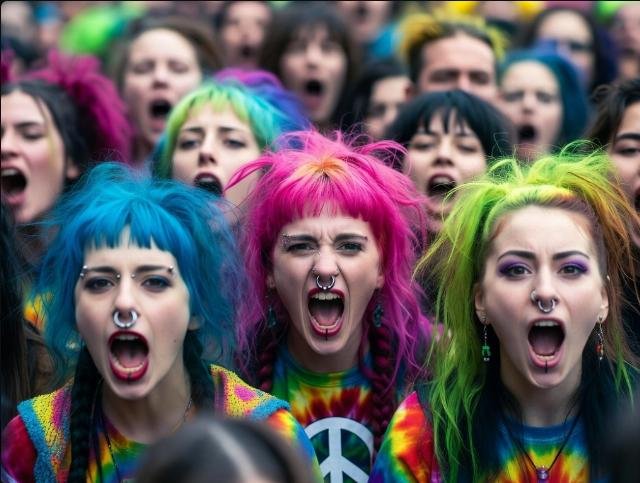
Chantrill draws a direct line to the present. He points to the Democratic Socialists of America — “our DSA kiddies,” as he calls them — who he says think it acceptable to kill healthcare executives and who argue over whether Charlie Kirk deserved to be mourned. His conclusion: politics destroys kindness, because in politics you are either with us or against us.
He then poses the question bluntly: are the DSA activists, crying “felon” or “racist” or pushing the latest “-ism,” turning into Mao’s Red Guards? His answer is an invitation to wait and see.
History, Chantrill suggests, offers a pattern. Every Reign of Terror exhausts itself eventually, and the real question is what follows. Is it Napoleon and twenty years of war? Or can people come back together, “all friendly like”?
His hope is poetic, almost literary. He wishes for a poet of our age to compose an epic of recent trials — complete with heroes, villains, and faithful dogs. After the victory over what he calls the forces of evil, kindness would resume, and people would return to convention, integrity, and fidelity. Government, in this vision, is reduced to a whiny Gollum muttering about his “precious.”
That, Chantrill writes, is what the Inklings constructed after the horror of World War I — and that was before Hitler, before Stalin, before Mao’s Red Guards, before the DSA activists of today.
His closing request is modest in scope but large in ambition: all he wants is for a poet to coin a word that symbolizes how the world ought to be. After leftism.
Whether such a word can be invented on demand is another matter. But the essay reflects a broader frustration on the right — that the vocabulary of community, cooperation, and collective life has been claimed by political opponents, leaving conservatives searching for language that describes their own vision of social order without borrowing the terms they reject.
It’s a linguistic problem with a political edge: if you can’t name the world you want, how do you argue for it?
Source: www.americanthinker.com — https://www.americanthinker.com/articles/2026/09/what-will-we-call-the-world-after-leftism/