
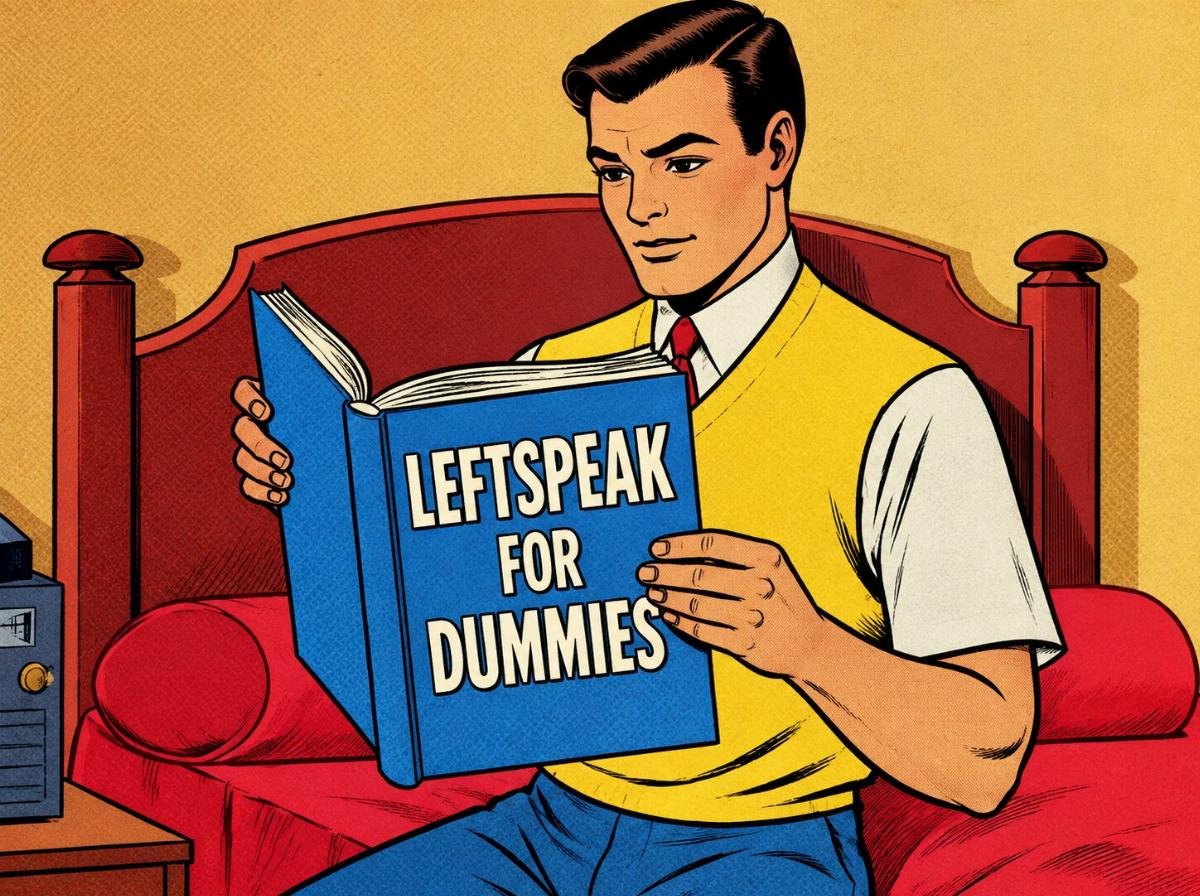
In a column published September 22 on American Thinker, writer J.A. Frascino makes a familiar charge with unusual packaging: the modern American left, Frascino argues, does not simply disagree with its opponents — it deliberately redefines the words they both use, bending language until the vocabulary of the republic serves the purposes of its would-be dismantlers.
The piece, titled “Reading between the Lines,” opens with the premise that “insurgent leftists disingenuously use language to sway public opinion in support of their narrative, so as to gain populist support for the overthrow of the social order.” From there, Frascino’s stated aim is to look past the “intended impact” of that “inflammatory rhetoric” and to “unmask the true meaning” of what he calls “verbal malfeasance.”
What follows is less an essay than a glossary — a set of sardonic re-definitions, each one compressing a conservative grievance into a single line. The form is old and deliberately provocative: take a term the left claims as its own, then redefine it as something its users would never accept.
A Dictionary Built on Distrust
Some of Frascino’s entries target economic and policy language. “Reparations,” he writes, amounts to “virtue-signaling with other people’s money.” “Going green” becomes “growing moldy from inadequate electrical energy” — an allusion to reliability concerns that have shadowed renewable-energy transitions. “Socialism” is dismissed as “a socioeconomic model incompatible with human nature.”
Other entries aim at the vocabulary of identity and culture. A “feminist,” in Frascino’s formulation, is “a female who rejects femininity.” “Toxic masculinity” is recast as “an obstacle to gender equality” — that is, a phrase whose real function is to pathologize ordinary male behavior. “Permissive parenting” is said to mean “ceding discipline and character building to social media and the teachers union.”
“Globalization,” meanwhile, is defined as “advancing third world nations by degrading first world nations,” and “legalized THC” carries perhaps the column’s sharpest partisan sting: “DNC-sanctioned opiate of the masses.”
Several entries are aimed squarely at the press and at the vocabulary of civil liberties. “Freedom of speech,” Frascino writes, has come to mean “the right to censor opposing opinion.” “Freedom of the press” is boiled down to a rueful play on the New York Times’ famous slogan: “All the news that’s fit to spin.” “Hate speech” is “language the left hates to hear” — a definition that treats the category itself as a rhetorical weapon rather than a description.
Two entries are more philosophical. “Post-modernism” is labeled “a cultural philosophy at the heart of contemporary progressivism that dogmatically opposes dogma” — a line that leans on the apparent paradox of an anti-dogmatic movement enforcing its own orthodoxy. “Authoritarianism” is described as “a trait vilified by leftist authority,” implying that the accusation is leveled only at opponents.
And one entry is a direct smash at the Democratic Party’s branding: “Democracy,” Frascino writes, has been quietly revised to mean “government of the people, by the Democrat party, for the Democrat party.” The line repurposes Lincoln’s Gettysburg formulation to suggest that the left’s professed devotion to democratic norms is really a claim to permanent rule. Another entry, on artificial intelligence, casts “death by A.I.” as “fear-mongering for a new apocalypse that needs big government regulation” — the only entry in the list that reads as a critique of a regulatory impulse rather than a cultural one.
The Punchline and the Plea
Frascino does not pretend the list is neutral analysis. The column closes by drawing what he presents as the obvious conclusion: “It doesn’t take much to read between the lines: the modern ‘American’ leftist is as anti-American as one can get.” The scare quotes around “American” do the work of the argument — the claim being that the left’s use of patriotic vocabulary is itself a kind of camouflage.
He ends with an appeal rather than an indictment: “Now more than ever, the ability to speak our minds is crucial to the republic we cherish.” It is a standard closing move for opinion writing in the outlet’s register — a warning framed as a defense of open discourse, issued from a publication that has built an audience around the conviction that such discourse is under threat.
Opinion Writing as Vocabulary War
It is worth being clear about what this piece is and is not. Frascino is not reporting a finding or citing a study; he is offering a set of assertions, each of which a reader will either nod along with or reject outright depending on priors. The column’s persuasive force rests entirely on the recognition-jolt of its definitions — the sense, for readers inclined to share them, that someone has finally said out loud what they suspect about how certain words are used.
That is a legitimate mode of political writing, and it is a very old one. Redefining an opponent’s vocabulary is one of the most durable tactics in politics, precisely because whoever controls the meaning of a word controls the range of arguments that can be made with it. Frascino’s contention is that the left has been winning that contest for years, and that the remedy is not to invent new words but to call out the old ones.
Whether the definitions land will depend on the reader. But the column makes a coherent case for its own existence: that the gap between what a political phrase says and what it does is often where the real argument hides, and that closing that gap is the work of anyone who wants to argue back. Frascino’s glossary is, in the end, less a set of definitions than a challenge to the reader to supply their own.
Source: www.americanthinker.com — https://www.americanthinker.com/blog/2026/09/reading-between-the-lines/