
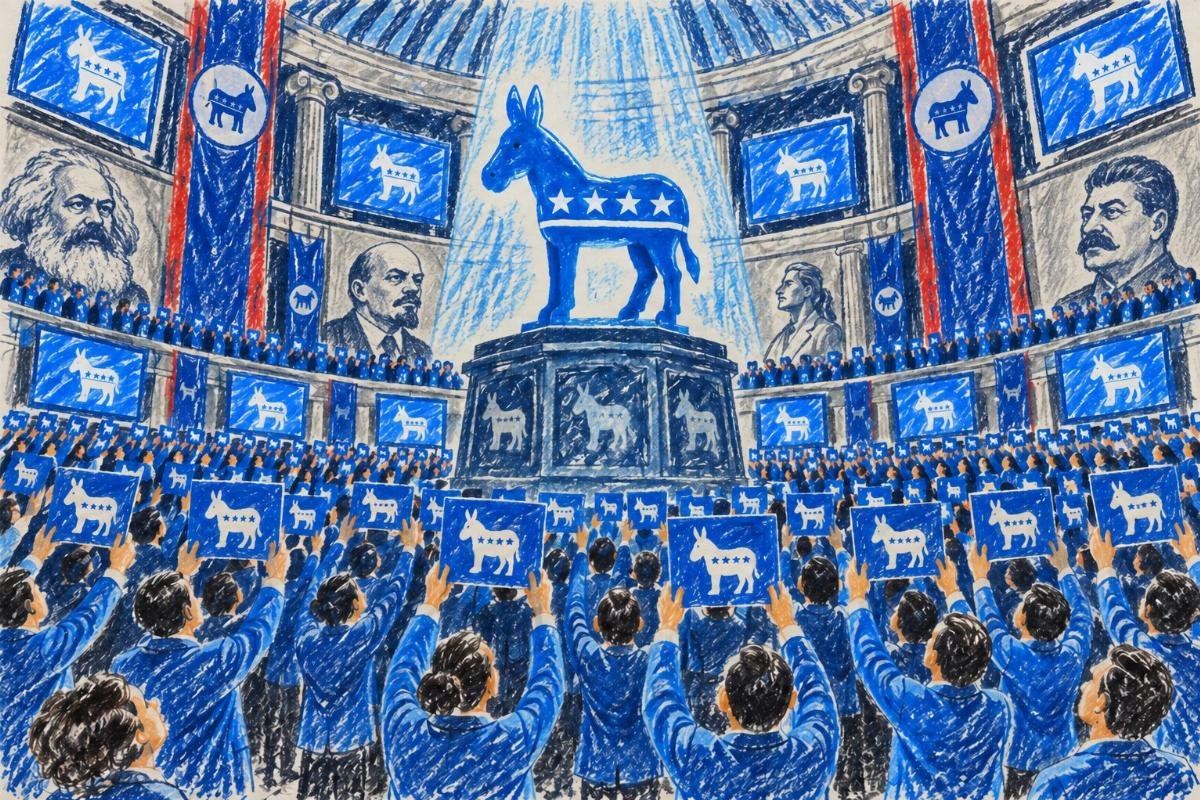
The central error that conservatives, libertarians, and the political Right keep making, according to a new essay in American Thinker, is treating the Left as just another ideological opponent — one that can be persuaded by facts, softened by compromise, or trusted to respect the rules of liberal governance once it holds power. The author, writing under the name W. Galt, argues that the Left is better understood as operating with the mental architecture of a cult, making ordinary political debate not just unproductive but structurally impossible.
Cults as a Mental Structure, Not Just Ritual
Galt’s piece, published September 23, 2026, begins by challenging the conventional image of a cult. Cults, he writes, are not defined chiefly by strange rituals or a magnetic leader. They are defined by how the mind organizes itself around a doctrine: unwavering adherence to that doctrine, rejection of doubt, a stark division between insiders and enemies, the primacy of narrative over facts, impunity for leaders, and a denial mechanism that protects group identity even at the cost of reality.
The essay lists patterns that research on cults has identified over the years. The group demands excessive and uncritical commitment. Questioning is discouraged or punished in moral terms. A polarized worldview takes hold, dividing humanity into the chosen and the enemy. The ends are treated as justifying the means. Doctrine outranks personal experience and contradictory evidence. Members build their identity more out of opposition to an adversary than out of any coherent positive program. And leaders are rarely held truly accountable — their lies or contradictions are reinterpreted, ignored, or even recast as proof of moral superiority.
Layered on top of this, Galt writes, is psychological denial as a defense mechanism. Accepting a fact that contradicts the narrative would mean letting reality stop being what the believer needs it to be. That is why evidence bounces off rather than penetrates, and why reason itself comes to feel like an existential threat. Contradictory evidence — historical failures, human costs, internal inconsistencies, empirical results — is not debated on its merits. It is reinterpreted, relativized, or blamed on the enemy. The believer, in Galt’s phrasing, simply does not see it, neutralizing it to avoid having to change his identity.
This, he argues, explains how certain groups can hold contradictory positions without discomfort, why outside criticism strengthens adherence rather than weakening it, and why rational dialogue turns sterile. At that point, the dispute is no longer about ideas. It is a defense of a psychological and group identity.
Applying the Framework to the Contemporary Left
Galt then runs the contemporary Left — which he defines as spanning from social democracy to communism — through this framework. Its narrative, built around oppression, privilege, capitalism as absolute evil, and ubiquitous fascism, functions as dogma, he writes. Facts that contradict that narrative, he says — the economic failures of socialism, the deaths of millions, violence committed by protected groups, demographic or crime statistics — get reinterpreted, relativized, or attributed to enemy conspiracies. The contradictions of political leaders do not trigger a crisis of faith; they are forgiven or concealed, because in this framework the message matters more than consistency.
Identity, in Galt’s account, is constructed through hostility toward an adversary. Capitalism, individual liberty, liberal democracy, and Western civilization are not treated as imperfect systems open to reform. They become Evil itself. This structure, he writes, helps explain both permanent activism and the ease with which activism can slide into coercion. Terrorism, within this logic, is not an aberration but activism carried to its extreme: anyone convinced he holds absolute moral truth and faces a demonized enemy can come to regard any means as legitimate. From there, Galt argues, comes the ability of highly mobilized minorities to capture the media narrative, dominate the streets, and under certain circumstances acquire institutional power, with psychological denial preserving the barrier — because accepting reality would mean ceasing to belong.
He concedes that the variants of socialism differ in intensity while sharing a core. Social democracy may look more moderate, but in his view it preserves the primacy of the egalitarian narrative and the same difficulty accepting limits imposed by human nature or economics. Communism, he writes, simply carries the logic to its ultimate consequences.

The Draw of the Cause — and the Islamist Parallel
On the question of why this worldview attracts so many followers, Galt suggests that whatever its promises — which he says he will examine in a later article — the believer is someone alienated from his own society who finds in a transcendent political cause an escape from the burdens of the individual self. He credits Jamie Glazov for the argument that part of the attraction of mass movements lies in self-abnegation: the chance to dissolve an unsatisfactory identity into something supposedly greater and purer.
Galt extends the comparison to Islamism, arguing that the two can operate according to sectarian logics. Both, he writes, construct identity through opposition to a common enemy — Western civilization, capitalism, individual liberty, national sovereignty. Both place a sacred narrative above facts, justify extreme means, demand unwavering loyalty, and punish internal dissent. Both, he adds, have produced cultures in which death is glorified rather than merely feared. History, in his telling, shows that neither socialism nor Islamism merely takes prisoners; both have produced conversion or death, and millions of lives have been destroyed by what he calls these pathological ideologies.
He is careful to note that this does not mean the two share every dogma — only that they can share a mental structure. Common hatred, he observes, can unite more effectively than common love. That is why, in his view, we repeatedly see tactical coalitions, complicit silences, and a systematic reluctance to confront the incompatibility between Islamism and liberal values. The Left, he writes, does not realize it, because its mechanism of denial prevents that recognition without endangering its own identity. Neither Iran — where he says the Left collaborated in the revolution only to be repressed once Islamism prevailed — nor other historical precedents have been enough to force recognition of what he considers obvious.
The Strategic Warning
The essay’s most pointed argument is aimed not at the Left but at its opponents. The Right, conservatives, and libertarians, Galt writes, make a fatal strategic mistake when they treat the Left as simply another ideology that is susceptible to rational debate, facts, and compromise. They expect it to correct itself when confronted with evidence. They expect it, once in power, to respect the rules of liberty and truth. They fail to understand, he argues, that the adversary is not operating within the same framework.
The difference, in his account, is not merely ideological but vital, existential, and civilizational. A concession is never just a temporary exchange. It can become an irreversible advance of the sectarian narrative into the realm of reality. Every cultural, institutional, or legislative conquest, he warns, becomes entrenched and is rarely reversed. And the Right, by failing to grasp this mental mechanism, remains permanently at a disadvantage.
Galt closes by insisting that describing the Left as a cult is not name-calling but, in his view, a condition of political and civilizational survival. Those who keep trying to reason with people who have turned denial of reality into an identity, he writes, are condemned to lose — and every loss means one fewer opportunity for a better life and another step toward the abyss.
Source: www.americanthinker.com — https://www.americanthinker.com/articles/2026/09/the-left-is-a-cult/