
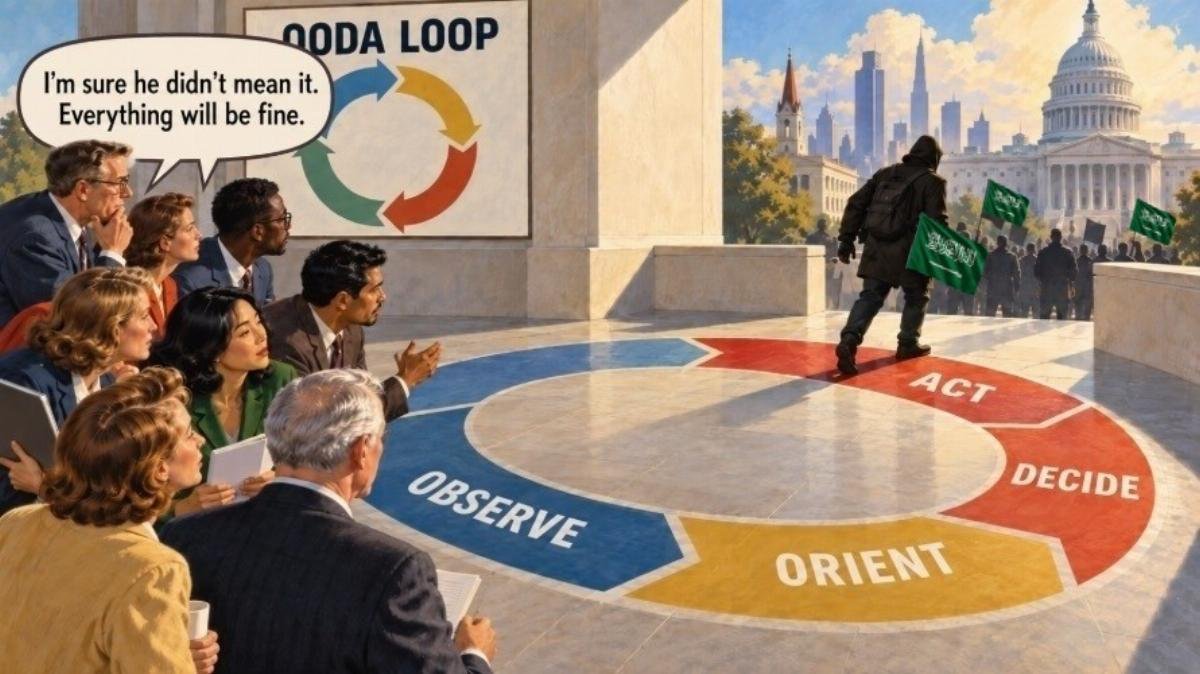
In a self-defense class, the instructor explains, the attacker already has the upper hand before anyone throws a punch. He knows what he wants, he’s picked his target, and he’s decided what he’s willing to do. His victim may still be figuring out what’s happening.
Tsahi Shemesh thinks that asymmetry describes more than a street confrontation. It describes the position Western democracies have put themselves in.
Writing for American Thinker, Shemesh — an Israeli-American IDF veteran who runs Krav Maga Experts in New York City — argues that the West is losing ground to ideological movements not because it lacks resources or warning, but because it struggles to see what its own assumptions tell it shouldn’t be there. As he puts it, the West “still stands there, effectively blinded by its own ideology,” even as its adversaries are poised to strike or already have.
A framework borrowed from a fighter pilot
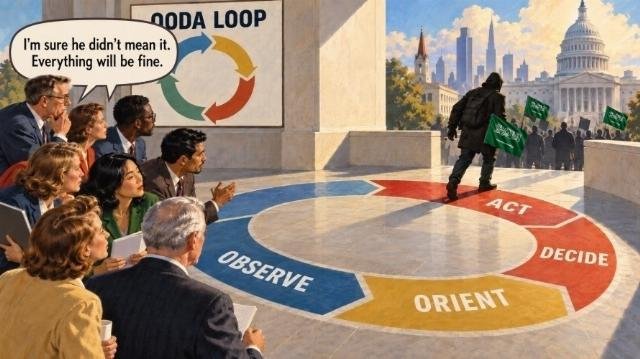
Shemesh builds his argument around the OODA loop, the decision cycle popularized by military strategist John Boyd: observe, orient, decide, act. Information gets gathered, interpreted, converted into decisions, and then into action — and the side that moves through that loop faster holds the advantage.
His worry is what happens when a civilization becomes so attached to its assumptions that it can’t process evidence that contradicts them. In his telling, that is precisely the trap the West has walked into. “A society that cannot examine uncomfortable information will struggle to orient itself,” he writes. Poor orientation leads to poor decisions, and poor decisions lead to events forcing choices that could have been made under better circumstances earlier.
The self-defense parallel is deliberate. Shemesh notes that the earliest warnings usually arrive before any physical contact — a stranger crowding your space, ignoring your boundaries, blocking your exit. Catching those signals is what buys a defender options. Miss them, and the only choices left are bad ones.
Jihadist threat and the socialist question
He applies the same lens to two categories of ideological threat, and treats them differently.
On radical Islamist organizations, Shemesh points to what he calls observable facts: declared objectives, recruitment, celebrations of terrorist attacks, and the use of Western freedoms to spread propaganda. He cites Europol’s count of 24 jihadist terrorist attacks in the European Union in 2024 — a figure that includes completed, failed, and foiled plots. In his view, that record demands serious examination rather than being filtered out of the conversation.
Authoritarian socialist movements, he argues, present a different problem. Their historical record, he writes, includes political repression, censorship, and the concentration of economic and governmental power — but he is careful to note that contemporary democratic socialist movements vary widely in their aims and in their commitment to political pluralism. The distinction that matters, in his framing, is what a movement intends to do once it holds power, how it plans to get there, and whether it will respect the freedoms of people who disagree.
That leads him to a difficulty he regards as genuinely hard: movements that pursue influence through lawful democratic participation while rejecting core democratic protections in the system they propose to build. A society that reads every political movement through its own commitment to tolerance, he suggests, risks misreading groups that don’t share those principles at all.
Warning signs that accumulate quietly
Observation by itself, Shemesh stresses, accomplishes little. He offers the example of a student who registers that someone is behaving aggressively but keeps interpreting the encounter as an ordinary disagreement — expectations interfering with judgment. Institutions, he argues, are vulnerable to the same failure.
What makes the institutional version harder is timing. Restrictions on political opposition, intimidation of journalists, and attacks on judicial independence are all visible developments, he writes. Their cumulative effect may not become clear until institutions have already lost much of their capacity to resist. Ideological movements, like attackers, can build an advantage over years of organizing, recruitment, propaganda, and institutional entrenchment.
Shemesh doesn’t dismiss Western counterterrorism efforts. He acknowledges that governments have substantial capabilities and have prevented attacks. But success in one case, he warns, guarantees nothing about whether emerging threats elsewhere will be spotted in time.
Judgment, not reflex
Importantly, his argument is not a call for panic or for indiscriminate action. He insists that distinguishing peaceful political advocacy from intimidation, coercion, and violence is part of the task, and that the response must fit the actual threat. Poorly conceived action can create new dangers just as surely as hesitation lets an existing one grow. Every decision creates consequences — including the decision to do nothing.
What he’s really asking is whether Western institutions can do three things at once: recognize threats to their foundational principles, confront evidence that challenges their own assumptions, and decide before the available options narrow. Religious freedom, free expression, equality before the law, and political pluralism, he notes, depend on institutions willing to protect them — and on a public willing to see clearly while there’s still time.
“The warning signs matter most while there is still time to respond,” Shemesh writes. Whether the West acts on that, in his telling, is an open question.
Source: www.americanthinker.com — https://www.americanthinker.com/articles/2026/09/the-west-hasn-t-even-entered-the-ooda-loop/