
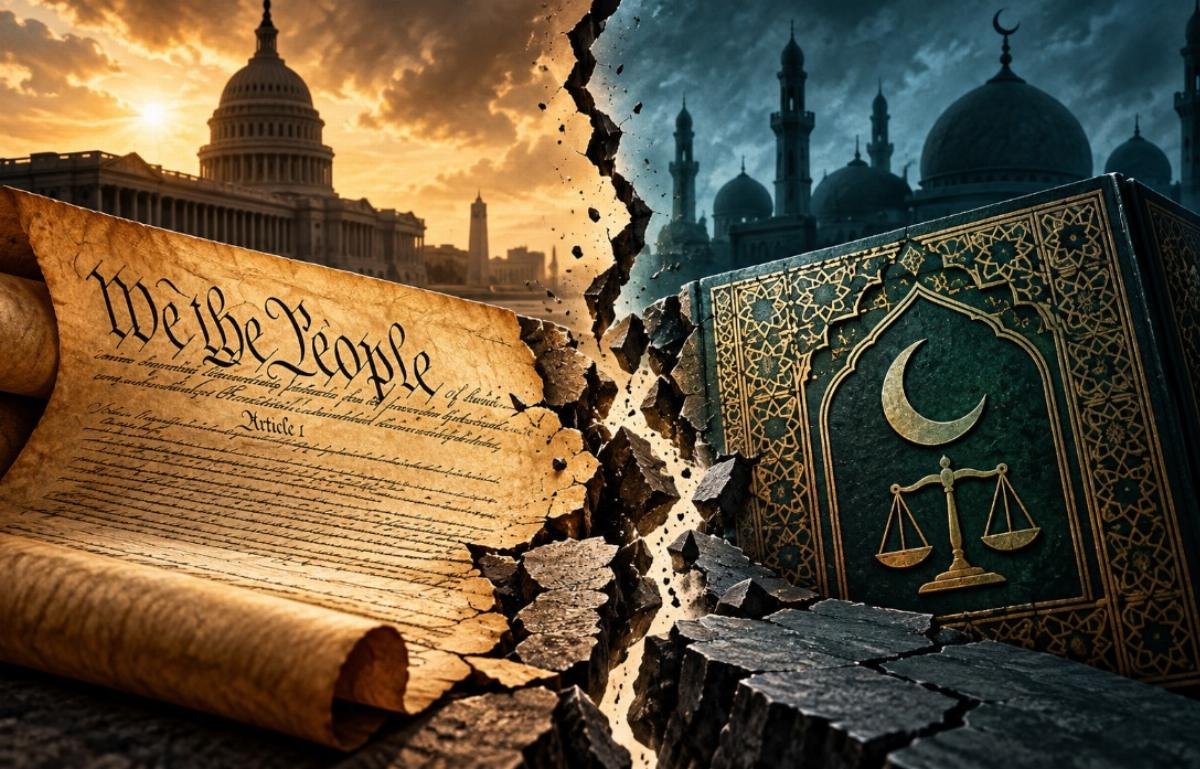
An essay published by American Thinker argues that the growing presence of Islam in American public life raises a question the country has largely avoided: what happens when sharia law and the Constitution point in opposite directions — and whether Congress should act on the answer.
Written by Susan Quinn and dated September 29, 2026, the piece is framed as an examination of legitimacy. Quinn notes that Islam has been “practiced not only as a religion, but also as a political and legal system that its most ardent practitioners embrace,” and she treats that duality, rather than theology, as the crux of the problem. Her central concern is whether a Muslim who adheres strictly to sharia can function inside a country bound by the Constitution — a question she says warrants careful examination rather than assumption.
A debate among Muslims themselves
Quinn acknowledges that the question is contested within Islam. She writes that Muslim scholars have argued for years over whether Islam is only a religion or also a political and legal system, and that the majority view holds it to be both. Reformers, she notes, take the opposite position — that Islam is a religion alone and that sharia does not need to be strictly followed. Quinn frames this disagreement not as a settled matter but as an unresolved contest, and she makes her own prediction plain: at some point, she writes, extremists will probably win out, particularly as Muslims continue arriving from other countries.
She also points to Texas as a case study, describing it as home to one of the largest Muslim populations in the country and a place where advocacy for sharia is visible. She cites Shaykh Uthman ibn Farooq, who spoke at a livestreamed event at the Sufaraa Center in McKinney, Texas. According to the essay, Farooq said, “We love this country. We want good for this country. And that’s why we want Islam for this country, ’cause we think that’s the best thing. And we’re not going to be ashamed of that.” Farooq went on to argue that Muslims are fully within their constitutional rights to follow sharia — “The Constitution of this country protects that. That’s our right to believe in the Sharia. Yes, I said it. That’s our right,” he said, according to the piece.
Quinn also references other Texas developments: Governor Greg Abbott directing law enforcement to investigate the establishment of sharia courts in Dallas, and an imam who protested against and threatened a business for selling pork and other products that violated sharia law.
Where the conflicts would land
The essay’s core charge is that no one is asking the practical question — what happens when the two legal systems collide — so it supplies a list. Quinn identifies honor killings, capital punishment for apostates, and corporal punishments including stoning, lashing, and amputation for blasphemy, theft, and adultery as areas of potential conflict. She presents these not as hypotheticals about American Muslims generally but as the stakes of a system she believes some adherents would place above American law.
From there the argument turns to politics. Quinn contends that as the Muslim population grows, particularly through immigration from Muslim countries, Muslims are increasingly aligning with American progressives — a coalition she describes as the Left seeing them as allies in a shared project of destroying the country. But she does not treat that alliance as durable. In her telling, progressives fail to recognize that Muslims may abandon them as they gain power, because many Muslims reject Western social values and the two groups are fundamentally at odds in ways that will eventually surface.
To illustrate the point, the essay quotes an outside passage asserting that the sentiments of Ilhan Omar and Rashida Tlaib, the “deceptive narrative-weaving of Mamdani,” and the “criminal actions taken to fund jihad by vast swaths of the foreign-born Somali enclave in Minnesota” are evidence that for many Muslims, the interests of Islam concretely supersede the well-being of American citizens and fidelity to the Constitution. The quoted passage concludes that the common thread of such participation in American institutions appears to be “the degradation of Western principles in favor of Islamic advancement.”
That Minnesota reference connects to an earlier passage in Quinn’s piece, where she cites what she calls the enormous fraud network established within Minneapolis’s Somali community.
The prescriptions
Quinn is explicit that she wants Congress, not the courts or voters alone, to take up the matter. She writes that Congress needs to determine the degree to which Islam has gained political and institutional power in the country. That would include examining Muslim enclaves with large foreign-born populations, especially given the Minneapolis fraud case, and deporting those found to have engaged in fraud who are legally subject to deportation. Congress should also hold hearings, she argues, to establish whether and to what extent the First Amendment and other constitutional and legal requirements are being challenged or violated.
The essay then moves to immigration, posing a set of questions rather than a single proposal. If investigations confirm the level of incursion she suspects, Quinn writes, the country needs to reconsider its criteria for allowing Muslims to enter and become citizens. Should immigrants be screened for their allegiance to the Constitution? Are they prepared to accept the Constitution and American law as controlling when those laws conflict with sharia? She leaves open other possibilities too, asking whether Muslims will accept government requirements that practices violating the Constitution cannot be enforced as law — and, at the more restrictive end, whether the importation of practicing Muslims should be banned at all. Her final question is whether radical Muslims will eventually gain enough positions within governing institutions to change the very fabric of the country.
Taken as a whole, the piece runs along two tracks that don’t always resolve into one another. One is constitutional: a republic that permits the free exercise of religion must still decide which law controls when a religious legal code and the Constitution diverge. The other is demographic and political: Quinn treats immigration and the growth of Muslim communities as forces that will determine how that tension gets settled, and she is skeptical that the outcome will be benign.
It closes by returning to Congress, and to a warning. “Our country’s survival as a constitutional republic may depend on it,” Quinn writes, before the essay’s final line pivots to speech itself: “Now more than ever, the ability to speak our minds is crucial to the republic we cherish.” The piece ends with a donation appeal for the publication.
The essay does not cite specific legislative proposals, pending bills, or named sponsors for the congressional action it recommends, and it does not attempt to quantify the Muslim population or its political representation beyond the Texas and Minnesota references. Its case rests on the interpretation of sharia as inherently political and legal, which Quinn attributes to a majority of Muslim scholars, and on the inference that a growing population will translate into increased institutional power. Whether either premise holds is left as the subject of the hearings she wants convened.
Source: www.americanthinker.com — https://www.americanthinker.com/blog/2026/09/can-we-delegitimize-islam/