
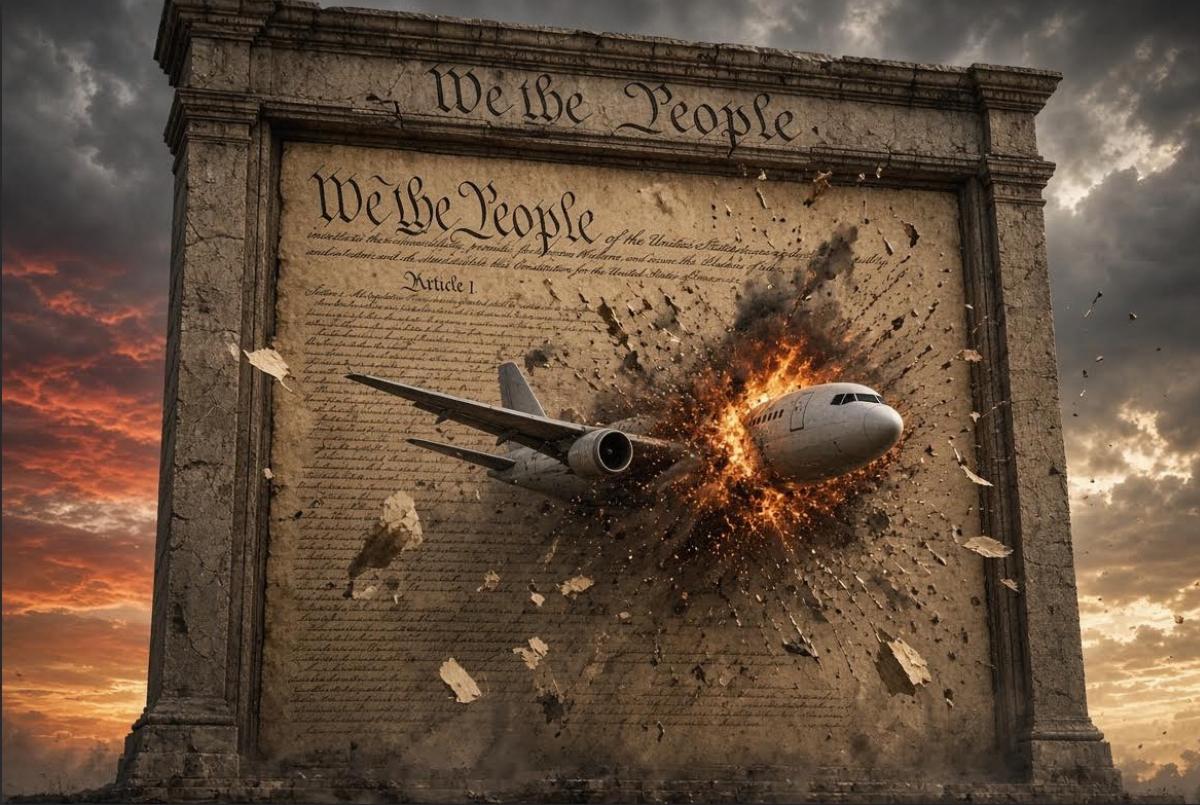
Twenty-five years after September 11, Vince Coyner wants to reframe what the attackers actually accomplished. Writing in American Thinker, Coyner argues that the towers were only part of the story, and possibly not even the most consequential part.
His essay lands in a year that compresses two anniversaries uncomfortably together: the 250th birthday of the United States and the 25th anniversary of the attacks. For Coyner, those two dates are tangled up with each other, and the second one did real damage to the first.
What the 9/11 Generation Was Taught to Believe
Coyner’s essay opens with autobiography. Born two decades after World War II, raised on military bases in Italy and Cuba, he describes a childhood surrounded by parades, marches, and drills. The details are specific — military flights, the national anthem before movies, lunch in a barracks galley flanked by Marines and Navy NCOs. But his point is that this experience wasn’t unusual. Most Americans, he writes, simply knew their country was fundamentally good.
He carried that assumption for decades, treating it less as a belief than as a kind of pressure — invisible, constant, not something anyone argued about. He characterizes his thinking this way: America was destined to win World War II not because of shipyards or fighter production, but because the country was on the right side. Vietnam, in his telling, could be argued about, but it didn’t change the underlying fact. Nations make mistakes, he writes; his was essentially decent.
Then came that morning in Atlanta. Coyner recalls going back to bed after the gym, being awakened by a call from his sister, turning on the TV, and watching the second plane hit the South Tower live. “America was being attacked,” he writes, invoking the comparison that many reached for that week: Pearl Harbor. He says he spent the next seven days glued to his television, roughly 20 hours a day, leaving only for food at an eerily empty Publix across the street.
“Islam Is Peace” as the Turning Point
Coyner then describes a period of self-education. He lists books by Bernard Lewis, Dore Gold, Steven Emerson, Robert Spencer, and David Horowitz, and says the reading, combined with observation, led him to a conclusion he states plainly: Islam, in his view, is incompatible with the United States. He frames the moment as the revival of a 1,400-year clash of civilizations that had lain mostly dormant for four centuries.
His essay turns sharply on President George W. Bush. Coyner writes that Bush’s description of Islam as a religion of peace was “against all observable facts,” and he identifies that moment as the beginning of a political correctness he says was already infecting American life. The unity that followed the attacks, he concedes, was real — the kind of cohesion the country hadn’t seen in decades. He just doesn’t think it held.
The media, he argues, showcased every American wartime mistake and elevated those calling for withdrawal. By 2003, he writes, rallies were common and Bush was being compared to Hitler. In 2004, he continues, Democrats nominated what he calls a globalist in John Kerry. Four years later, he writes, the country sent to the White House a man who had promised to fundamentally transform it.
‘A Bizarro World’ Ascribed to the Left
The essay’s middle section is a litany of cultural transformation, compressed into a quarter-century. Coyner describes political correctness as a coalition that merged communists, environmentalists, gay activists, minorities, and Islam into what he calls a largely anti-American Democratic Party — one he characterizes as anti-white, anti-Christian, anti-capitalist, and fundamentally anti-Western civilization. He ties the cultural shift to the impulse to protect the “religion of peace,” which he says set off a cascade of victimization claims that absorbed every aggrieved group along the way.
From there the list is long: statues of Confederate generals but also of Christopher Columbus, George Washington, Abraham Lincoln, Ulysses S. Grant, and Theodore Roosevelt; a changed definition of marriage after two millennia of Western consensus; cultural-appropriation controversies over Halloween costumes; the replacement of Broken Windows policing and stop-and-frisk with Defund the Police and community responders; borders he says were essentially eliminated while blue states prioritized protecting violators over immigration law; and the collapse, as he puts it, of biology into a new “reality” in which sex is changeable — with consequences he extends to children.
For many Americans, Coyner writes, the legacy of September 11 is a country that feels like a Bizarro world where up is down and anything pro-American is treated as suspect.
A Deliberately Personal Counter-Legacy
Coyner is explicit that this is not his own conclusion. His legacy from 9/11 is inverted: the attacks forced him to examine American and world history more seriously, and he says that examination confirmed rather than weakened his view. He calls the Founding Fathers imperfect but credits them with what he regards as the greatest document since the Bible, and credits the system they built for prosperity unmatched in human history and for saving the world twice.
He notes that his blog is called Imperfect America, with a subtitle borrowed from the Voltaire line that perfect is the enemy of the good. America, in his framing, has an original sin and an imperfect record — and remains a force for good.
His final move is the essay’s thesis. To whatever extent September 11 set in motion the estrangement of many Americans from what makes the country, in his view, the greatest of God’s creation, the terrorists accomplished far more than they could have imagined. He describes trying to push back daily, through writing and through reminders not to take the country for granted. His closing warning is historical: unappreciated and unprotected civilizations can collapse, and sometimes quickly.
The piece ends on a note about speech — an argument that the ability to speak freely matters more now than ever to the republic. It reads less like a policy argument than a personal accounting, offered on an anniversary that, by his own reckoning, measures loss in two directions at once.
Source: www.americanthinker.com — https://www.americanthinker.com/articles/2026/09/the-terrorists-real-victory-wasn-t-the-towers-it-was-much-worse/