
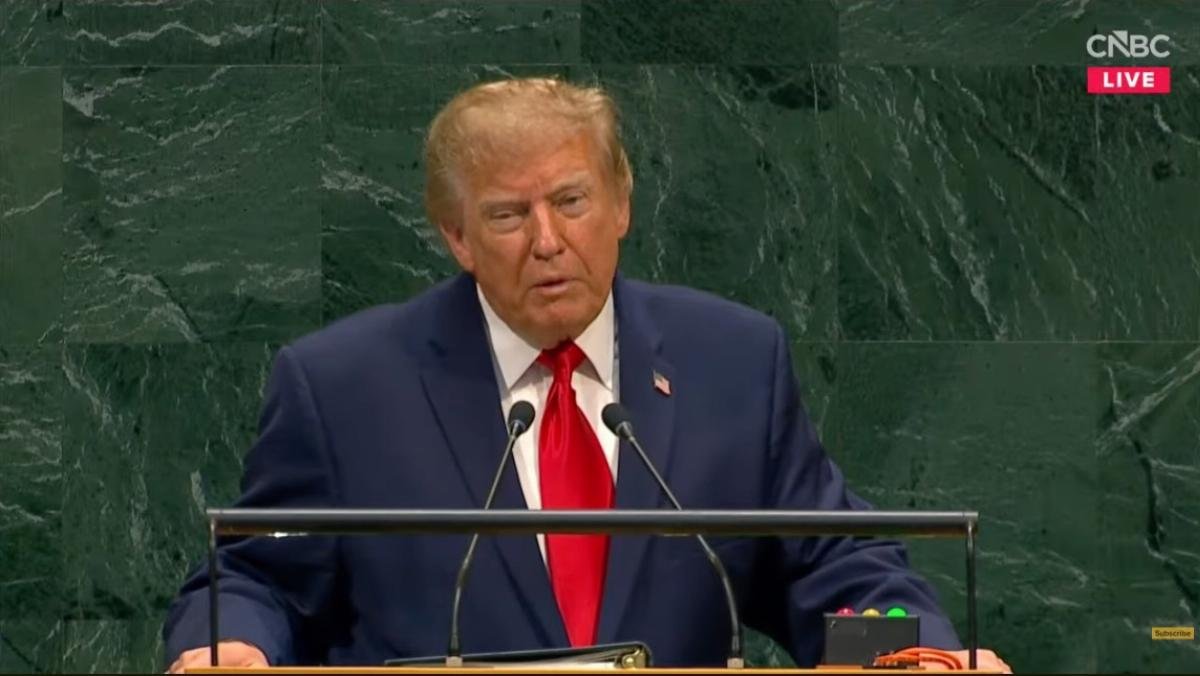
President Trump’s address before the United Nations this week drew an unusually enthusiastic review from American Thinker’s Andrea Widburg, who confessed at the outset that she typically finds his speeches “so discursive” that he often fails to land the core messages that would help voters understand his policies. This one, she wrote in a September 23 opinion piece, broke the pattern.
Widburg, who openly describes herself as someone who likes Trump, agrees with most of his policies, and appreciates his “often sly sense of humor,” called the UN address “a model of clarity, both practically and morally,” and urged readers who had not yet watched or read it to do so.
A Domestic Record She Says Republicans Should Memorize
According to Widburg’s account, Trump opened with a compact summary of his domestic accomplishments — a section she argues every Republican candidate should commit to memory for use at speeches, town halls, and media appearances. She also notes that he addressed rising gas prices, which she says the media “obsessively highlight,” and pointed to oil prices during the Iran War as a comparison she believes Trump’s defenders should raise when he is unfavorably measured against Barack Obama or Joe Biden.
Widburg’s assessment of that record is unreserved: she calls it “extraordinary” and argues that in a media environment she considers honest, Trump “would be the most popular president in American history.” Her conclusion is that the GOP and its candidates are failing to communicate the full scope of his economic record to the public.
Iran and the ‘Bully No More’
The heart of Widburg’s praise, though, concerns Iran. She singles out what she describes as Trump’s courage and moral clarity on the subject, quoting his line that the Iranian regime has ruled for fifty-one years “by bloodshed and mass murder” and that it was “the bully of the Middle East, but they are the bully no more.” She also highlights his vow that he will never allow Iran to obtain a nuclear weapon.
In Widburg’s telling, Trump explained that he first attempted a negotiated settlement with Tehran and was rebuffed, after which Operation Midnight Hammer buried Iran’s nuclear stockpile — “or at least most of it,” she writes — beneath mounds of rubble. Yet Iran kept working toward a program that, in Trump’s quoted words, would have let a “wicked regime” spread terror “knowing that any attempt to stop them would face an arsenal of nuclear annihilation.”
Widburg underscores Trump’s linkage of Iran to the October 7 attack on Israel three years ago, in which, he said, Iran-funded terrorists killed 1,200 innocent civilians, including Americans and babies. Trump noted that Iran’s Supreme Leader celebrated the massacre as “a service to humanity” — a point Widburg treats as a significant acknowledgment that civilians were not incidental casualties of war but deliberate targets.
She also cites Trump’s reminder that Iran killed 72,000 of its own citizens in 2026 alone, and his warning about what such a regime could do behind a nuclear shield. Then comes the indictment of world leaders that Widburg clearly regards as the speech’s sharpest moment: that this was a reality “far too many preferred to ignore,” that many presidents and others simply wanted to ignore it, and that they knew the problem but were unwilling to act.
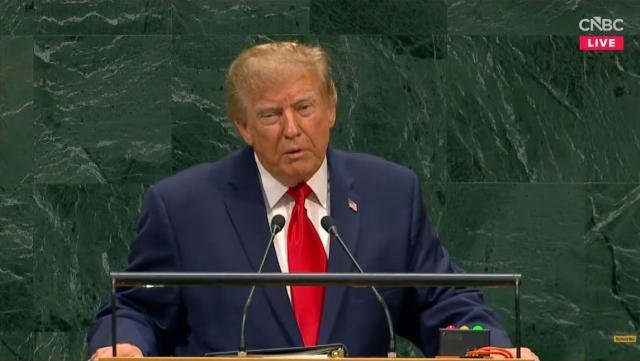
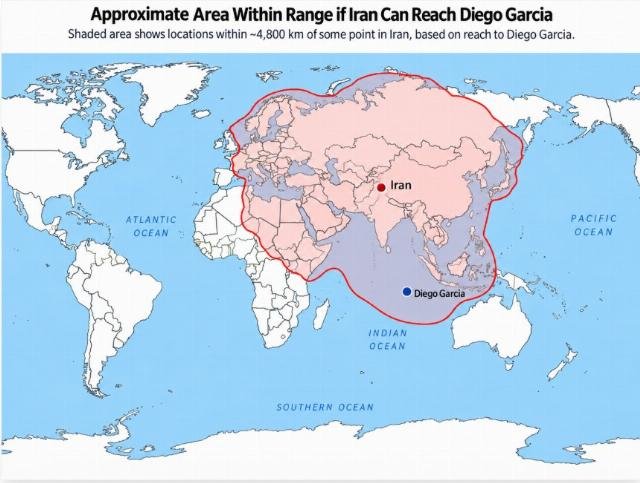
Widburg credits Operation Epic Fury with destroying Iran’s military capacity, writing that all 159 ships of its navy now sit at the bottom of the sea, and that its air force, radar, anti-aircraft equipment, and missile and drone manufacturing capacity are gone or nearly gone, along with its economy. Still, she notes, Iran has not stopped, with inflation out of control — and she points out that the UN’s contribution was merely to condemn attacks on commercial shipping.
Trump’s demand, as she relays it, is that the world must keep up the pressure, with only two outcomes on the table. One is a deal that would allow Iran to rebuild into perhaps one of the greatest countries in the Middle East, contingent on Tehran. The other, implicitly contingent on whether the international community proves weak or strong, is that he “annihilate the Islamic Republic and do it quickly,” driving it “into hell with no chance of survival and no hope of future greatness.” Trump added that he believes a deal will come right after the election, “because it doesn’t make sense for them not to.”
On the question of Iranian interference in the midterms, Widburg quotes Trump saying he gives it no credence and that it “doesn’t even enter my mind” — the only consideration being that Iran will never have a nuclear weapon. For Widburg, that is courage, moral clarity, and reverence for national security “not just for America, but for the world.”
Other Claims, and Notes of Doubt
The speech ranged beyond Iran. Widburg lists Trump’s Middle East foreign policy accomplishments, including a Gaza ceasefire she doubts can hold, given what she calls the “foul” nature of Gazans; wars he says he ended between Cambodia and Thailand, Kosovo and Serbia, the Democratic Republic of the Congo and Rwanda, Pakistan and India, and Armenia and Azerbaijan; the turnaround in Venezuela; and the Greenland Agreement. She notes that he continues to hold out hope for Russia and Ukraine, though she has her own doubts there.
Trump also claimed to have reformed the UN itself. Widburg is skeptical, calling the institution so corrupt that, in her view, it cannot be saved — adding, as a partisan aside, that its Secretary-General is a “pro-China communist” thanks to Obama’s help.
Finally, she notes his defense of AI — or, as he now calls it, “superintelligence” — and his refusal to be swayed by the same people who panicked over climate change.
Widburg’s closing verdict is that Trump is “a practical visionary,” one of the rarest combinations of traits, a patriot and a peacemaker who, flaws and all, is presiding over “a most golden of golden ages.” If more Americans understood that, she concludes, the midterms would be a red wave.
It is worth being clear about what this piece is and is not. It is an openly declared fan’s review of a speech he liked, not a neutral fact-check, and several of the claims she repeats — the scale of Iran’s casualties, the destruction of its fleet, the string of ended wars — are stated as Trump said them rather than independently verified in her column. The value of the piece lies elsewhere: in the argument that Trump’s UN address, whatever one thinks of its content, achieved a focus and structure his critics rarely concede him. For readers trying to understand how the president’s supporters are framing the case heading into the midterms, that argument is the story.
Source: www.americanthinker.com — https://www.americanthinker.com/blog/2026/09/trump-s-superlatively-good-speech-at-the-un/