
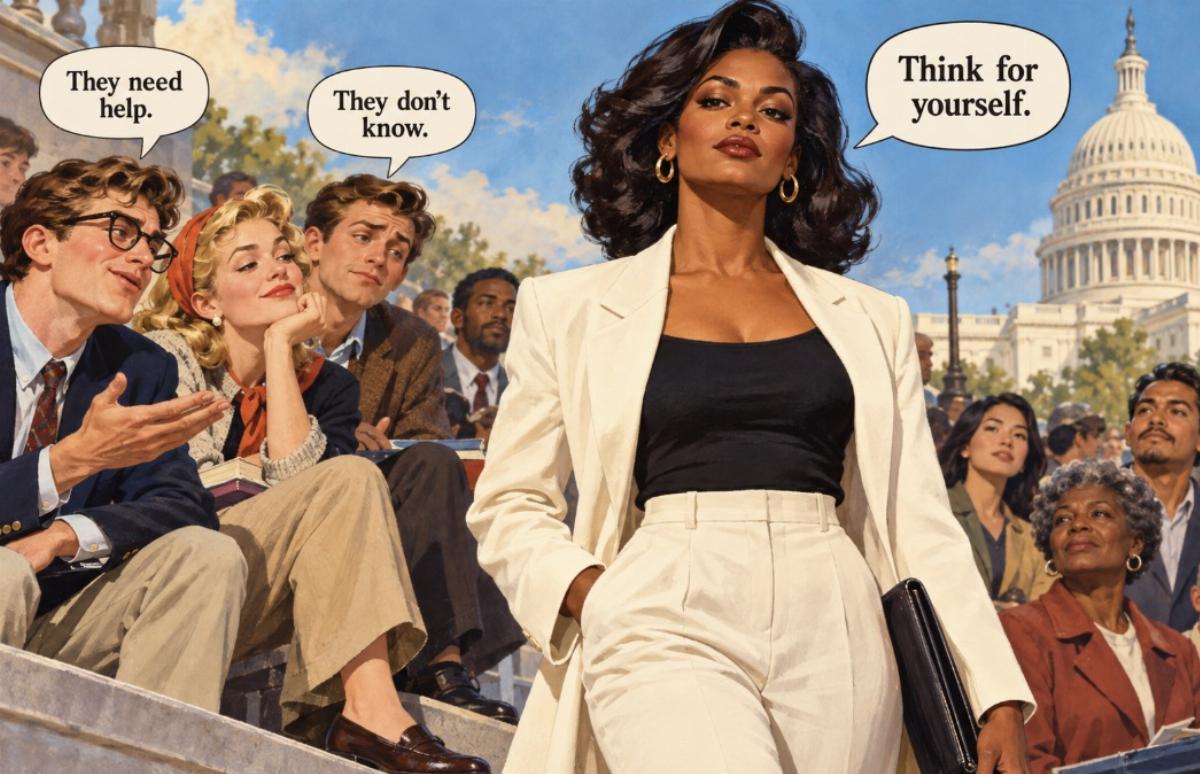
An op-ed published by American Thinker argues that the Democratic Party’s most vocal white activists routinely describe Black Americans in terms that are, in the outlet’s words, “amazingly racist” — and that a surprising number of Black voters continue to accept it. The piece, written by Andrea Widburg and dated September 27, 2026, frames the dynamic as a “plantation-style soft bigotry of low expectations,” a phrase the author uses to describe what she sees as the party’s approach to its most reliable voting bloc.
The spark for Widburg’s argument is an old Ami Horowitz interview at UC Berkeley that has recirculated on social media. In the clip, Horowitz asked a group of white, left-wing college students whether Black Americans face particular hurdles when it comes to voting. According to Widburg, their answers were “breathtakingly paternalistic.” She writes that the students repeatedly assumed Black Americans lack the knowledge, resources, or basic ability to do things the students themselves take for granted — a posture she compares directly to how an “Antebellum plantation owner would have spoken in the same terms about his slaves’ intelligence and abilities.”
Widburg highlights what she calls the “key quotations” from that video and contrasts them with responses from Black residents in Harlem, which she presents as a stark and instructive counterpoint. The Berkeley clip gained a second life through a post from the account Wall Street Apes, which she says excerpted the students’ statements and placed them alongside actual data. Among the claims Widburg attributes to the white liberal women in the video: that Black people do not know how to go online and use the internet, that they lack data for their smartphones, and that Black communities do not know how to obtain the information needed to vote.
Against those assertions, Widburg cites figures showing that 94 percent of Black adults have access to the internet and 91 percent have access to a smartphone — numbers she says demolish the premise that Black Americans are somehow locked out of the digital tools required to find information, secure identification, or navigate government services. She notes, too, that the students offered a separate argument about felon disenfranchisement, quoting one as saying Black people are “at a disadvantage for voting because you can’t vote if you’re a felon.”
The author’s rejoinder to the Berkeley students is blunt: “One only has to spend a few minutes on TikTok, X, YouTube, or any other major social-media platform to recognize the absurdity” of assuming Black Americans cannot use the internet — whether to research candidates, meet ID requirements, or make their political opinions heard.
The deeper trap, as the op-ed sees it
Widburg is careful to say the condescension is not the whole story. She argues there is “a more complicated truth buried beneath the Berkeley students’ condescension”: that too many Black Americans remain politically trapped inside the Democratic Party and the institutions surrounding it. She offers three overlapping explanations.
The first is cultural and historical. In her telling, the New Deal and Lyndon Johnson’s Great Society legislation “locked in” Black loyalty to the Democratic Party in a way that even the Republican Party’s role in abolishing slavery failed to overcome. The second is what she calls a Manichaean political narrative that divides the two parties into pure good and pure evil — a framing, she writes, that largely erases the messier historical record, including the Republican Party’s central role in emancipation and Reconstruction and the Democratic Party’s long association with slavery, segregation, and Jim Crow. The third explanation is less partisan and more psychological: the ordinary human tendency toward groupthink, in which people adopt the political assumptions of the families, communities, institutions, and cultural figures around them.
It is at this point that Widburg introduces Nicki Minaj, whom she describes as “one of the most prominent black entertainers in America.” Widburg credits the rapper with showing “great courage” by increasingly challenging political orthodoxies that, in the author’s view, most celebrities would never dare question.
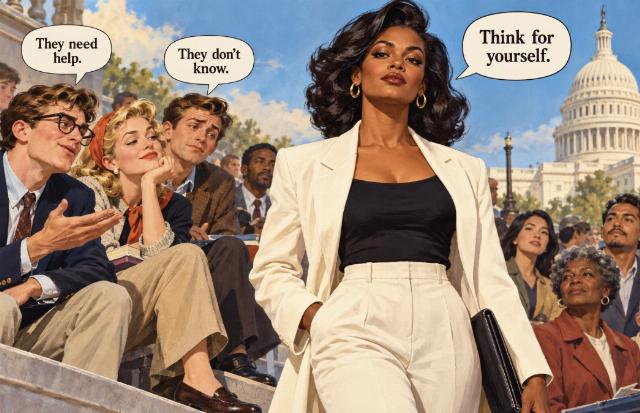
The op-ed quotes Minaj at length from a clip circulating on social media. In it, Minaj says Black people “are not allowed, according to the Democrats, for the most part, to make a different decision,” that they are “not allowed to think” and “not allowed to voice concerns, to make an argument as to why we don’t like a particular candidate.” Minaj goes on to say that those who do step out of line are seeing “in real time” what happens to them — “smear campaigns and just outright nasty behavior from these adults” — and concludes that Democrats “kind of have been just digging their own grave in that way.”
Widburg seizes on the second half of that statement as the heart of her case: that Democrats care about Black voters only for their votes. She also stresses Minaj’s stature — calling her “one of the most influential rappers of all time” — arguing it matters precisely because of who is delivering the message. Minaj, in Widburg’s reading, is rejecting the idea that Black Americans owe automatic allegiance to any one political party and is instead urging independent thought, rather than letting politicians, activists, or cultural gatekeepers dictate what they are supposed to believe.
The midterm math and a closing warning
Widburg then makes a strategic argument about electoral consequences. If Minaj can shift even a small number of votes in the midterms — a low-turnout environment where, she notes, “only the passionate few vote” — she might alter the entire trajectory of the election. Widburg compares Minaj’s potential influence to that of Elon Musk, saying the rapper “will be as important in her way.”
The piece closes on a broader, almost civic note: that the ability to speak one’s mind is, now more than ever, crucial to the republic. The op-ed appears in American Thinker’s culture and race section, and the outlet appends a fundraising appeal urging readers who find its work resonant to donate so it can continue paying staff and keeping its ideas in circulation.
Whatever one makes of Widburg’s framing, the column is best understood as an argument rather than a reported survey. Its central evidence is a years-old campus interview recirculated online, a set of internet-access statistics, and a rapper’s social-media commentary — assembled to make the case that the Democratic Party’s relationship with Black voters is built on a condescension its beneficiaries should no longer tolerate, and that a celebrity megaphone may be the tool that finally loosens the party’s grip.
Source: www.americanthinker.com — https://www.americanthinker.com/blog/2026/09/white-dems-are-amazingly-racist-but-too-many-blacks-willingly-accept-the-bigotry/
Source: www.americanthinker.com
Related coverage
- Right-Wing YouTube Channel ‘Clown World’ Draws Fire for Airing Patriot Front Clip
- Did Francesca Hong’s Wisconsin loss echo the 2020 Trump ‘treatment’?
- ADHD, Nazis, and Climate Change: One Doctor’s Case That Overused Words Are Losing Their Power
- American Thinker Column Redefines ‘Democracy’ and ‘Freedom of Speech’ in Blistering Glossary of the Left