
R.W. Trewyn is well into his eighth decade, and he’ll admit that keeping tabs on elementary school classrooms hasn’t exactly been a priority. But a couple of trips to the bank changed that. The teller — likely in his 20s — couldn’t decipher what Trewyn’s wife had written on a cashier’s check. The same thing happened with a female teller the next time. His wife, he notes, has beautiful handwriting. The bank’s solution? Printing only.
For Trewyn, that small, everyday moment crystallized what he sees as a quiet educational catastrophe: the disappearance of cursive from American schools, and with it, the loss of a skill that once connected generations.
In an essay titled “Cursing cursive’s curse,” published August 25, 2026, on American Thinker, Trewyn — a veteran of the Vietnam War and a former educator with more than 55 years in higher education — takes aim at what he calls the “grade school morons” who stopped teaching penmanship. He doesn’t stop at cursive. He argues that today’s teachers all too often appear to be “indoctrinators of stupid, not educators,” a broad indictment rooted in a specific, tangible grievance.
A memory forged in fire
Trewyn’s own connection to cursive is visceral, bound to a night he can’t forget. On February 7, 1970, he stood in the cold and watched Old Main burn on the campus of what is now the University of Wisconsin-Whitewater. Vietnam War protestors had torched the building, and Trewyn — just a few months home from combat — watched the flames consume the classrooms of his childhood, including the K–6 rooms in the west wing that burned first.
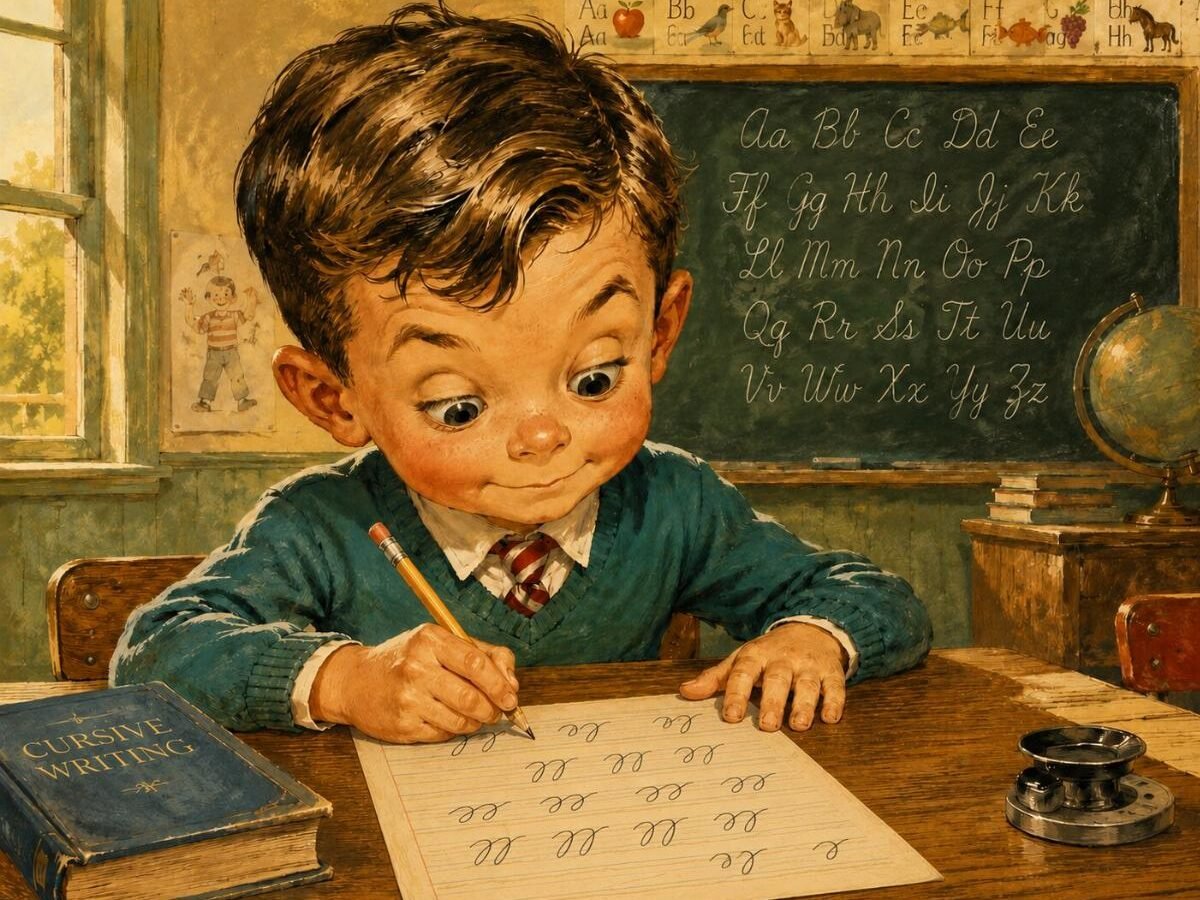
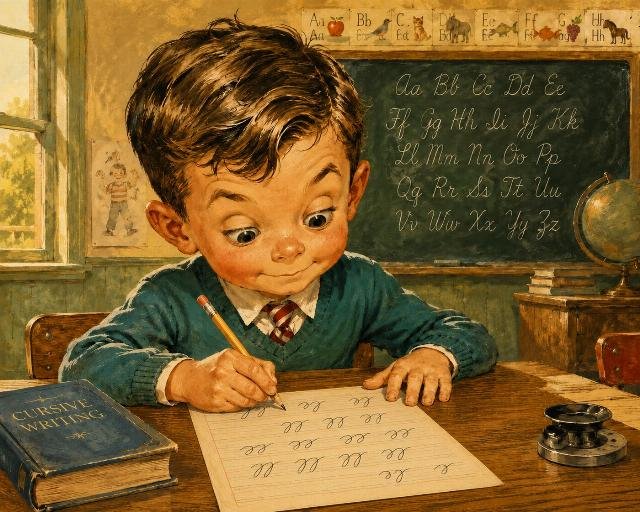
In that frigid night air, he says, he pondered each year of his schooling, one by one, as the fire devoured them. The cursive alphabet above the blackboard — every upper- and lower-case letter on lined paper — remains “crystal clear” in his mind, etched there by both practice and loss.
“Perhaps it was first or third,” he writes, “but regardless, the perfect letters on lined paper are crystal clear.”
The practical and the cultural case
Trewyn’s argument is not merely nostalgic. He points to a real, practical consequence: people can no longer sign their names the way they used to, and they can’t read names written in cursive. The bank teller episode is his proof.
“It has been proven that they can’t read names written in cursive,” he states, although the essay offers anecdotal evidence rather than formal research. Still, the point lands: if a generation can’t read or write cursive, then every handwritten document — from checks to letters to historical documents — becomes a locked door.
He also raises a subtler question: “Is a printed name unique like a written signature, so one’s autograph is distinctively their own?” The implication is that cursive isn’t just a skill; it’s a form of identity, a way of marking the world that printing simply doesn’t replicate.
A broader indictment
For Trewyn, cursive is only the most visible symptom of a deeper malaise. He mentions, almost in passing, his horror at “kindergarteners being subjected to Drag Queen Hour” — a reference that will resonate with some readers and alienate others. The essay, published on the conservative site American Thinker, wears its politics on its sleeve.
“Moving forward, more cursing will likely be in order regarding the ignorance that caused grade school morons to stop teaching our children,” he writes. “And, unquestionably, cursive isn’t the only problem.”
That rhetorical heat — the insulting epithets, the sweeping claims about teachers — invites pushback. Are today’s educators really “indoctrinators of stupid”? Or is Trewyn, in his own words, simply paying attention to elementary schools only when “sick insanity” hits the news? He admits as much himself.
Still, his core case is hard to dismiss. Whether or not one shares his cultural anxieties, the practical loss of cursive is real. Handwriting instruction has declined in many U.S. schools over the past two decades, replaced by keyboarding and digital literacy. Whether that trade-off is wise remains an open question — but Trewyn’s anecdote suggests that at least one bank has already adjusted its procedures to accommodate the shift.
An unlikely rallying cry
The essay closes with a call to action: “So maybe it’s time for all American patriots to start cursing cursive’s curse. Something needs to be done to save America’s youth.” That sentence is equal parts earnest and tongue-in-cheek, a knowing nod to the alliteration that gives the piece its title.
Trewyn’s personal stake is evident. He watched his schoolhouse burn in 1970, and with it, a piece of his childhood. He’s now watching another piece disappear — not in flames, but in the quiet absence of a lined paper alphabet above a blackboard. For a man in his eighties, the loss of cursive may feel like the loss of a shared language.
Whether that loss is a genuine crisis or the natural evolution of communication in a digital age is a debate worth having. Trewyn has fired an opening salvo. The question is who will pick it up.
Source: www.americanthinker.com — https://www.americanthinker.com/blog/2026/08/cursing-cursive-s-curse/