

The weapons the United States spent two decades pouring into Afghanistan didn’t leave when the last American plane lifted off the runway in Kabul. According to reporting by the BBC, roughly half a million of them are now unaccounted for — and the United Nations believes some have landed with al-Qaeda affiliates.
American Thinker’s Silvio Canto Jr. flagged the BBC findings, arguing they confirm what critics of the 2021 withdrawal long predicted: that leaving behind vast stocks of US-funded military equipment would eventually arm the wrong people.
What the BBC found
According to the BBC, sources say half a million weapons obtained by the Taliban have been lost, sold, or smuggled to militant groups, with the UN believing some have reached al-Qaeda affiliates. The Taliban took control of around one million weapons and pieces of military equipment when it retook Afghanistan in 2021, a figure a former Afghan official gave to the BBC anonymously.
That cache didn’t materialize out of nowhere. As the Taliban swept across the country that summer, Afghan soldiers surrendered or fled, abandoning their weapons and vehicles. Some equipment was simply left behind by departing US forces, the BBC reported. The stockpile included American-made firearms such as M4 and M16 rifles, alongside older weapons that had accumulated in Afghan hands across decades of conflict.
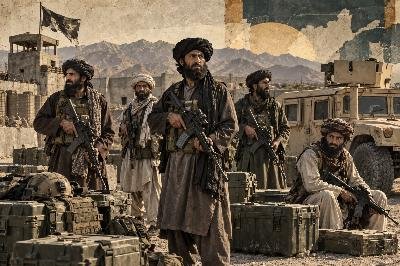
The most striking detail comes from a closed-door meeting. Sources told the BBC that at the UN Security Council’s Sanctions Committee session in Doha late last year, the Taliban itself admitted that at least half of the equipment is now “unaccounted” for. A person from the committee said they had verified with other sources that the whereabouts of half a million items was unknown.
A February UN report stated that al-Qaeda affiliates — including Tehreek-e-Taliban Pakistan, the Islamic Movement of Uzbekistan, the East Turkestan Islamic Movement, and Yemen’s Ansarullah movement — were either accessing Taliban-captured weapons or buying them on the black market.
The BBC put those findings to Hamdullah Fitrat, deputy spokesperson for the Taliban government, who said the Taliban takes the protection and storage of weapons very seriously. That assurance sits uneasily next to the committee’s own accounting.
The argument critics have been making since 2021
Canto’s commentary frames the BBC report as vindication of predictions made at the time of the withdrawal. For him, the central failure belongs to the Biden administration, which he says ordered soldiers to leave the equipment behind and didn’t weigh the consequences.
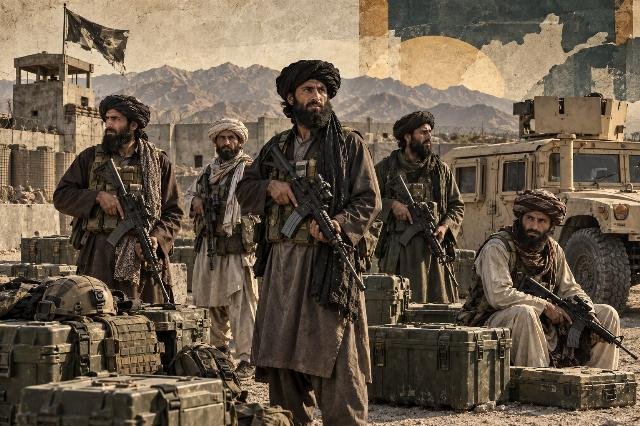
His stated concern is concrete: that these weapons wind up with people who know how to use them and are turned against US soldiers in the region. He also points to the black market as a natural destination for much of the stock, speculating that cartels purchase weapons there with cash.
As for remedies, Canto is notably pessimistic. “I’m not sure what we can do today,” he writes, describing the harm as done and expressing hope that a lesson has been learned. He floats bombing one of the Taliban’s military parades as a symbolic reminder that the equipment is stolen — while conceding the gesture may mean little to such a group.
The tone throughout is bitter and retrospective, returning more than once to the idea that the Taliban effectively built up its military inventory by letting the United States walk away from its own hardware.
What remains unresolved
The BBC reporting leaves several questions open. It’s not clear precisely how many of the missing items are US-made versus older stock, nor how much has been sold versus simply lost track of. The Taliban’s own accounting — the admission that half the equipment is unaccounted for — comes secondhand, through sources describing a closed-door committee meeting.
What is documented is the scale: around one million weapons and pieces of equipment seized in 2021, a UN finding that multiple militant groups are accessing or buying Taliban-captured arms, and a Taliban response that insists the stock is being handled responsibly.
For critics of the withdrawal, the through-line is simple enough. The arsenal didn’t disappear into thin air in 2021; it changed hands. The question now is where the missing half-million ended up — and the UN’s answer, at least in part, is with groups that have spent years fighting US and allied forces.
Source: www.americanthinker.com — https://www.americanthinker.com/blog/2026/09/guess-who-is-walking-around-with-those-us-weapons/