

A single social media post about a college football game has touched off a weeklong fight in Texas Republican politics — and, according to a piece in The Federalist, exposed what the outlet calls the emptiness of “civic nationalism” as a source of American identity.
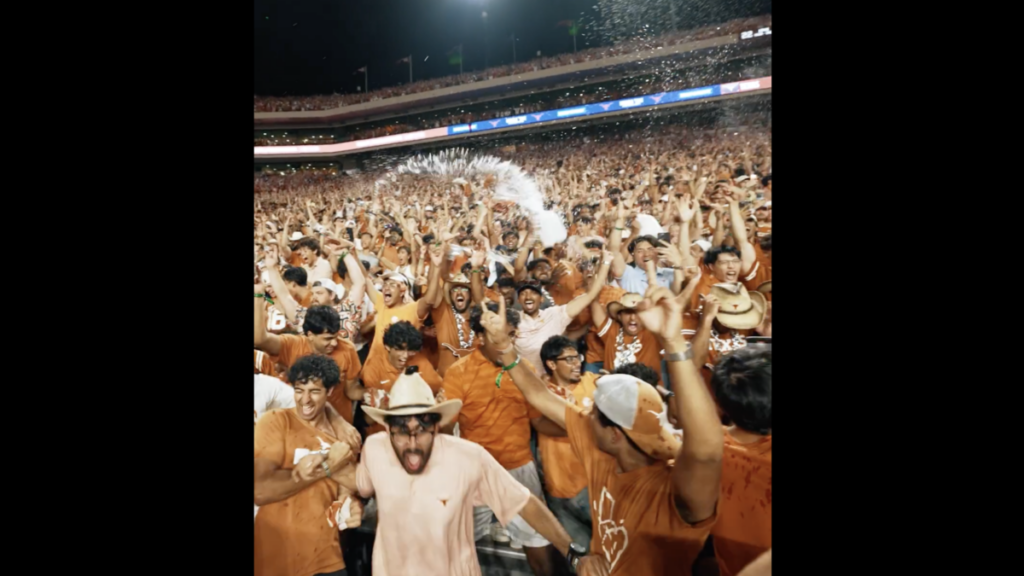
The controversy began when Bo French, a candidate for Texas Railroad Commissioner, shared an image from the previous weekend’s University of Texas-Ohio State game showing a crowd of UT students, most of them of South Asian descent, celebrating the Longhorns’ upset win. “I heard UT graduation this year looked like this. I didn’t believe it. The problem is now obviously far worse than anyone imagined,” French wrote, according to The Federalist.
The post drew immediate backlash from establishment Republicans. Outgoing Sen. John Cornyn, who lost his primary to Attorney General Ken Paxton, called the post racist and intolerant. James Talarico, who won the Texas Democratic primary for Senate, sided with Cornyn and pressed Paxton to condemn French’s remarks. Paxton instead attacked Talarico over a past comment that white men are America’s top terror threat.

A debate about assimilation, not just a post
Online, the argument quickly widened into a referendum on whether it is acceptable to observe demographic change at institutions like UT, where South Asians are heavily overrepresented and white men are heavily underrepresented, per The Federalist’s framing. Civic nationalists on the right argued French’s post was self-refuting: the students were at a football game, wearing UT colors, one even in a cowboy hat — evidence, in that view, of assimilation working as intended. Others noted many of those students are likely American citizens, which under civic nationalism makes them as American as anyone else.
The Federalist’s Brianna Lyman rejected that logic, writing that “just because someone was born on our soil doesn’t magically make them an assimilated American — and that’s a conversation we must have. Many immigrant groups, some generations removed from the initial migrants, cling to cultures and traditions that are fundamentally at odds with American culture.”
That claim, the outlet argues, forces a concession civic nationalists resist: that American culture has shape and content, that it is something rather than anything or nothing. On this view, being American requires more than process neutralism, more than assenting to abstract Enlightenment propositions, and certainly more than paperwork.

The creed came from somewhere
The Federalist does not dismiss the civic creed outright. Individual rights, free speech, and the rule of law matter, it concedes — but they did not appear from nothing. They emerged from Christian Europe and specifically from England, the outlet argues, shaped by the doctrine of imago Dei embedded in English custom, law, and political structure. That culture, carried to Massachusetts and Virginia in the early seventeenth century, is what their descendants eventually used to found the United States.
David French of The New York Times entered the fray, arguing America is “a nation with a culture created by an idea.” The Federalist counters that he has it backwards: the idea emerged from the culture, the culture from the faith. From that premise follows a hard conclusion — that immigrants outside the Anglo-American tradition must choose adoption into it and abandon the parts of their native culture incompatible with it, if they wish to become fully American.
The Federalist contends most immigrants today are neither interested in nor doing this. It points to the image at the center of the fight: the South Asian students were clustered in their own ethnic enclave in the stadium, which the outlet reads as a sign of a broader pattern. Recent immigrants and their children, it argues, assimilate less than earlier waves did, recreating localized versions of their homelands in communities of every size rather than concentrating in big-city enclaves like Chinatown or Little Italy. Once settled there, the piece says, they are less likely to marry outside those communities and more likely to retain native customs and mores — resisting assimilation rather than pursuing it.
That was not always the case, the outlet writes. Before the mid-twentieth century, the ideal immigrant aspired for their children to be fully American in a way they themselves never could be, and American leaders and civic culture treated that aspiration as a virtue. Low immigration levels relative to today, combined with a coherent mainstream culture, made assimilation possible.
The piece closes by invoking Indian writer Nirad Chadhuri, whose 1951 dedication in The Autobiography of an Unknown Indian honored the British Empire in India — a passage, The Federalist notes, that got him vilified in his home country.
For all the heat, the underlying question remains unresolved in American politics, and the Texas episode suggests it will keep resurfacing — through primaries, online fights, and, apparently, an ordinary Saturday in Austin.
Source: thefederalist.com — https://thefederalist.com/2026/09/18/what-is-an-american-the-civic-nationalists-have-no-idea/