
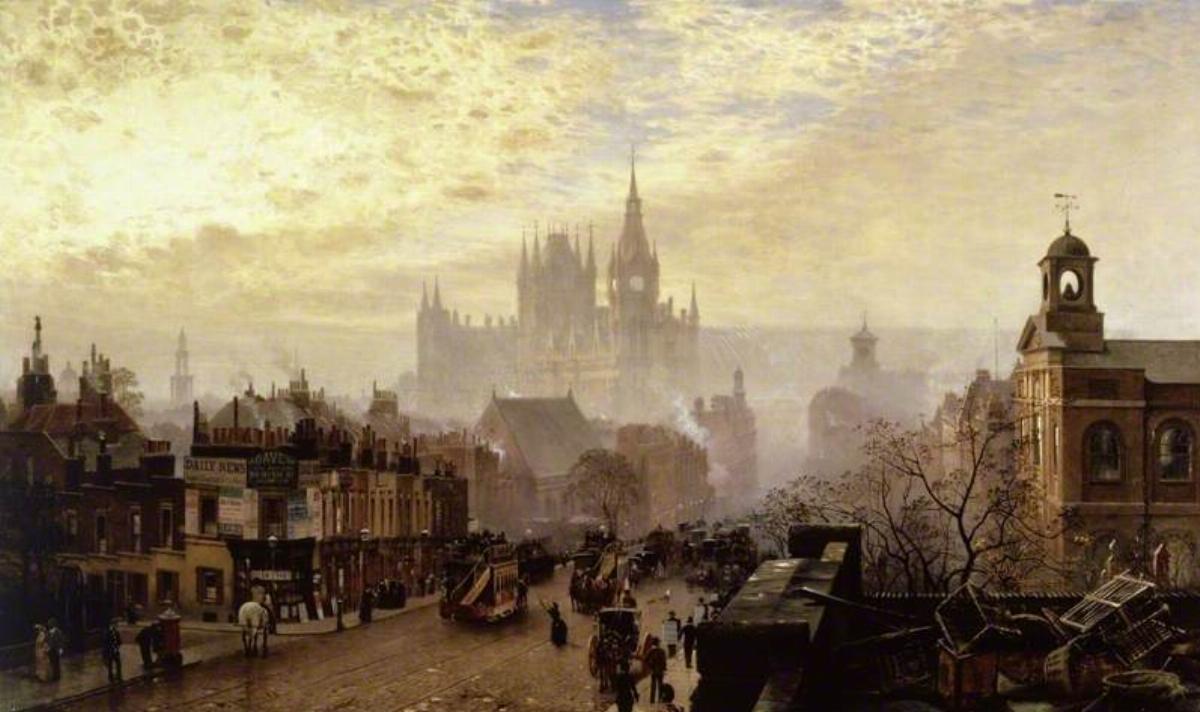
Brendan O’Neill went back to the northwest London suburb where he grew up and found he could no longer hear it. According to his reflection in The Spectator on August 29, 2026, the streets that formed the backdrop of his childhood now carry a different sound — what he describes as a mix of Urdu, Russian, Romanian and other languages, with no English speech among them. The shops have turned over too: the record store is now a greengrocer, the bookshop an Afro barbers, the convent a block of flats. On the Tube home, the sound of a young English voice lands on him with unusual force, a brief note of continuity in a day otherwise defined by its absence.
That personal account is the starting point for Lars Møller’s essay in American Thinker, published September 18, 2026, which treats O’Neill’s afternoon as something larger than a man’s nostalgia. The question he draws out of it is pointed: what is left of a place when the ordinary signals of mutual understanding — shared speech, shared manners, inherited habits of presence — no longer line the street? O’Neill’s suburb, in his telling, hasn’t been abandoned. It has been overwritten.
The Problem With Naming the Loss
Møller’s central complaint is not really about demographics. It’s about permission. He argues that contemporary Western societies treat any lament for this kind of transformation as evidence of moral failure — that to miss the sound of a market cry or the greetings of old men at their gates is to invite accusations of fragility, of harboring an illicit preference for one’s own. The result, as he frames it, is an inversion: the native is told his own continuity amounts to aggression, while being asked to accept every new arrival as a matter of basic justice.
Underneath that inversion sits a story about history, one Møller says casts Western peoples as permanent debtors. Their past becomes a ledger of sins demanding endless compensatory openness. In that schema, home stops being a dwelling and becomes a resource — something to be offered, shared, diluted. To want a dense, particular attachment to a specific place and its people is recast as the residue of supremacy.
He points to a related tension between legal status and lived membership. Citizenship, he notes, is distributed with administrative ease, so that someone who has spent five years in a country without learning its language is declared as British as the native whose grandparents laid the streets now filled with speech he cannot follow. Møller treats the distinction between a passport and a felt sense of belonging as something that ought to be clarified rather than avoided, though he acknowledges the culture prefers to treat that distinction as embarrassing.
Christopher Nolan, Roger Scruton, and the Pull of Ithaca
The essay reaches for cultural reference points to make the case that this longing is not a political invention. Christopher Nolan’s Dunkirk (2017) and The Odyssey (2026) both, in Møller’s reading, treat home as the endpoint of ordeal. The soldiers on the beach want only the short crossing back to ordinary English life; survival gets measured by the recovery of a familiar shore. Odysseus spends ten years wandering for the single purpose of reclaiming Ithaca, his wife, his son, and the household order that violence interrupted. In both, home is not a sentimental backdrop — it’s the moral horizon that gives suffering a shape. Strip away the possibility of return, Møller argues, and endurance stops meaning anything.
He builds the philosophical half of the argument on Roger Scruton, who gave this orientation a vocabulary. For Scruton, home is a place of ends rather than a node in a network of means. Economic rationality treats every relationship and landscape as an instrument for further production or consumption; the household shelters persons and objects valued for their own sake — the particular table, the particular voices, the rituals that can’t be swapped out without loss. Scruton called the disposition that protects places sacred to us oikophilia, the love of home. It arises, in his account, before politics does, out of the slow settling of shared manners, dialects, architecture and landscape. Political order, he argued, can’t survive on abstract rights or global procedures alone; it needs the deeper loyalty of people who already feel the place is theirs in a non-contractual sense. Discourage that loyalty systematically, and the institutions resting on it start to lose their authority.
Møller’s term for the present condition is the enforced attenuation of oikophilia — the native taught to regard his own continuity with suspicion while the newcomer is celebrated for the disruption he brings. He invokes Hegel’s account of alienation, which Scruton adapted, to describe the individual who cannot recognize himself in the world he inhabits. Western cities, in this reading, increasingly manufacture that condition, and the sounds O’Neill heard on his old streets are its auditory form. One walks among people whose presence is officially celebrated but whose language and customs stay closed — a guest in one’s own streets, expected to feel grateful for the privilege.
The Asymmetry Argument
The sharpest edge of the piece is its claim about unequal moral demands. No comparable expectation, Møller writes, is placed on the societies the new populations come from. Their home places remain, in his words, dense, particular and unapologetic. The Westerner alone is told his attachment is a historical crime requiring perpetual self-effacement. What follows, he contends, is not enrichment but a thinning of the social fabric. Shared public language once gave people a common medium in which trust could form without constant negotiation; replace it with a multiplicity of private codes and you get permanent low-level friction. Neighborliness is hard to build when the basic sounds of the street are opaque.
O’Neill invoked Babel, and Møller leans on the image: the confusion of tongues as a judgment that blocks collective purpose. The difference, he says, is that contemporary Western cities have recreated that confusion voluntarily and then forbidden anyone to express regret. To want a common language in which to understand and be understood gets recast as an illegitimate demand for homogeneity — even though, he argues, some degree of shared speech, shared memory and shared expectations of conduct is what everyday cooperation in a free society quietly depends on. A citizenship reduced to a bureaucratic stamp, in his view, cannot supply the missing substance.
The essay closes on the idea that belonging somewhere specific is not a luxury of the privileged but a condition of human flourishing. Without a place that can be loved for its own sake, Møller writes, identity gets assembled from abstractions — rights, markets, global narratives — that offer no concrete shelter. The Western experiment in radical openness has produced, for many, homelessness at home. O’Neill can walk those streets freely. What he cannot do, as the essay frames it, is say out loud that something was lost when the voices changed. The prohibition itself, Møller concludes, is the clearest sign of what has already been given up — the permission to prefer the near to the far without having to defend the preference in the language of universal ethics. Withdraw that permission, and the need for rootedness doesn’t vanish. It just goes underground.
Source: www.americanthinker.com — https://www.americanthinker.com/articles/2026/09/strangers-on-native-soil/