
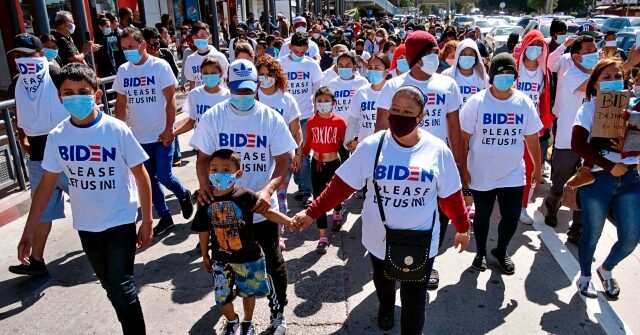
The Brookings Institution released a report this week concluding that the millions of migrants admitted to the United States during former President Joe Biden’s term — described by Breitbart News as the largest mass migration under a one-term president in American history — contributed to higher housing costs and lower average wages, even as the researchers framed the overall effect as a net positive for native-born Americans.
According to the report, the influx “may have reduced average wages of all workers by as much as 1.5%, likely in part because immigrants took lower-wage jobs.” The same paper found that native-born workers’ wages rose 0.9% overall and that native-born employment was “roughly unchanged.”
Rents Up, but Native Renters Said to Come Out Ahead
The housing findings were similarly mixed. Brookings researchers estimated that demand generated by the new arrivals pushed rents up by 1.4% to 1.6%. They then argued that native renters still gained, writing that native renters’ wages rose by more, “increasing at least 1.6% net of the rent increase.”
That framing — an acknowledged cost to the broader workforce offset by a smaller gain for one group — is central to how the researchers characterize the episode. Rather than presenting the wage and rent effects as straightforward harms, the paper presents them as a tradeoff that ultimately benefited the native-born population. Breitbart’s coverage emphasizes that the institution “admits” the migration reduced wages and raised rents, while noting the researchers’ own conclusion that the changes amounted to a net benefit for Americans.
Part of a Growing Body of Research
The Brookings paper does not arrive in isolation. It follows a series of studies examining how the Biden-era migration wave affected American jobs, earnings and housing inflation.
In June, the Federal Reserve Bank of Dallas reported that mass immigration contributed to rising housing prices between early 2021 and early 2024, finding that population growth drove up costs. According to that report, “during the boom period an increase in unauthorized immigrant worker flows equal to 1% of a local area’s initial employment increased local house prices by 2.2% and increased local rents by 1.4%.”
The Dallas Fed also offered a broader estimate: a back-of-the-envelope calculation suggested that unauthorized immigrant worker flows could explain roughly 30% of total house price growth and 20% of total rent growth over the boom period for the average local market.
Separately, a Housing and Urban Development investigation published last year found that the Biden administration’s admission of millions of migrants drove up prices for Americans with low incomes who do not receive public assistance — a group that, unlike some renters, would not have had access to housing subsidies to cushion the increase.
A Pattern Across Federal Research
Taken together, the three data points — Brookings, the Dallas Fed and HUD — describe a consistent pattern: large-scale migration increased demand for housing faster than supply could respond, pushing rents and home prices upward, while exerting downward pressure on average wages across the workforce.
What distinguishes the Brookings paper is its interpretation. Where the Dallas Fed and HUD findings were largely presented as costs, Brookings pairs its estimates with the argument that native-born workers and renters gained more than they lost. The wage figure of 0.9% for native-born workers and the minimum 1.6% net gain for native renters are the numbers the researchers lean on to make that case.
Critics of the Biden administration’s immigration policies have pointed to the same body of research to argue the opposite: that a policy choice to admit millions of people in a short period produced measurable economic disruption for American workers and renters, particularly those at the lower end of the wage scale who compete most directly with new arrivals for jobs and housing.
Breitbart News noted in its coverage that the Brookings report “admits” the wage and rent effects while spinning the overall result as beneficial. The outlet’s framing reflects a broader political fight over how to characterize the economic legacy of the Biden-era border policies — a debate that is likely to persist as more research emerges.
What the Numbers Show
Stripped of interpretation, the Brookings estimates break down as follows: average wages for all workers down by as much as 1.5%; native-born wages up 0.9%; native-born employment roughly flat; rents up 1.4% to 1.6%; native renters’ wages up at least 1.6% net of the rent increase.
The Dallas Fed figures point to a 2.2% increase in local house prices and a 1.4% increase in local rents for every 1% increase in unauthorized immigrant worker flows relative to a local area’s initial employment — with those flows accounting for about 30% of house price growth and 20% of rent growth in the average market during the boom period.
The HUD investigation focused on a narrower question: how the migration affected low-income Americans not receiving public assistance, finding that they faced higher prices as a result.
The Political Stakes
Immigration remains one of the most contested issues in American politics, and the economic research on its effects has become a central battleground. Supporters of expansive immigration policies tend to emphasize aggregate growth and the fiscal contributions of new arrivals; critics focus on distributional effects — who gains, who loses, and by how much.
The Brookings paper lands squarely in that fight. Its own numbers show wage suppression across the workforce and rent increases driven by migration-related demand. Its conclusion, however, is that native-born Americans were left better off. Whether that conclusion persuades policymakers and voters — or whether the underlying figures become fodder for restrictionist arguments — will depend less on the research itself than on how each side chooses to frame it.
For now, the report adds another data point to a growing record: three separate federal or quasi-federal analyses have now linked the Biden-era migration surge to higher housing costs, and at least one has linked it to lower average wages. The debate over what those findings mean, and what should be done about them, is only intensifying.
Source: www.breitbart.com — https://www.breitbart.com/politics/2026/09/24/left-wing-brookings-institution-admits-bidens-mass-migration-reduced-wages-caused-rents-to-rise/