

Officials in a small Central Valley city have approved a residential development that sits directly in the path of California’s high-speed rail project, according to a new report, throwing another obstacle in front of a megaproject that has struggled for years with delays and ballooning costs.
The Fresno Bee first reported on August 21 that the Shafter City Council voted to approve a large housing tract on land that state planners had long identified as part of the route for the bullet train. Shafter sits about 20 miles north of Bakersfield, squarely along the segment that would eventually link Bakersfield to Merced.
The move comes after years of waiting by the city and the property’s developer, who said they never heard from the California High-Speed Rail Authority about acquiring the land. With no action from the state 11 years into what authorities have called active construction, they decided to move forward with the homes.
The development places new residential units on a corridor that the state had mapped out for its initial operating segment, a crucial piece of the 494-mile system voters approved in 2008. That original vision — connecting Los Angeles and San Francisco at speeds up to 220 mph — has been repeatedly scaled back. Since construction began in 2015, the state has focused on a much narrower goal: a 119-mile line linking Bakersfield to Merced through the Central Valley.
Even that goal now appears to have shrunk further. The current work plan, state officials have indicated, is to finish track from Wasco to Merced — skipping Bakersfield entirely for now. Wasco, which sits just north of Shafter, is home to the rail authority’s central marshaling yard, a facility that briefly buzzed with activity for a press conference earlier this year before going quiet again.
Under the state’s revised approach, once the Wasco-to-Merced segment is done — a stretch that might be described as “Phase One of Phase One of Phase One” — the authority would then start thinking about connecting the line to Bakersfield. That would constitute something like a second phase of the initial phase. The practical upshot, critics note, is that riders hoping to board a high-speed train in Bakersfield would still find no track there.
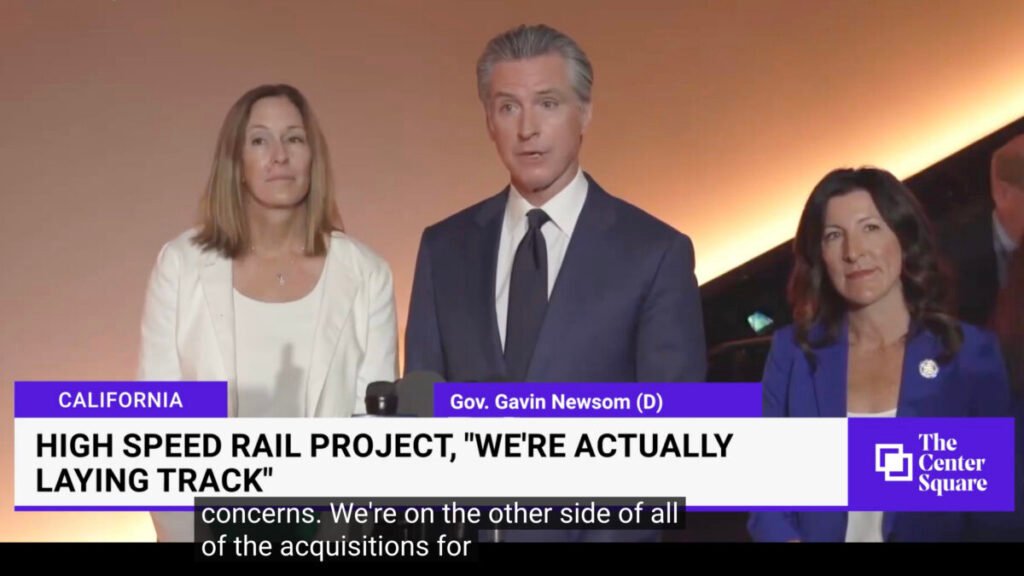
In September of last year, during a San Francisco press conference about energy prices, Governor Gavin Newsom expressed relief that the project had cleared its early hurdles. “We’re on the other side of all of the acquisitions,” he said, suggesting the route was fully state-owned and ready for construction.
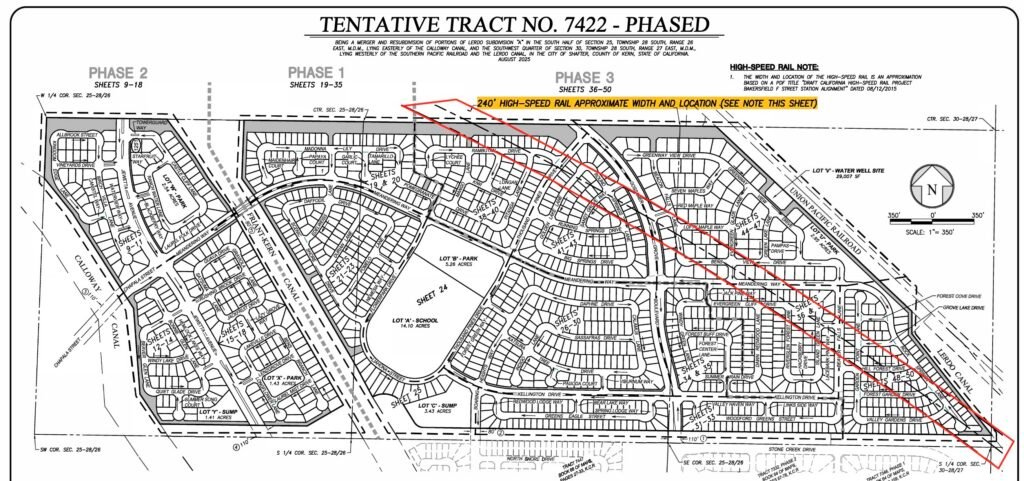
But the Shafter housing vote tells a different story. It suggests that at least one significant property on the planned corridor was never acquired — and now may never be, at least not without expensive and contentious legal action.

The High-Speed Rail Authority, when contacted by The Federalist, defended its approach. A press representative said the Shafter site is “part of the planned Bakersfield extension,” and that state engineers are still evaluating what land they will need. “Final property requirements will be established as the design is further refined,” the spokesperson said, adding that the authority continues to “work directly with affected landowners as part of our acquisition process.”
The same email touted progress, saying “high-speed rail track is scheduled to be laid as early as November of this year.” That claim stands in tension with Newsom’s own September 2025 statement that the state was already laying track, a contradiction the authority did not explain.
For those tracking the project’s trajectory, the Shafter approval is the latest sign of a widening mismatch between political rhetoric and on-the-ground reality. The state spent years and billions of dollars acquiring land and designing the route, yet it appears to have missed — or ignored — a key property along the very corridor it now hopes to build.
The developer and city officials said they waited patiently for the rail authority to make a move. When no acquisition offer came, they proceeded with the housing plan, which the city council approved after reviewing maps that clearly showed the rail alignment running through the property — marked in red on the presentation.
Critics see the episode as emblematic of a project that has lurched from one planning setback to another while costs have climbed into the tens of billions of dollars. The initial Merced-to-Bakersfield segment alone was once projected to cost around $20 billion; current estimates run significantly higher.
And even that rail line, when and if it opens, would not reach either Los Angeles or San Francisco — the two cities that inspired the 2008 bond measure. It would run through the Central Valley, a region not known for heavy intercity rail demand, leading some to dub it the “train to nowhere.”
The news also complicates Newsom’s assurances that the hardest part of the project is behind the state. If the Shafter housing development stands, the rail authority may have to reroute the line, acquire the newly built homes through eminent domain, or tunnel under the subdivision — all expensive, time-consuming options.
Officials in Shafter, a city of about 20,000 people known for agriculture and oil, have not commented on the controversy. But their decision reflects a broader impatience in the Central Valley, where residents have heard for two decades that high-speed rail is coming, only to watch the timeline slip again and again.
Newsom’s office did not respond to requests for comment on the Shafter vote.
The rail authority, meanwhile, insists the project is on track. Track laying could begin as soon as November, according to the agency — a claim that echoes previous announcements of imminent progress, several of which have come and gone without visible results.
For now, the immediate goal, according to the rail authority’s own description, is to connect Wasco to Merced. Bakersfield, and the thousands of Central Valley residents who voted for the bullet train two decades ago, will have to wait — perhaps another decade, perhaps longer.
Source: thefederalist.com — https://thefederalist.com/2026/09/02/a-california-city-drops-houses-on-gavin-newsoms-bullet-train/