
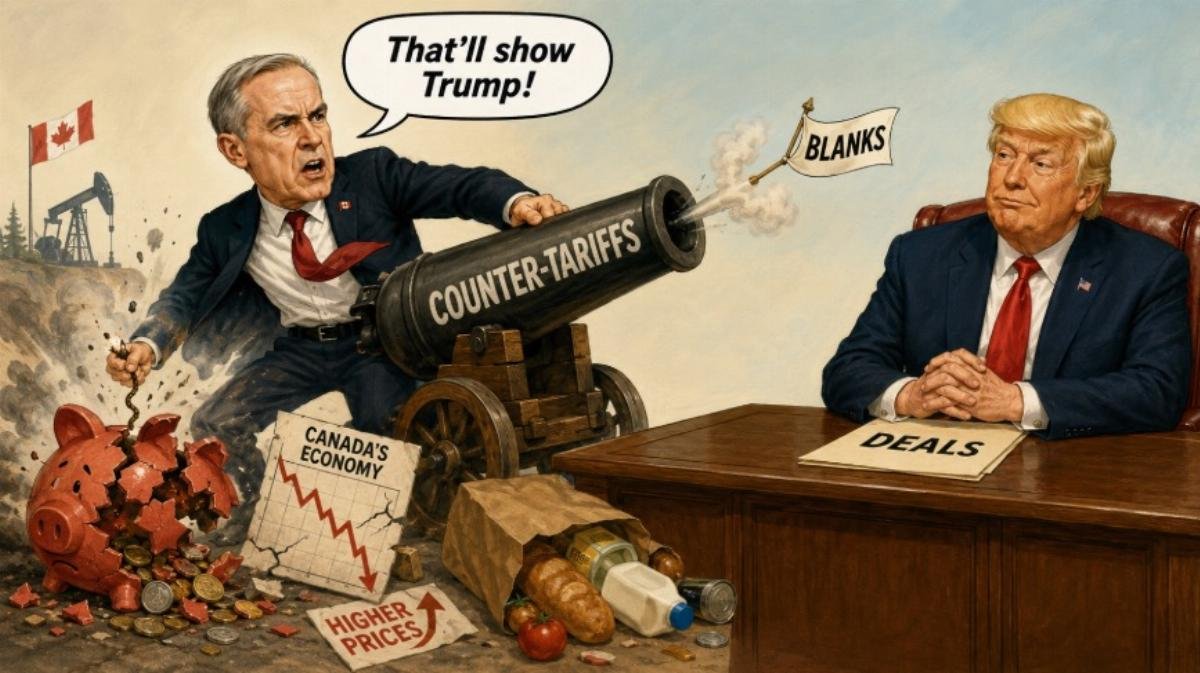
A conservative columnist is warning that Canada’s tariff fight with the U.S. is a losing battle driven by anti-Trump sentiment rather than economic sense.
Writing for American Thinker, Silvio Canto, Jr. argues that Prime Minister Mark Carney’s plan for dollar-for-dollar counter-tariffs against the U.S. is unrealistic and could hurt Canadians more than Americans.
According to Canto, Canada is “firing blanks” in a trade war where the U.S. economy is roughly 13 times larger than Canada’s. He notes that Carney has already begun backing away from his pledge of matching retaliation, saying Canada may instead pursue targeted tariffs.
But even targeted tariffs carry risk, Canto writes, because the burden of higher costs on U.S. goods will fall on Canadian consumers, not American exporters.
The column, published Saturday, comes amid escalating trade tensions between the two countries. Carney had said in the wake of the breakdown in negotiations that he would respond with dollar-for-dollar counter-tariffs and increase government support for Canadian businesses, with details promised by Sept. 8.

Canto argues that a smarter approach would be to sit down with President Trump and negotiate economic deals like the EU, Japan, and South Korea have done. He also suggests Canada should embrace energy expansion—”drill baby drill”—to boost its economy.
Canada’s longer-term struggles
Canto points to Statistics Canada data cited in a Financial Post article that shows Canada’s economy has been trailing the U.S. for years. The agency highlighted three key measures: labor productivity, real GDP per capita, and real gross national income per capita.
He also notes that Canada has only just met its NATO spending benchmark of 2% of GDP for the first time in 2025-2026, after decades of falling short.
“Canada has been in decline for a while,” Canto wrote. “It did not start with the first and second election of ‘The Orange Man.'”
The column accuses Carney of “playing on this irrational hatred of Trump consuming Canada,” a phenomenon Canto calls Trump Derangement Syndrome.
“The good news is that PM Carney looks ‘tough,’ whatever that means,” Canto wrote. “The bad news is that the Trump presidency will end in 2029, but the Canadian economy will still be around and continue declining.”
Canto’s critique reflects a common conservative argument that anti-Trump sentiment in Canada is clouding judgment and harming the country’s own interests.
However, supporters of Carney’s approach argue that standing up to U.S. trade pressure is a matter of sovereignty and principle, and that targeted tariffs can be designed to minimize harm to Canadian consumers.
The tariff situation remains fluid, with both sides still negotiating. Carney’s government has said it will announce the details of its counter-tariff and support programs by Sept. 8, though it has acknowledged the need for a nuanced approach.
As the dispute continues, economists on both sides of the border are watching closely to see whether Canada’s retaliation will backfire or achieve its intended effect.
Source: www.americanthinker.com — https://www.americanthinker.com/blog/2026/08/too-much-about-trump-not-too-much-about-canada/