
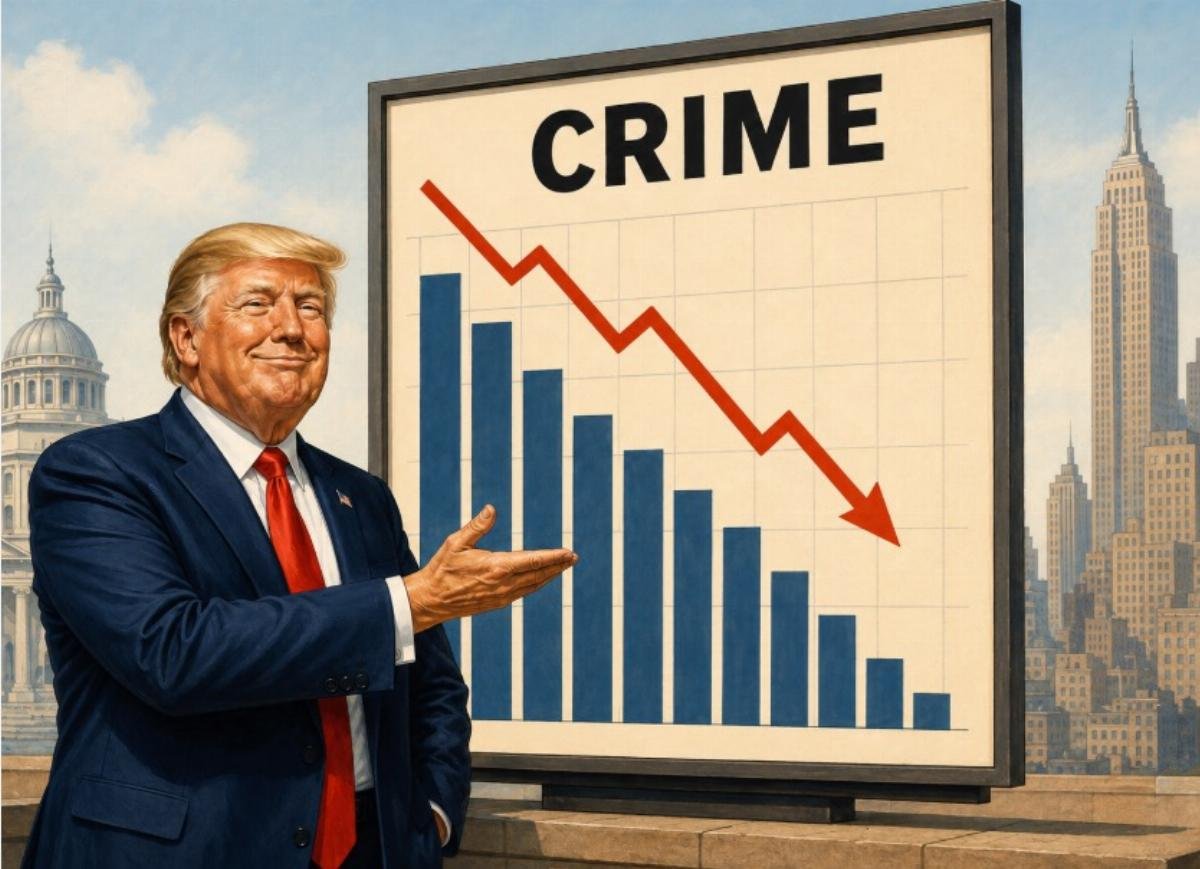
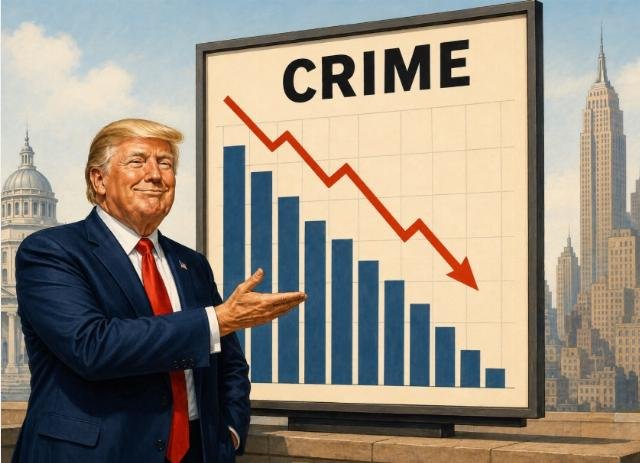
The FBI’s annual crime report for 2025 is out, and the numbers are striking: the murder rate hit a 20-year low, violent crime fell by the largest one-year margin on record, and categories from robbery to motor vehicle theft all posted double-digit declines. President Trump is celebrating, but the question of who deserves credit—and whether the numbers can even be trusted—has ignited a partisan fight.
According to the FBI’s Uniform Crime Reporting (UCR) Summary, which compiles data from about 87% of the nation’s police departments, the murder rate dropped 18.1% compared to the prior year. Aggravated assaults fell 7.2%, rapes declined 7.6%, and robbery was down 18.5%. Motor vehicle theft decreased 22.7%, and burglary fell 15.8%. The report reflects a broader trend that experts have tracked for several years, as crime rates continue to recede from a spike that followed the COVID-19 pandemic.
Trump has seized on the numbers. On social media, he touted “thousands fewer murders and rapes” and “more than a million fewer violent crimes,” framing the drop as proof that his administration’s hard-line approach—including immigration crackdowns and National Guard deployments in several major cities—is working.
The Politics of a Crime Decline
The left, however, is pushing back. Some Democrats note that the decline began in 2023 under President Biden, suggesting the trend predates Trump’s return to office. Others go further. Economist Paul Krugman, for instance, has argued that Trump is trying to “sabotage” a decline driven in part by social support programs from Biden’s American Rescue Plan Act.
But not everyone on the center-left is willing to hand Biden the credit. Adam Gelb, CEO of the Council on Criminal Justice, offered a more measured take: “The homicide drop is historic and crystal clear. But right now, what’s driving it is about as clear as a glass of milk.” Gelb pointed out that crime is falling in cities with vastly different public safety strategies, economic conditions, and political leadership, cautioning against crediting any single leader, party, or policy before the evidence catches up.
S. David Sultzer, writing for American Thinker, acknowledges the political reality: the decline began under Biden, but he argues it was inevitable. Sultzer points to the “Ferguson effect”—reduced policing following protests that began after the 2014 police shooting of Michael Brown—and suggests that as the fervor of BLM and ANTIFA agitation waned, police began to reassert themselves. The crime spike peaked in 2021 and 2022, he notes, before the current decline.
The Data Problem
Beyond the blame game, there’s a deeper issue: the reliability of crime statistics themselves. Sultzer argues that while the overall drop appears to be a genuine nationwide trend, the data is muddied by widespread manipulation and misreporting.
Last year, Washington, D.C. police were caught manipulating their crime data—an example, Sultzer says, of a problem that is “ubiquitous” in many major cities. He also cites jurisdictions that refuse to identify undocumented immigrants in their criminal justice systems, making statistics incomplete, and a trend of local police mislabeling the race of individuals they arrest, which skews the numbers.
Sultzer points to a social media post showing what he describes as a “mis-labeling problem,” where every criminal in a particular dataset is labeled as White. “How in the world is that not being prosecuted as fraud?” he asks.
Who Gets the Credit?
Even if the data were perfect, the causal story remains unclear. Sultzer argues that Trump’s policies—crackdowns on immigration, National Guard deployments, and a general “backing the blue” posture—are likely contributors. But he concedes that the nationwide consistency of the decline makes it difficult to attribute to any single policy.
That hasn’t stopped partisans from trying. Trump’s victory lap is mirrored by Democratic efforts to claim the trend as proof of Biden-era programs. Meanwhile, Gelb’s caution—that the consistency across the map should make us wary of handing credit to any one leader or policy—suggests the truth may be more complex than either side wants to admit.
For Sultzer, the real scandal is not the crime decline itself, but the state of the data. “There are lies, damn lies, and statistics,” he writes, “and then there are crime statistics abused by politicians, police, and partisans to tell a narrative, not reality.” He suggests Congress and the administration should turn their attention to fixing the data collection mess, so that future policy decisions—and credit—can be based on something more solid than narrative.
Until then, the arguments over who deserves credit for the falling crime rate are likely to continue—with each side cherry-picking the numbers to fit their story.
Source: www.americanthinker.com — https://www.americanthinker.com/blog/2026/08/crime-is-plummeting-across-the-us-can-trump-claim-credit/