
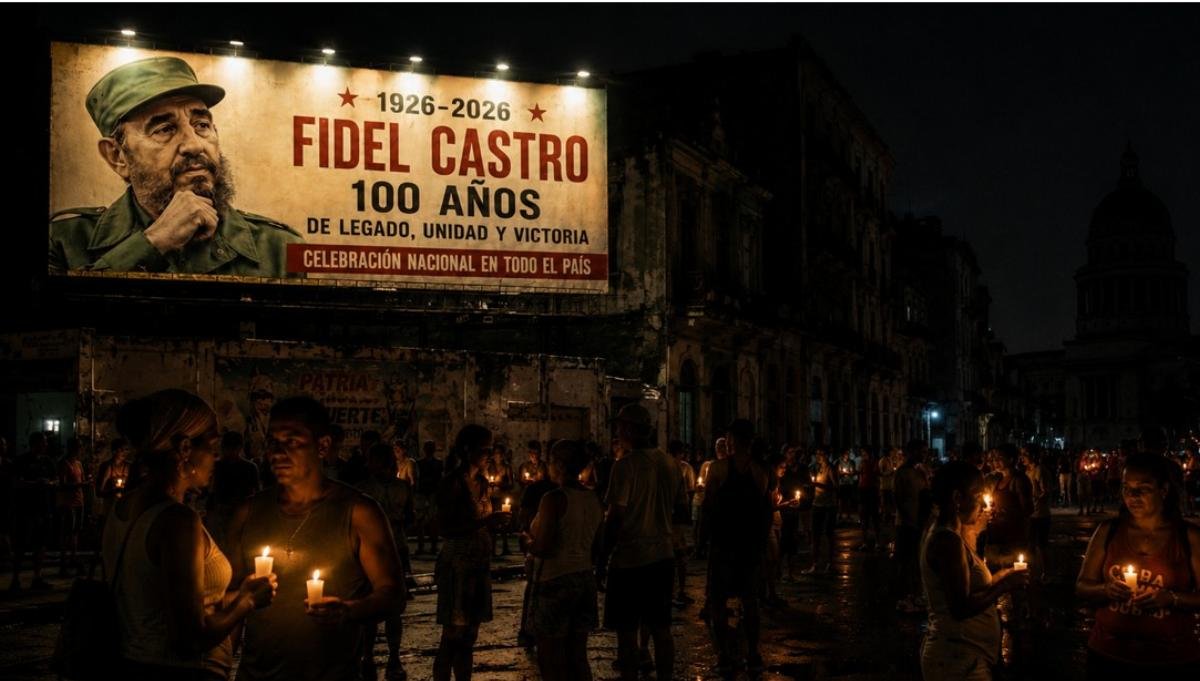
On August 21, 2026, Cuba marked the centennial of Fidel Castro’s birth with the expected trappings: flags waving, speeches delivered, and all the solemnity of a revolutionary state honoring its founding figure. But beneath the pageantry, a stark contrast emerged—one that, according to a commentary published by American Thinker, exposes the limits of ideology when confronted with the basic mechanics of daily life.
The piece, written by Luis Gonzalez and titled “Cuba: The Revolution That Needs Its Enemies,” observes that the centennial celebrations were accompanied by something far less glorious: candles. Not as part of any official ceremony, but as a grim necessity for citizens enduring blackouts that no amount of revolutionary rhetoric can fix.
It’s a telling juxtaposition, the author suggests. On one hand, a regime commemorating its founding martyr with all the pomp of state power. On the other, ordinary Cubans facing the mundane but relentless reality of an electrical grid that cannot keep the lights on.
The symbolism of the candle
Gonzalez’s analysis leans on the symbolic weight of that image. Here is a revolution that has long defined itself by its enemies—first imperialism, then the blockade, then the various forces that Washington and Miami have arrayed against it over the decades. The narrative of external threat has been central to the regime’s legitimacy, a way to explain hardship and rally loyalty. But a blackout is harder to blame on an embargo or a superpower a hundred miles away. A candle flickering in the dark is an inconvenient counterpoint to any speech about triumph and resilience.
The centennial, the author suggests, becomes an exercise in cognitive dissonance. The regime celebrates a past it can still control—the revolutionary victory, the iconic beard, the defiant speeches—while the present slips out of its grasp in ways as fundamental as losing power in one’s home. The revolution, Gonzalez argues, has come to need its enemies in a deeper sense than mere political calculus. Without them, the failures become harder to obscure. The enemy of yesterday was supposed to be the cause of today’s problems; when the problems persist even as the enemy recedes, the narrative falters.
A revolution that defines itself by opposition
The broader point of the commentary is that Cuba’s political project has historically been built less on a positive vision than on opposition. From the early days of the revolution, the leadership defined itself against the United States, against the exiled community, against any number of external and internal foes. This adversary-driven approach served a purpose: it marshaled unity, justified sacrifices, and provided a scapegoat for failures. But it also, Gonzalez suggests, left the system dependent on those adversaries for its own coherence.
Now, in 2026, that dependence is showing its cost. The enemies have not vanished—the American embargo remains a fixture of policy, and tensions with Washington have their own rhythms—but the intensity of the Cold War-era standoff has faded. What remains is the day-to-day struggle of a society trying to function. And here, the ideological toolkit of the revolution, honed for combat on a world stage, proves inept for the task of keeping power flowing to homes, hospitals, and factories.
The unreachable promise
The blackouts also invoke a deeper historical irony. Castro’s revolution, Gonzalez notes, promised a future of prosperity and justice—a new man and a new society that would transcend the old order’s inequalities. The slogans of that era still decorate walls and T-shirts, turned into kitsch for tourists even as the promises remain unfulfilled. The centennial speeches, in this reading, are not so much celebrations as reminders of a deficit: the gap between the revolutionary dream and the lived reality of queues for bread and fuel, of crumbling infrastructure, of a currency that struggles to hold value.
Gonzalez’s argument fits a broader genre of commentary on Cuba that has grown more pointed as conditions on the island have worsened in recent years. The specific triggers vary—economic mismanagement, the pandemic’s toll on tourism, the tightening of certain policies—but the common thread is a recognition that the revolution’s promises have not kept pace with its people’s needs. The blackouts, in this context, are not an isolated failure but a symptom of a systemic exhaustion.
Why the enemies matter now more than ever
If the revolution needs its enemies, then its current predicament is acute. The old antagonists have not entirely disappeared, but their ability to galvanize the population has diminished. The United States, despite its ongoing embargo, is no longer the all-encompassing foe it once was; younger generations, having grown up post-Cold War, may not feel the same urgency about the blockade that their elders did. The exile community in Miami remains a familiar antagonist, but its influence is diffused. In this vacuum, the regime faces a challenge: how to maintain legitimacy when the enemy’s shadow no longer looms large enough to explain every hardship.
The author’s tone is not one of sympathy. American Thinker, as a publication, tends toward conservative and anti-communist perspectives, and Gonzalez’s piece fits that mold. It is an argument that the revolution’s days are numbered, or at least that its ability to govern effectively is under threat, and that its reliance on external foes is a sign of weakness rather than strength.
What the centennial reveals
Centennials are moments for reflection, and this one offered Cubans a chance to look back at almost a century of revolutionary legacy. Gonzalez suggests that what that look reveals is not the triumph claimed by the speeches but the persistence of struggle. The flags could be flown, the speeches declaimed, but the candles for the blackouts tell a different story. They speak of a society that has not achieved the promised transformation, that remains dependent on imported fuels and crumbling infrastructure, that cannot take for granted the basic modern convenience of a steady power supply.
The centennial also, perhaps, reveals a regime aware of its own fragility. The decision to celebrate Castro’s 100th birthday with such ceremony, in a country facing such difficulties, might be read as a bid to shore up legitimacy, to connect the present leadership with the revolutionary charisma of the past. But, as Gonzalez’s commentary implies, the gesture risks looking hollow when the lights are off.
The broader lesson
There is a broader lesson in this commentary, one that extends beyond Cuba. Any political project that defines itself primarily by opposition—by who it is against rather than what it is for—risks hollowing itself out over time. When the enemy fades, the question becomes: what remains? In Cuba’s case, the answer, according to Gonzalez, has been a system struggling to provide for its people, kept afloat less by ideology than by coercion and inertia.
It’s a contentious claim, and not everyone would agree. Supporters of the revolution might argue that Cuba’s achievements in education, healthcare, and international solidarity outweigh its economic failures, and that the blackouts are the result of external sabotage rather than internal inadequacy. But Gonzalez’s commentary offers a counterpoint, grounded in the observation that ideology cannot fix an electrical grid. The candles, in his telling, are the true measure of the centennial.
As Cuba moves beyond its 100-year anniversary of Castro’s birth, the question hangs in the air: Can a revolution that has always defined itself by its enemies survive the absence of those enemies? Or will it, like a house without a foundation, collapse under the weight of its own contradictions? The blackouts, at least, suggest that the revolution’s ideological capital may be insufficient to meet the basic demands of the present.
For now, the flags still wave, the speeches continue, and the candles keep burning—each one a small, flickering testament to a promise that remains, for many Cubans, decidedly unfulfilled.
Source: www.americanthinker.com — https://www.americanthinker.com/articles/2026/08/cuba-the-revolution-that-needs-its-enemies/