
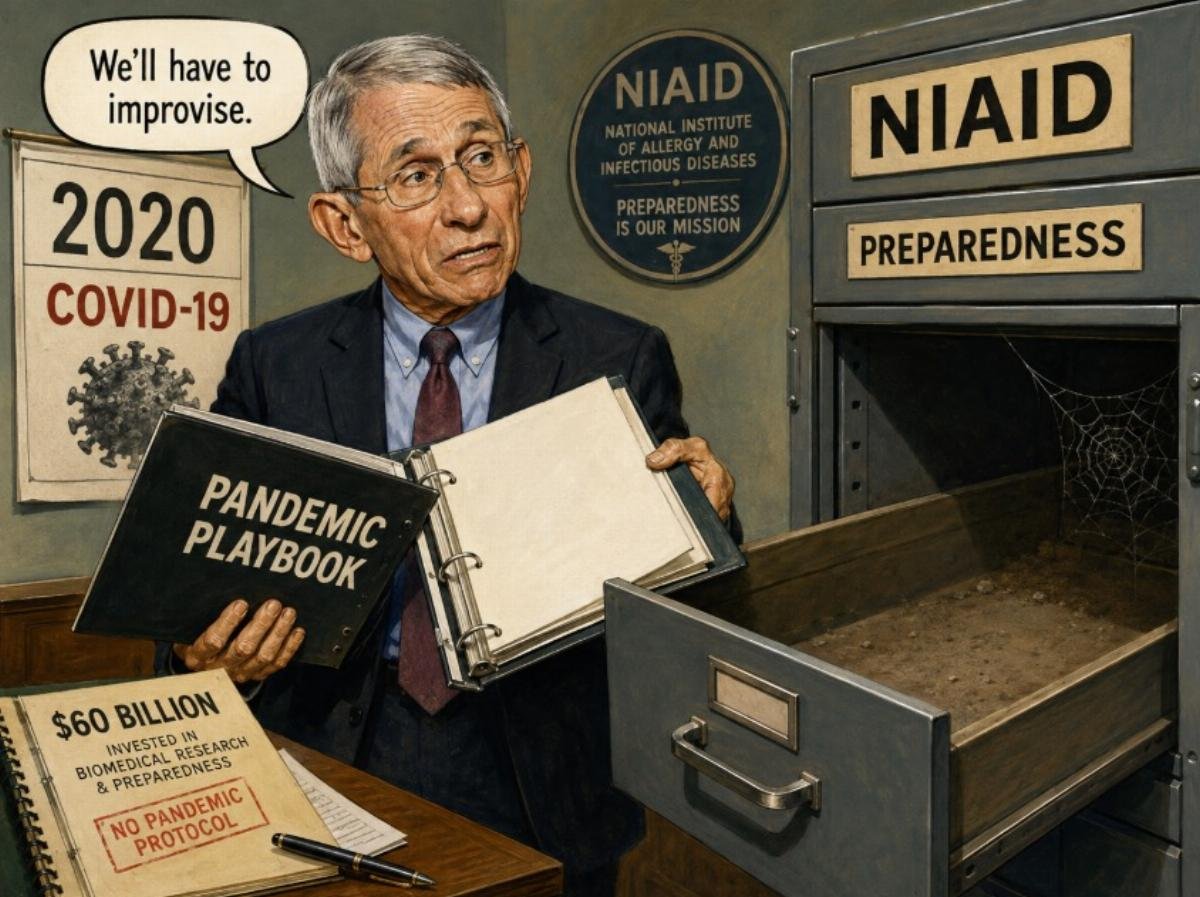
Nearly four decades after Dr. Anthony Fauci took the helm at the National Institute of Allergy and Infectious Diseases (NIAID), the United States entered the COVID-19 pandemic with a $60 billion preparedness investment and, apparently, no playbook. That’s the central question raised in a new op-ed by Allan J. Feifer, published Wednesday in American Thinker: Why was America’s pandemic doctrine in 2020 so lacking after all that time and money?
Fauci, as NIAID director, oversaw billions in infectious disease research, including projects in Wuhan, China. He advised presidents of both parties and helped shape the nation’s response to emerging pathogens. He was, in effect, the country’s chief guardian against the next inevitable outbreak. When COVID hit, that system should have been primed. Instead, as Feifer puts it, America watched its leading public health institutions improvise in real time.
The argument hinges on a distinction that has gotten too little attention in the heated debates over masks, lockdowns, and vaccines: The virus was novel, but the organizational requirements of a pandemic are not. Militaries don’t wait for a war to start to write their doctrine. Fire departments don’t abandon their procedures because every fire is different. Yet public health, after decades of preparation, seemed to be reinventing fundamental decision-making processes mid-crisis.
A pattern of improvisation
COVID-19 wasn’t the first infectious disease to threaten the United States. The nation had faced influenza pandemics in 1918, 1957, and 1968, plus SARS, MERS, H1N1, Ebola, and Zika. Each outbreak is unique, but the core questions remain consistent: How quickly can the pathogen be identified? How should evidence be gathered and evaluated? How should vulnerable populations be protected? And how should uncertainty be communicated to the public as recommendations evolve?
Feifer points to age stratification as a concrete example. Early evidence showed that mortality risk was overwhelmingly concentrated among older Americans — 93% of deaths. Yet public policy treated the risk as uniform. That is precisely the kind of distinction NIAID exists to make, Feifer argues, and it didn’t. Instead, the nation got daily press conferences that frequently contradicted earlier guidance, with scientific certainty proclaimed and then discarded.
Fauci’s defense — that COVID was unlike anything modern medicine had encountered — strikes Feifer as weak, confusing biological novelty for institutional novelty. Pathogens differ; the fundamental requirements of pandemic response remain remarkably consistent. Even the possibility that SARS-CoV-2 may have resulted from laboratory manipulation or research-related activity could have been anticipated, given that more than 100,000 researchers were working on all aspects of pandemics under NIAID’s umbrella.
The conflict that eroded trust
Feifer also takes aim at the role Fauci played beyond the lab. Fauci became the public face of the response, willingly, and his profile grew beyond anything previously associated with a career government scientist. He was hailed as “America’s doctor” by some, while critics saw him increasingly as a political figure rather than an independent scientific adviser.
The conflict became unavoidable when questions emerged about NIAID’s role in funding coronavirus research, including gain-of-function work, that may have contributed to the origins of the very virus Fauci was fighting. Feifer argues that the appearance of such a conflict demanded extraordinary transparency. Instead, public confidence deteriorated as those questions were reflexively dismissed rather than openly examined.
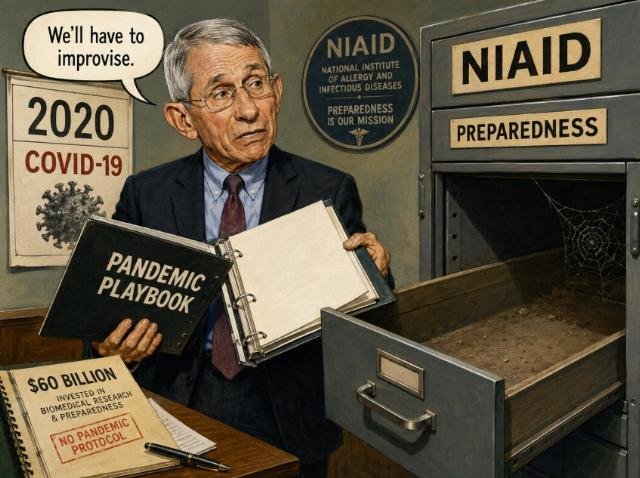
What did $60 billion buy?
The op-ed’s sharpest question is a simple one: What exactly did decades of preparation buy us? If the answer is an improvised national response marked by conflicting guidance, economic upheaval, and a profound loss of trust, then something failed long before COVID-19 reached American shores, Feifer writes.
He acknowledges that debates over masks, school closures, nursing home policies, vaccines, and mandates will and should continue. But before asking whether individual policies succeeded or failed, Americans should ask the more fundamental question about the readiness system that was supposed to make those policies coherent.
Feifer also notes that Fauci’s invocation of the Fifth Amendment 111 times during a recent congressional hearing left many questions unresolved. Regardless of the legal significance, he writes, the American people deserve a full accounting.
A warning about the next pandemic
The op-ed ends with a warning: history will judge Anthony Fauci, but the systemic failure is larger than one man. If the nation doesn’t honestly acknowledge why its preparedness system collapsed at the worst possible moment, it risks repeating the same mistakes when the next pandemic inevitably arrives.
Source: www.americanthinker.com — https://www.americanthinker.com/articles/2026/08/fauci-and-the-pandemic-playbook-that-wasn-t/