
Nearly 60 House Democrats have signed a letter urging the Justice Department and FBI to investigate what they describe as a surge in anti-Black lynchings — a push The Federalist is characterizing as the newest entry in a decades-long catalog of manufactured racial panics.
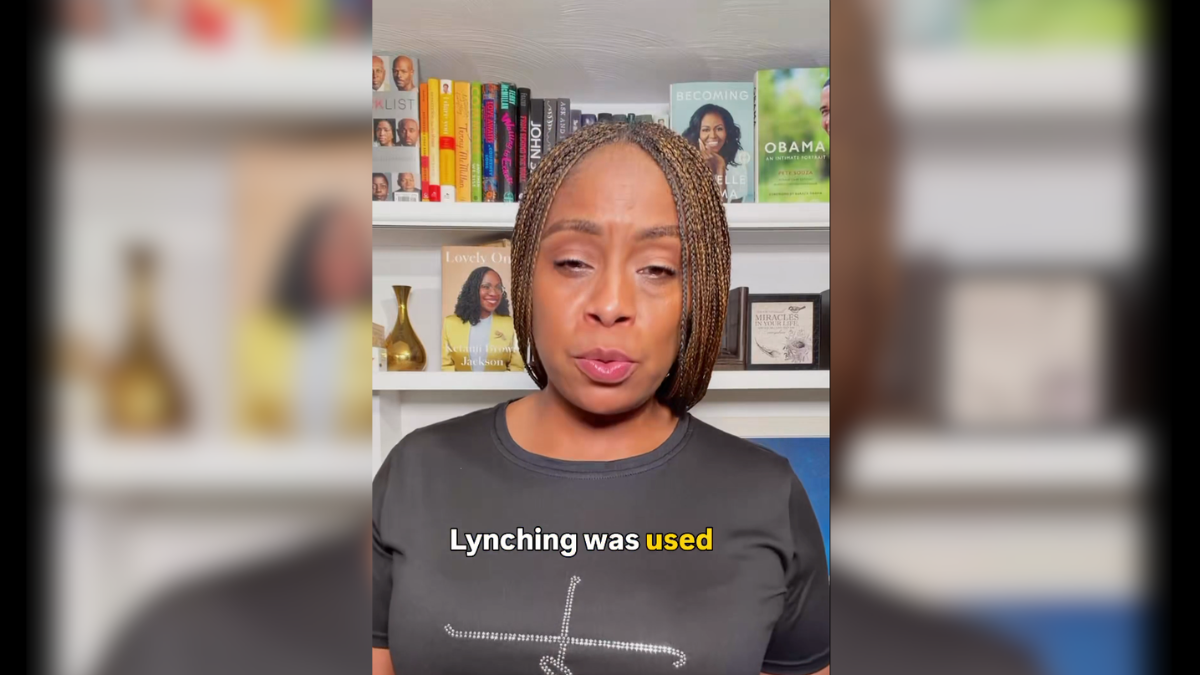
The letter, led by Rep. Ayanna Pressley of Massachusetts and joined by Rep. Shontel Brown of Ohio and 58 other House colleagues, calls modern-day lynching a “national crisis” and asks federal authorities to intervene. In a video posted to social media earlier this month, Brown asserted that Black Americans are being found dead hanging from trees at an alarming rate and invoked the country’s racial history as context.
According to The Federalist, the underlying evidence does not support the framing.

What the Individual Cases Show
The outlet points to a series of deaths that have circulated widely online as suspected lynchings. A 21-year-old man found in a Georgia park was effectively ruled a suicide, with no indication anyone else was present. A Delta State University student in Mississippi was likewise determined to have died by suicide. A 16-year-old in Charlotte was also a suicide, per local police.
The one case that remains an active homicide investigation is in Kentucky, and The Federalist notes it warrants exactly that scrutiny. But local law enforcement has described the death as drug-related and the hanging as staged, and both suspects in custody are Black. One open homicide probe, the outlet argues, does not amount to a nationwide epidemic of racial terror. Actor Dean Cain, who played Superman on television in the 1990s, was quoted in the piece saying Brown is “inventing racism.”
A Familiar Pattern, the Outlet Argues
The Federalist frames the current letter as part of a longer tradition. It cites the Jussie Smollett case, in which a Chicago jury convicted the former “Empire” actor on five counts of disorderly conduct in 2021 for paying two men $3,500 to stage a hate crime that included placing a rope around his neck. The outlet acknowledges the Illinois Supreme Court overturned the verdict in 2024, but stresses the reversal turned on a narrow double jeopardy question rather than any doubt about the underlying facts.

The piece also revisits NASCAR driver Bubba Wallace’s 2020 garage incident, in which a pull rope tied in the shape of a noose prompted a national firestorm before the FBI determined the rope had been in the stall since before Wallace’s team was assigned that garage — a detail captured on video that went unchecked before the story spread.
Other examples cited include a 2023 cross burning in Colorado Springs, where three people staged the act in front of a Black mayoral candidate’s campaign sign and emailed footage to news outlets; all three were later convicted federally. The Federalist also references a University of La Verne student who allegedly fabricated a series of racist threats against herself and her own student group — briefly shutting down campus — before police traced the messages back to her. And it notes that 17 years after Duke lacrosse players David Evans, Collin Finnerty and Reade Seligmann were declared innocent, their accuser publicly confessed in 2024 that the allegations had been fabricated.
The outlet reaches further back as well, citing the 1987 Tawana Brawley case, in which a grand jury concluded her rape claim was a hoax, and a jury later found Al Sharpton liable for defamation, ordering him to pay part of a $345,000 judgment he ultimately settled with donations from supporters. The Federalist presents this as evidence that the pattern is nearly four decades old and financially self-sustaining.
The Data Argument
Rather than accept the premise of a racial terror wave, the piece points to federal statistics. Bureau of Justice Statistics figures show 69 percent of violent incidents with white victims and 66 percent with Black victims were committed by an offender of the same race or ethnicity. FBI data on single-victim, single-offender murders found roughly 79 percent of white homicide victims were killed by white offenders, and roughly 89 percent of Black homicide victims were killed by Black offenders. The Federalist concludes from these figures that American crime is predominantly a function of proximity, opportunity and circumstance rather than race war.
A Battle Over History
The article also pushes back on the historical framing itself. It notes that the Reconstruction-era Ku Klux Klan was founded by Confederate veterans in Pulaski, Tennessee, and that by the late 1860s it functioned, in historian Eric Foner’s description, as a paramilitary force serving the interests of the white Southern Democratic Party, intimidating Black voters and Republican officeholders to restore Democratic control of the South.
Roughly a century later, the Civil Rights Act of 1964 cleared the Senate 73-27 and the House 289-126 only after a filibuster led largely by Southern Democrats, including West Virginia’s Robert Byrd, a former Klan recruiter who went on to serve another 46 years in the Senate. Republicans backed the bill by wider margins than Democrats in both chambers, the piece notes, with the remaining opposition coming almost entirely from the Southern Democratic bloc. The article also points to Supreme Court Justice Hugo Black, an Alabama Democrat who spent two years as a Klan member before Franklin Roosevelt appointed him to the bench.
The piece closes by invoking Martin Luther King Jr.’s call to judge people by the content of their character rather than the color of their skin, arguing that the standard applies equally to accusers. It contends that juries, coroners and FBI forensic examiners evaluate evidence rather than political talking points.
What Comes Next
The letter from Pressley, Brown and their colleagues asks federal law enforcement to open investigations into the hanging deaths, a request that would place the Justice Department in the position of reviewing cases that local authorities have already resolved as suicides, alongside one active Kentucky homicide probe. Whether the department takes up the request — and how it characterizes the pattern of cases — remains to be seen. For now, the dispute has become the latest flashpoint in a broader argument over how the country interprets racially charged incidents, and over which statistics and which historical chapters get to anchor that interpretation.
Source: thefederalist.com — https://thefederalist.com/2026/09/29/democrats-fake-lynching-panic-is-latest-in-a-long-line-of-racial-hoaxes/