
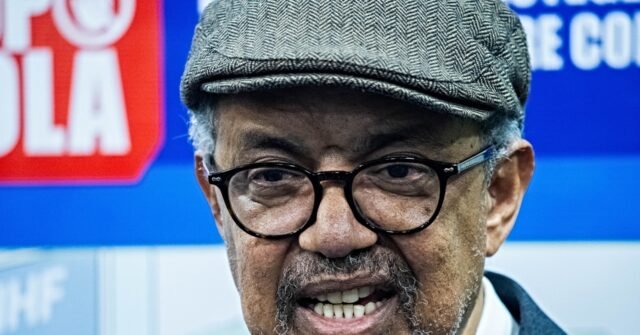
The World Health Organization has formally accepted nominations for four candidates seeking to become its next director-general, setting up a contest to replace incumbent Tedros Adhanom Ghebreyesus, who is term-limited and whose tenure has been marked by controversy.
According to the W.H.O., the candidates are Dr. Hanan Mohammed Al-Kuwari, former health minister of Qatar; Dr. Hanan Hassan Balkhy, the W.H.O.’s Eastern Mediterranean regional director; Dr. Hans Henri Kluge, the agency’s Europe regional director; and Budi Gunadi Sadikin, Indonesia’s health minister. The candidates were nominated by member states, with Qatar and Indonesia putting forward their own officials, while Saudi Arabia nominated Balkhy and Belgium nominated Kluge, the organization said this week.
The election for the next head of the U.N. health agency is expected to take place during the World Health Assembly in May, the annual gathering of member states. The W.H.O. has set a September 24 deadline for additional nominations, leaving open the possibility that more candidates could enter the race.
A Troubled Tenure
The incoming director-general will inherit an organization whose reputation has been battered during Tedros’s time in office, which has been defined largely by the W.H.O.’s handling of the Wuhan coronavirus pandemic. The pandemic has killed more than 7 million people since the virus emerged in central China in late 2019.
Tedros, the first person without a medical doctorate to run the agency, was first elected in 2017 and won a second five-year term unopposed in 2022. His final term is scheduled to conclude in May.
Beyond the pandemic response, the W.H.O. has faced a sex abuse scandal in the Democratic Republic of the Congo, where the agency was already grappling with an Ebola outbreak. Widespread disagreement among member states over the parameters of a proposed global pandemic treaty has also stalled that initiative. More recently, the agency was criticized for catching a rapidly expanding Ebola outbreak in the DRC months after it began.
The Candidates
All four candidates bring public health experience, either as health ministers or within the W.H.O.’s management structure, but not all are medical doctors. Sadikin, Indonesia’s health minister, is a nuclear physicist with a strong finance background. He appears to be positioning his nontraditional profile as an advantage, particularly as the W.H.O. faces increased fundraising needs after President Donald Trump withdrew the United States from the agency, cutting off millions in fees that helped keep it afloat.
In contrast, the other candidates are emphasizing their administrative experience, especially those who have been running W.H.O. subdivisions. Kluge, who leads the agency’s Europe office, published a manifesto on Tuesday outlining his proposals for the organization, stressing the need for people-centered initiatives.
“At the heart of this vision is a WHO that puts countries first, is people-centered, and organized as a network,” Kluge said in a social media message. “A WHO that always stays one step ahead of global health challenges and always acts in partnership.”
Kluge has helped lead the W.H.O.’s response to the pandemic in Europe, having assumed his regional role in February 2020, just as the virus was spreading across the continent.
Balkhy, who took over as Eastern Mediterranean director in 2024, missed the height of the pandemic’s early days but previously worked in the W.H.O.’s antimicrobial resistance arm. As a physician, she served as a pediatrician and has highlighted her work combating the Middle East Respiratory Syndrome (MERS) outbreak, which is seen as a precursor to the coronavirus, as well as her experience coordinating with diplomats from many countries.
In a nod to the criticism that Tedros’s tenure has faced, Balkhy said in her statement accepting the nomination that the W.H.O. must rebuild global trust.
“I believe that the World Health Organization must build trust, deliver impact, and demonstrate the value it provides to every Member State,” she said.
Al-Kuwari, the Qatari candidate, oversaw her country’s domestic response to the pandemic, which included the unique challenge of preparing for an influx of thousands of international visitors during the 2022 FIFA World Cup. While the tournament was widely criticized for Qatar’s use of migrant labor, treatment of LGBTQ people, and other human rights concerns, it did not become a superspreader event, and Qatar appears to have successfully contained any potential mass infection.
Election Process and Requirements
The W.H.O. has outlined a list of criteria that candidates must meet to be considered for the top job. According to a document explaining the election process, applicants must pass a medical examination to demonstrate physical fitness and have “a strong technical background in a health field.” Other requirements include “demonstrable leadership skills,” good communication, “sensitivity to cultural, social, and political differences,” and a commitment to the “mission and objectives” of the agency.
As the nomination window remains open through late September, new names could emerge to join the field, potentially shifting the dynamics of the race. Candidates are expected to campaign in the coming months, making their cases to W.H.O. member nations ahead of the World Health Assembly next year.
Source: www.breitbart.com — https://www.breitbart.com/health/2026/08/27/meet-the-candidates-vying-to-succeed-tedros-as-head-of-the-w-h-o/