
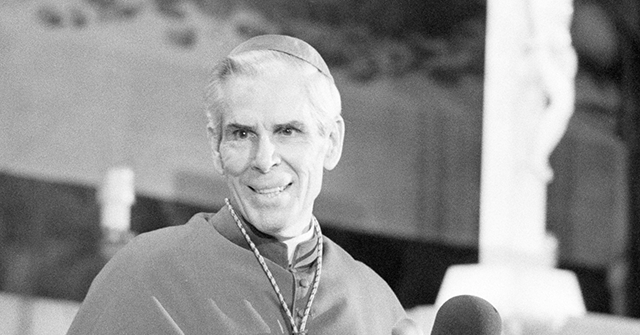
Archbishop Fulton Sheen took the final step before possible canonization on Tuesday as the Catholic Church beatified him during a Mass in St. Louis, Missouri. The milestone has prompted renewed attention to Sheen’s decades-long crusade against communism—and a fresh argument that the church should formally designate him the patron saint of anti-communism.
In a column published by Breitbart, writer James Pinkerton made that case directly, noting that “as we look around the world today, the red tide rising, we see the urgent need for Sheen-style moral armament.” The piece appeared under the outlet’s faith section.
A broadcaster with a message
Sheen, who lived from 1895 to 1979, was ordained a priest in 1919 and spent six decades serving the church in various roles, including as Bishop of Rochester, New York. But it was his gift for communication that made him a household name.
With movie-star looks and a theatrical delivery, Sheen took to radio in the 1930s before moving to primetime network television in the 1950s. His Emmy-winning show, Life Is Worth Living, reached an estimated 30 million Americans each week at its peak, making him the most successful televangelist in history. When he accepted his Emmy, he famously credited his writers: “Matthew, Mark, Luke, and John.”
According to Breitbart, Sheen’s stardom had faded by the late 1960s, but video clips and full episodes of his programs remain widely available online, something Pinkerton described as “miraculous, some might say.”
Confronting communism at home and abroad
Sheen’s anti-communism was not a late-career development. In the late 1930s, as communists in Spain targeted clergy, destroyed churches, and desecrated religious sites, Sheen rallied the faithful. Biographer Thomas C. Reeves recounted an October 1936 article Sheen wrote for The Tablet, a Brooklyn diocesan paper, in which he documented Soviet efforts to turn Spain into a communist state. A year later, Sheen recited statistics on atrocities against Catholics and criticized liberal intellectuals who backed the communist side.
Breitbart noted that Sheen was even willing to confront President Franklin D. Roosevelt behind the scenes, at a time when the administration included officials sympathetic to Soviet causes—and in some cases, outright Stalinist spies.
In the 1940s, Sheen called communist Russia “the most anti-Christ nation on the face of the earth.” He argued that the Soviet “saint” was Lenin’s rotted corpse, which he described as “a perfect symbol of that to which all communism must lead us all, unto dust, unto dissolution, unto death.”
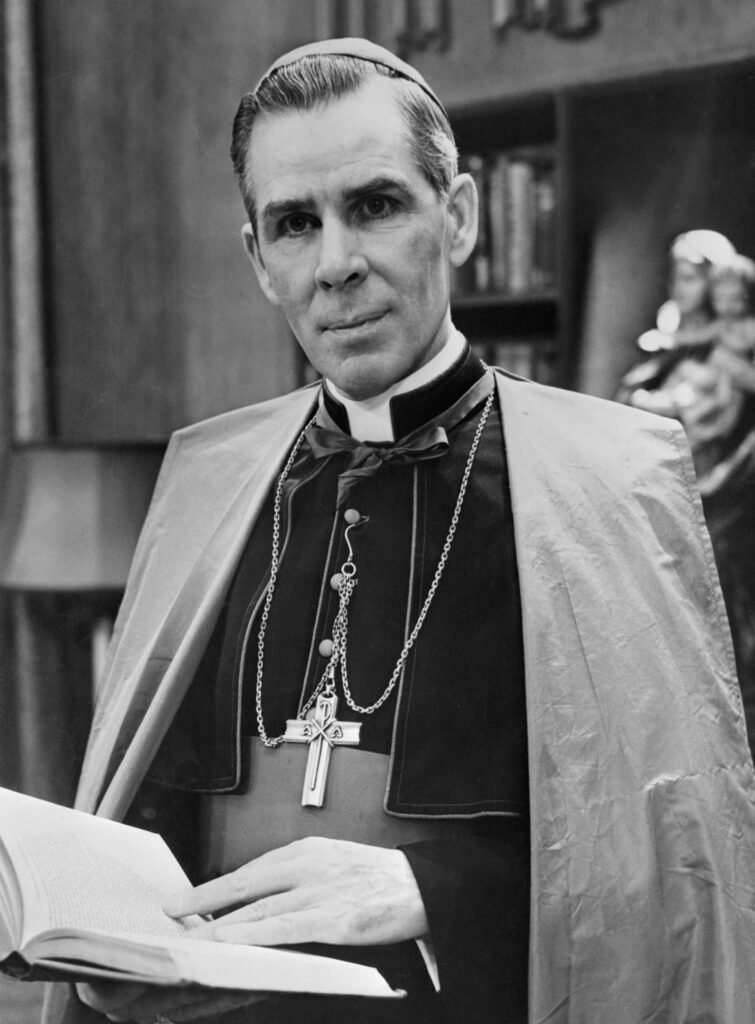
Pinkerton also recalled Sheen’s broader cultural commentary. During the protests and riots of the 1960s, Sheen criticized nihilism: “Our nation is too full with those who are crying ‘down.’ ‘Down with churches.’ ‘Down with the police.’ ‘Down with government.’ Can you build anything down? You cannot.”
On crime, Sheen said: “False compassion is a pity shown not to the family of the murdered, but to the murderer.” The Breitbart column framed this as a worldview that allows for forgiveness—but only after repentance, and with the protection of innocent life as a constant priority.
Sheen’s underlying message, according to the piece, was that political activism must never excuse personal failings. He put it this way: “Sometimes we can cover our want of individual justice with social justice.”
A political liberal of a different era
Despite his anti-communist fervor, Sheen was seen as a political liberal during his lifetime. Breitbart argued that this label reflected a different era—one in which liberals like Harry Truman and John F. Kennedy supported the police and the military and volunteered for combat duty. “There was nothing woke about either of those old-guard Democrats,” Pinkerton wrote, suggesting both presidents would be considered conservatives today.
Sheen was also prolific in print, publishing some 73 books along with countless columns and scripts. In 1943, he produced a prayer book for soldiers, distributed free to interested GIs. He dedicated it to the Queen of Heaven with a patriotic invocation that condemned both Imperial Japan’s rising-sun imagery and Nazi Germany’s swastika, expressing hope that the “false god of a rising sun sets, and the double cross untwists itself.”
Debate over a patron saint
Pinkerton acknowledged that some might argue a patron saint of anti-communism already exists: Pope John Paul II, canonized in 2014, who also framed his opposition to communism in spiritual terms. But he suggested there is room for another—one focused specifically on the United States.
“When fighting off Reds, we Americans need all the spiritual armor we can get,” he wrote. “This will be a long twilight struggle.”
The column listed other prominent anti-communist thinkers who made secular arguments—Friedrich Hayek, Ludwig von Mises, and Milton Friedman on liberty and economics; Charles De Gaulle, Margaret Thatcher, and Ronald Reagan on geopolitics; and Aleksandr Solzhenitsyn and John Paul II on spiritual grounds.
For now, Sheen’s beatification brings him one step closer to sainthood. Whether the church will one day name him the patron saint of anti-communism remains an open question—but the Breitbart column makes clear that for many conservative Catholics, his legacy as a moral warrior against godless ideology is already secure.
Source: www.breitbart.com — https://www.breitbart.com/faith/2026/09/24/pinkerton-fulton-sheen-should-be-the-patron-saint-of-anti-communism/