

Gasoline prices have a way of turning otherwise rational people into amateur political analysts. When the number on the sign drops, the president you voted for is a genius. When it climbs, the president you didn’t vote for is apparently behind the counter at every station in America, personally twisting the dial. That’s the dynamic George P. Brooks takes apart in a recent American Thinker op-ed, and whatever you think of his conclusions, the arithmetic he lays out is worth sitting with.
Start with the raw numbers. According to AAA data cited in the piece, the national average for regular gasoline sat around $4.49 per gallon on September 25, 2026 — a steep jump from roughly $3.16 a year earlier. AAA attributes the surge to expensive crude oil and volatility tied to the Strait of Hormuz. At the same time, gasoline demand ticked up from 8.79 million to 8.84 million barrels per day, inventories dipped from 207.7 million to 206 million barrels, and gasoline production slipped slightly. None of those moving parts has anything to do with who occupies the Oval Office.
Brooks doesn’t dispute that Iran and the Strait of Hormuz matter — he insists they do. The Energy Information Administration, he notes, has said disruptions to petroleum flows through Hormuz contributed to higher and more volatile oil prices during 2026, pushing international buyers toward alternative supplies while boosting U.S. refinery margins, production, and exports. The conflict can hit gasoline twice over: once through crude prices, and again through global competition for finished petroleum products.
Crude Is Not the Same as Gasoline
What Brooks rejects is the shorthand that goes straight from “there’s a war involving Iran” to “therefore gas is expensive.” His analogy: it’s like explaining the price of a hamburger by showing the cost of a cow while ignoring the slaughterhouse, the trucking company, the restaurant, the taxes, the labor, and the person behind the counter who now seems to think bacon requires its own financing plan.
Crude oil, he points out, is the raw material, not the finished product. The EIA breaks the retail price of gasoline into four components: crude-oil costs, refining costs and profits, taxes, and distribution and marketing. A crude-oil chart alone, in his framing, is one chapter of a longer book.
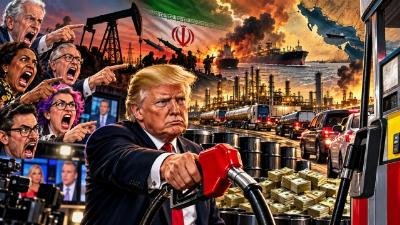
Refining deserves particular attention. In September, the EIA reported that elevated crude prices and elevated crack spreads were contributing to higher pump prices. Crack spreads measure the gap between what refined products are worth and what the crude used to make them costs. When those spreads widen unusually, refining becomes a much larger share of what drivers pay at the station.
That context is what makes Trump’s price-gouging claim worth examining rather than waving away, Brooks argues. In June, crude prices had fallen sharply from their May peak while gasoline declined much less. Trump responded by ordering the Justice Department to look into why consumers weren’t seeing comparable relief, and publicly questioned whether major oil companies were gouging motorists. That order doesn’t prove illegal conduct — high margins can reflect scarce refining capacity, tight inventories, disrupted transportation, or global buyers competing for limited supply. But those same conditions, Brooks writes, make regulatory scrutiny reasonable rather than hysterical.
The administration hasn’t limited itself to complaints. The Justice Department’s Antitrust Division and the Federal Trade Commission announced they would monitor petroleum markets for potentially illegal conduct contributing to high gasoline prices, and encouraged state attorneys general to examine possible antitrust and consumer-protection violations. Brooks is careful here: investigation is not proof of wrongdoing. But it does undercut the portrait of a president simply enjoying high prices from the sidelines.
Supply-Side Moves and Regional Quirks
On the supply side, the piece notes that in August the EPA, working with the Department of Energy, issued an emergency fuel waiver allowing broader E10 gasoline sales and ending certain summer-blend restrictions early, with the agency saying the move could increase available domestic gasoline supply.
Fuel specifications are a genuinely underappreciated variable. The EIA identifies regional requirements, refinery maintenance, unexpected outages, transportation constraints, consumption patterns, and inventories as factors affecting gasoline prices. California requires specialized blends that cost more to manufacture and are hard to replace quickly when a refinery goes down. That helps explain why California can sit above six dollars a gallon while Texas stays below four under the same president — unless, Brooks quips, Trump becomes dramatically more presidential the moment motorists cross the state line.
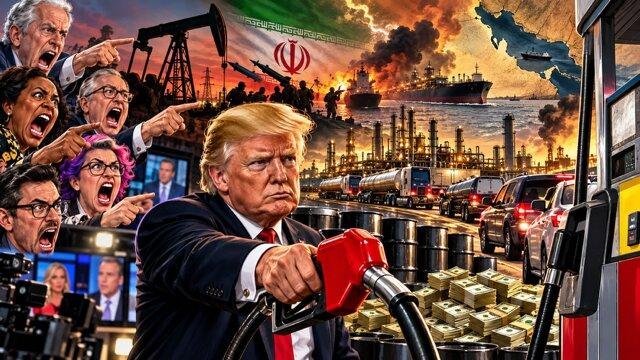
Then there’s the machinery between the barrel and the pump. Refinery outages matter because crude sitting in a tank does nothing for someone whose truck needs fuel. Inventories matter because falling supplies plus rising demand push prices upward. Distribution matters because gasoline travels from refinery to terminal to tanker truck to neighborhood station, leaving prices exposed to pipeline disruptions, hurricanes, bottlenecks, and freight costs. Exports matter because American refiners don’t operate inside a glass dome marked “For Americans Only” — Middle Eastern disruptions can raise foreign demand for U.S.-refined products, lifting margins and export volumes. Taxes matter because federal and state levies are baked into every gallon and vary widely by state.
Seasonality matters too. Gasoline usually gets cheaper as summer ends and demand softens. Yet AAA says this September is on pace for a record national September average, with the normal autumn reprieve colliding against expensive crude, Hormuz volatility, tighter inventories, and elevated refining economics.
Stack all of that up, Brooks writes, and the explanation “Trump made gas expensive” requires ignoring Iran, Hormuz, crude markets, refinery margins, capacity, maintenance, outages, inventories, seasonal blends, state regulations, taxes, distribution, exports, demand, and regional differences before arriving at the theory that the man in the Oval Office personally controls the Speedway sign. That, in his words, isn’t analysis — it’s partisan ventriloquism.
The Reckoning He Says Is Coming
To his credit, Brooks doesn’t let his own side off the hook. He acknowledges legitimate criticism of Trump’s energy and foreign policy, including the reality that instability involving Iran and Hormuz has contributed to higher petroleum prices. If administration policy feeds geopolitical instability in a major energy corridor, that belongs in the accounting too, he writes. Intellectual honesty, in his framing, doesn’t pause when the facts turn inconvenient.
The more interesting question is what happens next. If crude falls substantially, inventories recover, Hormuz traffic normalizes, and refinery margins stay extraordinarily high while motorists keep paying inflated prices, then scrutiny of industry pricing becomes harder to wave off. High margins under normalized conditions look very different from high margins during a supply shock.
Brooks lands on a straightforward demand: show the entire math. Crude, refining, taxes, transportation, inventories, regional specifications, profit margins. Somewhere in those numbers is the explanation glowing above the gas station. Trump may be right that parts of the industry deserve a look, and his critics may be right that Iran and Hormuz are pushing prices up. Those two things can be true at once, because economics doesn’t require joining a political fan club before you pick up a calculator.
Gasoline isn’t red or blue. It’s a globally traded commodity moving through a complicated refining and distribution system, and its price has more than one father. The next time someone reduces all of it to a meme blaming a single politician, the fair response — per Brooks — is to ask for the whole equation, not just the variable that happens to fit the narrative.
Source: www.americanthinker.com — https://www.americanthinker.com/blog/2026/09/the-math-at-the-pump-before-you-blame-trump-follow-the-damn-barrel/