

A newly published observational analysis reports that 84.4% of cancer patients treated off-label with a compounded combination of ivermectin and mebendazole experienced a clinical benefit, according to a sponsored article from Breitbart. The study, led by Dr. Peter McCullough and colleagues, was peer-reviewed and published in the international oncology journal Anticancer Research.
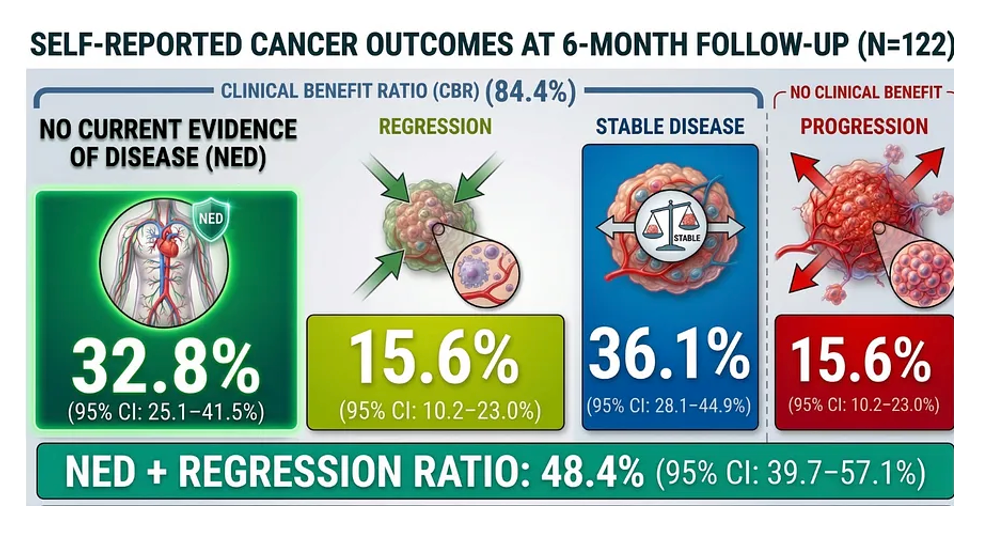
The report was produced by The Wellness Company’s Chief Medical Board in partnership with the McCullough Foundation. It followed 197 cancer patients who received the company’s U.S.-compounded formulation, which pairs 25 mg of ivermectin with 250 mg of mebendazole in a single capsule. Among the 122 patients who reached the six-month follow-up mark, the clinical benefit rate was 84.4%.
The findings arrive amid a broader decline in public trust in American medicine. According to the article, 71.5% of Americans said they placed “a lot of trust” in doctors and hospitals in April 2020. By January 2024, that figure had dropped to 40.1%. The Wellness Company, which sponsored the content, frames its research as a response to that erosion, arguing that patients are increasingly skeptical of a system they believe prioritizes financial interests over patient care.
A Repurposed Drug Combination
Both ivermectin and mebendazole are FDA-approved, inexpensive, and have decades of use in treating parasitic infections. Ivermectin, which earned its discoverers a Nobel Prize, is believed to disrupt tumor growth pathways and trigger apoptosis, or programmed cell death, in cancer cells. Mebendazole works through a different mechanism, cutting off the glucose supply that abnormal cells need to survive. The two drugs had already shown anti-cancer activity in preclinical studies, but rigorous clinical evidence on their combined use in cancer patients has been lacking.
Dr. McCullough described the results as promising enough to warrant further investigation. “This study reveals an exciting new potential that should expand the consideration of ivermectin and mebendazole for inclusion in the treatment of multiple cancer types,” he said in a statement. “We urgently need a full-fledged scientific investigation into this class of medications and their impact on cancer treatment.”
The analysis is observational, meaning it tracked outcomes in patients who received the compounded treatment rather than comparing them against a control group in a randomized trial. That distinction matters. While the 84.4% clinical benefit rate is striking, observational studies can be influenced by selection bias, placebo effects, and other confounding factors that randomized controlled trials are designed to minimize. The authors themselves call for a “full-fledged scientific investigation,” signaling that the current findings are preliminary and hypothesis-generating rather than definitive.
Patient Testimonials and Commercial Interests
The Breitbart article, which is clearly labeled as sponsored by The Wellness Company, includes testimonials from patients who used the compounded formulation. One patient, identified as Judith M., said she was stage 4 and terminal with metastatic breast cancer throughout her body before starting the regimen. “My PET scan last month showed no live cancer anywhere in my body,” she said. “The truth is Ivermectin and Mebendazole was a game changer.”
Another testimonial, from a woman named Helen, described her daughter’s experience with uterine cancer and lung nodules. After two weeks on the treatment, a biopsy reportedly required the physician to “SEARCH for a nodule big enough to get a sample from.” Helen credited the doctors involved for giving her family “HOPE and HEALING.”
These accounts, while compelling, are anecdotal and cannot be independently verified from the article alone. They also appear alongside promotional language for The Wellness Company, which the article notes is “the only company in the world to prescribe U.S. compounded Ivermectin + Mebendazole, in a high-dose tablet.” The company sells 45-day and 90-day supplies of what it markets as “the ultimate parasite cleanse” — a framing that positions the drug combination as both a cancer therapy and a general wellness product, despite the fact that cancer treatment claims require rigorous clinical validation.

The Broader Context of Repurposed Drugs in Oncology
Repurposing existing drugs for cancer treatment is not a fringe idea. Researchers have long explored off-label uses for inexpensive, well-characterized medications, particularly for cancers with limited treatment options or in cases where standard therapies have failed. The appeal is obvious: repurposed drugs are typically cheaper, have known safety profiles, and can move through clinical testing faster than novel compounds.
Ivermectin and mebendazole have both attracted attention in this space. Preclinical studies have suggested they may have anti-cancer properties, though translating those findings into human clinical benefit has proven challenging for many similar candidates. The current analysis adds to a growing body of early-stage evidence but does not replace the need for randomized trials.
Cancer remains one of the most common diagnoses in the United States, with roughly one in three Americans facing it in their lifetime. Standard treatments — chemotherapy, radiation, and targeted therapies — often come with severe side effects, high costs, and variable outcomes. That reality has fueled interest in alternative and adjunctive approaches, some of which eventually prove effective and others of which do not.
The McCullough Foundation, co-producer of the report, is a nonprofit organization founded by Dr. McCullough, a cardiologist who gained prominence during the COVID-19 pandemic for his advocacy of ivermectin and other repurposed drugs. His work in that arena was controversial, with some studies he cited later retracted or criticized for methodological flaws. That history does not invalidate the current findings, but it is part of the context in which they will be evaluated by the broader oncology community.
For now, the 84.4% clinical benefit rate stands as a preliminary observation from a single-arm analysis, not a proven cure. The authors’ own call for a “full-fledged scientific investigation” acknowledges as much. Whether that investigation materializes — and whether it confirms or contradicts these early results — will determine whether this drug combination moves from the margins of cancer care toward the mainstream.
Source: www.breitbart.com — https://www.breitbart.com/politics/2026/09/16/ivermectin-mebendazole-groundbreaking-study-reports-84-4-clinical-benefit-rate-in-cancer-patients/