
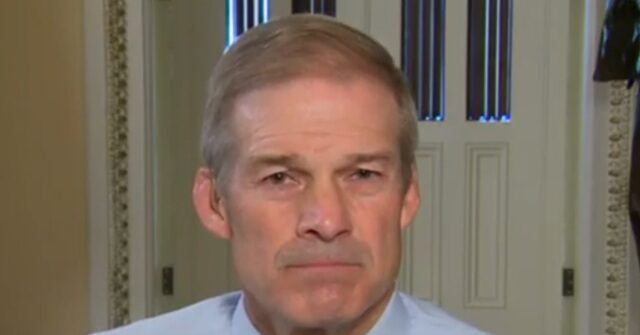
Rep. Jim Jordan (R-OH) argued that a wave of new economic data shows Republicans delivered on their 2024 campaign pledges, pointing to record business formation and a manufacturing surge during an appearance on Fox Business Network’s “The Evening Edit.”
Appearing alongside host Elizabeth MacDonald, the House Judiciary Committee chairman was asked to respond to what MacDonald described as “optimistic news” from Treasury Secretary Scott Bessent. She rattled off a series of statistics: nearly 580,000 new business applications in July, which she said was the highest monthly total in a series dating back to 2004 and up 23.4 percent from the same month a year earlier. MacDonald noted the figure surpassed the pandemic-era surge, and said the U.S. now has an unadjusted total of nearly four million new business formations during President Trump’s second term. She also pointed to manufacturing profits climbing by two-thirds since last year to nearly $144 billion.
Jordan said the picture extended to the labor market as well. “Not to mention the jobs growth we saw last month,” he said, citing roughly 167,000 new jobs on top of upward adjustments to prior months. “So jobs are up, business creations are up, everything is up.”
He was quick to add a caveat, acknowledging that voters are still feeling pressure at the grocery store and elsewhere. “But I understand for American families things still cost a little too much, and we’re dealing with that,” Jordan said.
A closing argument built on 2024 promises
The bulk of Jordan’s message was an appeal to the campaign promises Republicans made two years ago — a checklist he said has now been fulfilled. “We’ve got to go also tell the American people we did what we said we were going to do in 2024,” he said. “You elected us to secure the border, we did it. You elected us to cut your taxes, we did it at record levels.”
He added that Republicans had also followed through on changing the terms of the social safety net, saying: “You elected us to say to individuals in our welfare systems, if you’re able-bodied, guess what? You’re going to have to work now if you’re going to get American tax dollars.”
Jordan framed that record as the foundation for a broader political argument. “We understand the cost of things, and we also got to talk about how great this country is,” he said. “If we do that, I think we can stop the left and win.”
Mixed signals beneath the headline numbers
The numbers Jordan and MacDonald highlighted sit alongside a more complicated economic picture, as is often the case during any administration’s midterm stretch. Business applications have long been watched as a leading indicator of entrepreneurial confidence, though they measure filings rather than the number of businesses that ultimately open their doors and hire. Similarly, manufacturing profits are a measure of corporate earnings rather than a direct gauge of factory hiring or wage growth for workers on the line.
The 167,000 jobs Jordan cited is also modest by historical standards. Monthly payroll growth in the range of 150,000 to 200,000 is generally seen by economists as enough to absorb new entrants into the labor force but not the kind of explosive expansion that characterized the strongest stretches of the post-pandemic recovery. The upward revisions to prior months that Jordan mentioned have been a recurring feature of the data in recent years, alternately boosting and trimming the headline figures.
Jordan’s decision to lead with the affordability caveat reflects a recognition among Republicans that, despite positive aggregate indicators, consumer sentiment has remained stubbornly tied to the prices Americans see at checkout. Inflation has cooled from its peak, but the cumulative rise in the cost of living since 2021 remains a central theme in both parties’ messaging heading into the next election cycle.
What Republicans are selling — and what they’re up against
Jordan, a founding member of the House Freedom Caucus who has served as Judiciary chairman, is among the most prominent Republican voices in Congress and a frequent surrogate for the party’s economic message. His appearance on Fox Business is part of a broader effort by GOP lawmakers to move past intraparty fights over spending and legislative tactics and toward a unified closing argument based on their 2024 platform.
The “stop the left and win” formulation Jordan used points to the political stakes: control of Congress and the White House agenda will be shaped by whether voters credit Republicans for the economy’s bright spots or punish them for the lingering strain on household budgets. His answer — acknowledge the pain, then pivot to promises kept — is a template that is likely to be repeated by Republican candidates across the country.
Democrats, for their part, are expected to argue that the same policies Jordan celebrates have contributed to rising costs, and that tax cuts and welfare work requirements disproportionately benefit wealthier households while squeezing working families. The debate over who is to thank — or blame — for the economy’s direction is already taking shape.
For now, Jordan’s message was blunt: the party made promises in 2024 and, in his telling, has now checked them off the list. Whether voters accept that accounting is a question that will only be settled at the ballot box.
Source: www.breitbart.com — https://www.breitbart.com/clips/2026/09/11/jim-jordan-we-did-what-we-said-we-were-going-to-do-in-2024/