
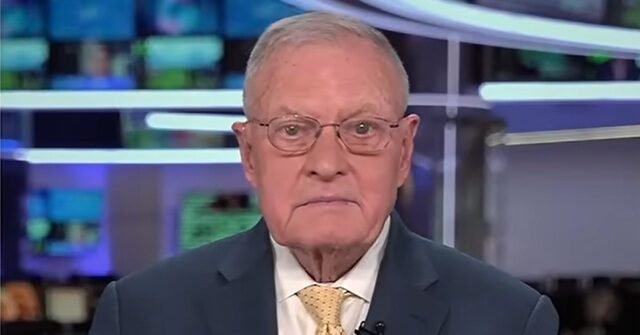
Rising diesel and oil prices are being driven by disruptions in the Middle East rather than by Russia’s war in Ukraine, former Trump National Security Adviser and former Trump envoy Keith Kellogg said Friday, adding that he parts company with the president on the question of what is behind the cost increases.
Speaking on Fox Business Network’s “Kudlow,” Kellogg pointed to shipping data tracking flows through the Persian Gulf as the clearest explanation for the pressure on fuel prices, according to Breitbart News, which reported on the segment.
‘It’s All What’s Happening in the Gulf’
Kellogg said the “real problem with diesel prices is not Zelensky in Ukraine” and not the Russia-Ukraine conflict at all. Instead, he argued, the issue is “all what’s happening in the Gulf.”
He directed viewers to Kpler, a firm that tracks commodity shipping, saying the graphs the company has published show where the bottleneck actually sits — in the diminished flow of tankers through the Strait of Hormuz, the narrow waterway through which a substantial share of the world’s seaborne oil passes.
“And if you look at the graphs that have come out of Kpler, you can see where the real problem is, with not having good transit through the Strait of Hormuz,” Kellogg said.
A Break With the President
Later in the appearance, Kellogg made clear he was not simply offering a technical correction but registering an open disagreement with the president’s framing of the price spike.
“I respectfully disagree with the president on this,” he said. “Look, those oil prices are not because of Zelensky in Russia.”
He went on to describe Russia’s role in the energy picture in sharply critical terms, calling what Moscow is doing “really cynical.”
The remarks place a veteran of Trump’s national security team at odds with the White House’s public explanation for fuel costs — a notable split given Kellogg’s long service in the administration, first as national security adviser during Trump’s first term and later as a special envoy.
Why the Strait Matters
Kellogg’s argument rests on a straightforward supply-chain point: when transit through Hormuz is constrained, barrels that would normally reach global markets are delayed or rerouted, and refined products like diesel — which have their own tight supply dynamics — feel the effect at the pump.
His reference to Kpler data suggests the case he is making is empirical rather than political, built on vessel-tracking evidence of reduced flows rather than on rhetoric about the war in Eastern Europe.
The comments also implicitly reject a common political argument that pins energy costs on U.S. support for Kyiv. By naming the Gulf as the source of the problem, Kellogg shifts the debate away from Ukraine aid and toward Middle East transit capacity.
A Familiar Voice on Foreign Policy
Kellogg has been among the more visible surrogates defending Trump’s foreign policy positions in television appearances, which makes his explicit disagreement on this point all the more noteworthy. The “Kudlow” segment put the split on the record in the president’s own preferred venue — a friendly Fox Business hour — rather than in a print interview or a think-tank panel.
Whether the administration adjusts its messaging on energy prices in response was not immediately clear from the segment.
The interview was reported by Breitbart News’ Ian Hanchett.
Source: www.breitbart.com — https://www.breitbart.com/clips/2026/10/17/kellogg-diesel-oil-prices-are-up-due-to-middle-east-not-zelensky/