
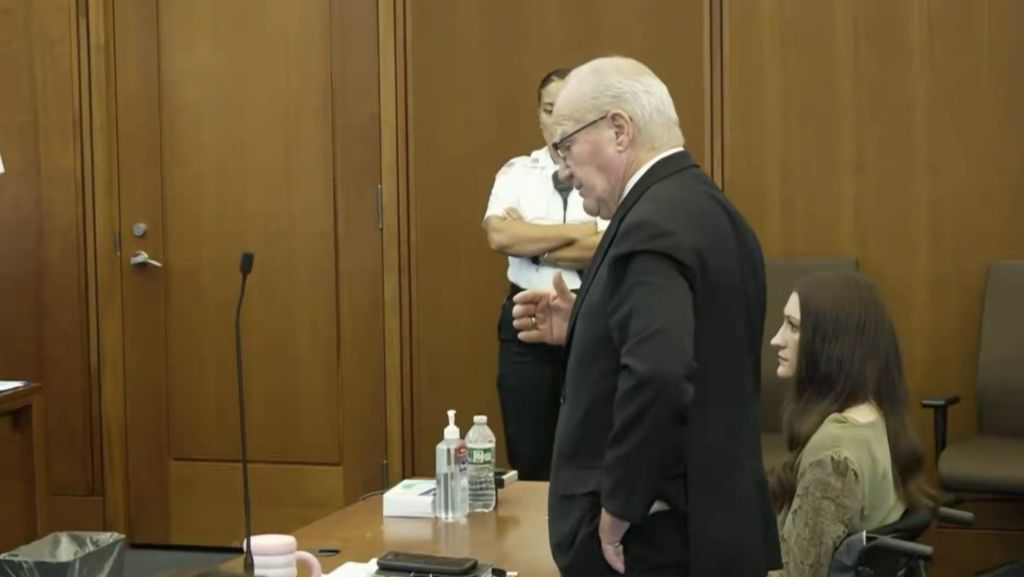
A Massachusetts judge declared a mistrial Friday in the case of Lindsay Clancy, the mother who admitted to killing her three young children, after a single juror prevented a unanimous verdict. The development itself was dramatic. But the response from Clancy’s defense attorney, Kevin Reddington, may have been even more so—and it’s fueling a debate about whether livestreaming trials is turning the justice system into performance art.
According to The Federalist, Reddington appeared to suggest during the proceedings that the holdout juror might be bigoted against disabled persons. Clancy uses a wheelchair after jumping from a window in an apparent suicide attempt following the killings.
“I further raise the issue of the American[s] with Disabilities Act. I believe that this is a situation where there is a clear and present danger that this individual, for some reason — what it is we don’t know — but is taking a position that’s intractable, regardless of proof beyond a reasonable doubt,” Reddington said, per the report.

There is no evidence the juror’s holdout had anything to do with Clancy’s disability, The Federalist noted. The juror may simply have found murder wrong or had doubts about the case. But the suggestion itself illustrates a growing dynamic: with cameras in the courtroom and clips circulating online, lawyers are increasingly playing to a third audience beyond the judge and jury—the internet.
The Case That Divided the Internet
Clancy has been on trial for the 2023 murders of her three children: Cora, 5, Dawson, 3, and Callan, 8 months. Neither side disputes the basic facts: she strangled the children with exercise bands before cutting herself and jumping out of a window. Her defense has argued she should not be held criminally responsible because she was suffering from postpartum psychosis at the time.
After several days of deliberations, the jury could not reach a unanimous decision, forcing the judge to declare a mistrial. The case had already become a flashpoint online, with social media splitting into two camps—those who believe Clancy is a cold-blooded killer and those who view her as a victim of mental illness.

The Federalist’s report suggests that the livestreaming of the trial intensified this divide, as constant clips from the courtroom fed the outrage machine. Attorneys, once focused solely on persuading the people in the room, now have to consider how their words and actions will play on TikTok, X, and potentially in future true-crime documentaries.
A History of Courtroom Spectacle
Reddington himself appears to have embraced the celebrity-adjacent status that cameras provide. According to The Federalist, he was photographed posing with Clancy supporters outside the courthouse, and the BBC reported that during the trial he “slammed a stack of papers” and “raised his voice.”
This is not the first time Reddington has turned a courtroom into a spectacle. The BBC notes he has a history of such behavior, including a 1989 case in which, defending a woman accused of killing her boyfriend, he reportedly threw a pair of ninja stars across the courtroom.

While lawyers are expected to zealously advocate for their clients, the incentive structure changes when cameras are rolling. Outlandish statements that would once have been confined to a courtroom transcript now become viral moments, shared and dissected by millions.
Cameras in Court: A Cautionary Tale
The Federalist draws a parallel to televised congressional hearings, which have devolved into what the outlet’s Shawn Fleetwood called “performative slugfests.”
“Representatives and senators alike aren’t focused on debating great matters of public policy so much as they are trying to one-up one another and grab coveted soundbites for cable news and social media,” Fleetwood wrote. “There is no reason to believe putting cameras in the courtroom would yield a different result.”
The Clancy case, with Reddington’s eyebrow-raising ADA comment, appears to be a case in point. Whether the mistrial leads to a retrial—and whether cameras will be allowed to broadcast it—remains to be seen. But the episode raises a pressing question: as courtrooms go live, are we trading justice for clicks?
Source: thefederalist.com — https://thefederalist.com/2026/09/04/livestreaming-trials-emboldens-lawyers-like-lindsay-clancys-to-act-out-for-clicks/