
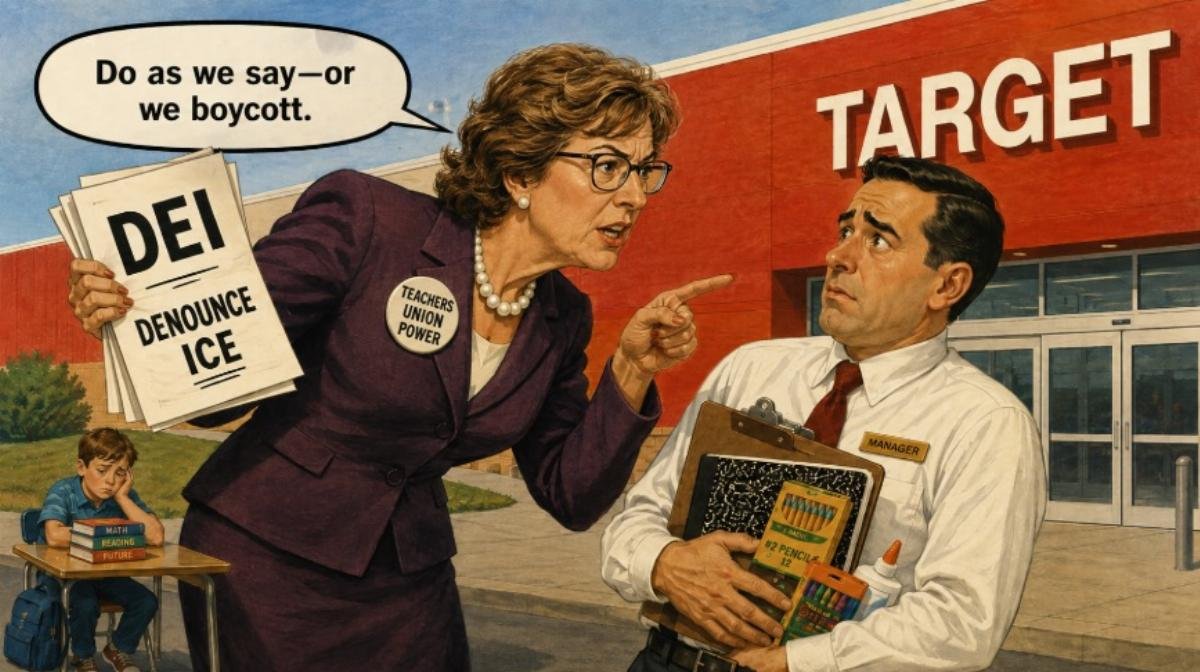
When Target began stepping back from its embrace of progressive diversity, equity, and inclusion (DEI) policies, it may have hoped for a quiet retreat. Instead, it has drawn the focused ire of one of the nation’s largest teachers’ unions — and a demand that goes well beyond corporate hiring practices.
According to a report from American Thinker, Randi Weingarten, president of the American Federation of Teachers (AFT), has escalated her campaign against the big-box retailer. The union is now pressing Target to publicly condemn U.S. Immigration and Customs Enforcement (ICE) operations, particularly in Minnesota, or face an organized boycott just before the crucial back-to-school shopping season.
This latest confrontation marks a significant intensification of a dispute that began last September. At that time, Weingarten reportedly flexed the union’s muscles against Target over DEI policy rollbacks, demanding that AFT’s membership boycott the store. By March 2026, according to the report, Target had caved to those initial demands. But Weingarten made clear that concession was only the opening act.
Now, in a letter to Target CEO Michael Fiddelke, Weingarten has laid down a new marker. The union is demanding that Target publicly call out what it terms ICE’s “continued abuses and long-term harm to the Twin Cities.” If Target refuses, the AFT will draft an official resolution urging its 1.8 million members to “shop local” and shift billions of dollars in annual school supply purchases elsewhere.
A Union’s Declining Grip
The escalation comes at a precarious time for teachers’ unions. A new report from the Fordham Institute, cited in the American Thinker piece, indicates that union influence is waning nationwide. The report used 59 different measures — including budgets, membership numbers, political wins and losses, and survey data on perceived strength — to reach its conclusions.

The findings paint a picture of an institution losing its foothold. The percentage of K-12 teachers who are union members fell in 45 states plus the District of Columbia over the past decade. Teachers’ unions’ share of contributions to state-level political parties has declined in 34 states. And crucially, 69 percent of survey participants did not list a teachers’ union as the most influential group in their state’s education politics.
This erosion of power may explain the aggressiveness of the current campaign. The report’s authors suggest that unions are weakening in influence, a dynamic that could push leadership toward more confrontational tactics to demonstrate relevance.
Beyond Bargaining: The Politics of Pressure
Critics of the AFT’s approach argue that the union has drifted far from its original mandate. The commentary frames today’s teachers’ unions as entities that “reject accountability and merit-based systems; block school choice and competition; promote bureaucratic inefficiencies; and have politicized the curriculum.”
The Target dispute, however, represents a departure from education policy altogether. By leveraging the union’s purchasing power for political statements on immigration enforcement, the AFT is engaging in what the source labels “economic extortion” — using the threat of a massive boycott to compel a private company to adopt a specific political stance.
The strategy capitalizes on the scale of school supply spending. With 1.8 million members, the AFT controls a significant share of institutional purchasing for classrooms across the country. The threat to redirect “billions of dollars” of that spending is a substantial financial weapon.

Target, for its part, found itself in an unenviable position. After initially acquiring the DEI policies at significant cost, the retailer’s attempt to walk them back triggered union retaliation. The sequence suggests that for the AFT, the fight was never about any single policy but about asserting the union’s power to dictate corporate behavior.
Mixed Motivations and a Shifting Landscape
The backdrop of declining union membership adds another layer of complexity. The source suggests that following the revelations during the Covid-19 pandemic about teachers’ performance, curriculum decisions, and treatment of students, one might have expected teachers to reassess their priorities. Instead, the report claims, union leadership “doubled down, demanding more restrictions on student masking and closing down classrooms.”
Now, with the attacks on Target and the new demands regarding ICE, the trajectory appears to be toward more extreme and damaging actions. The source argues that these moves are driven by the union’s internal demands, with less regard for the public interest or the students and families unions were originally created to serve.
There was a time, the commentary notes, when unions were “invaluable to protecting the health and well-being of workers,” fighting for living wages, decent facilities, safe environments, and restrictions on child labor. The accusation leveled now is that these unions have “outlived their usefulness” — that children are no longer a high priority.
The power dynamic is the crux of the matter. For Weingarten and the AFT, the Target campaign is a demonstration of force. For Target, it presents a strategic dilemma: capitulate to the latest demand and face the prospect of endless future concessions, or resist and risk losing billions in school supply revenue.
For observers, the dispute raises broader questions about the role of unions in the modern economy. When a teachers’ union uses its economic might to force a retailer to take a position on federal immigration enforcement, it moves beyond traditional collective bargaining into a different realm of political activism. The outcome of this standoff may well determine whether other corporations see similar pressure campaigns as a credible threat, or as a bluff that can be called.
Source: www.americanthinker.com — https://www.americanthinker.com/blog/2026/08/randi-weingarten-is-using-economic-extortion-against-target/