
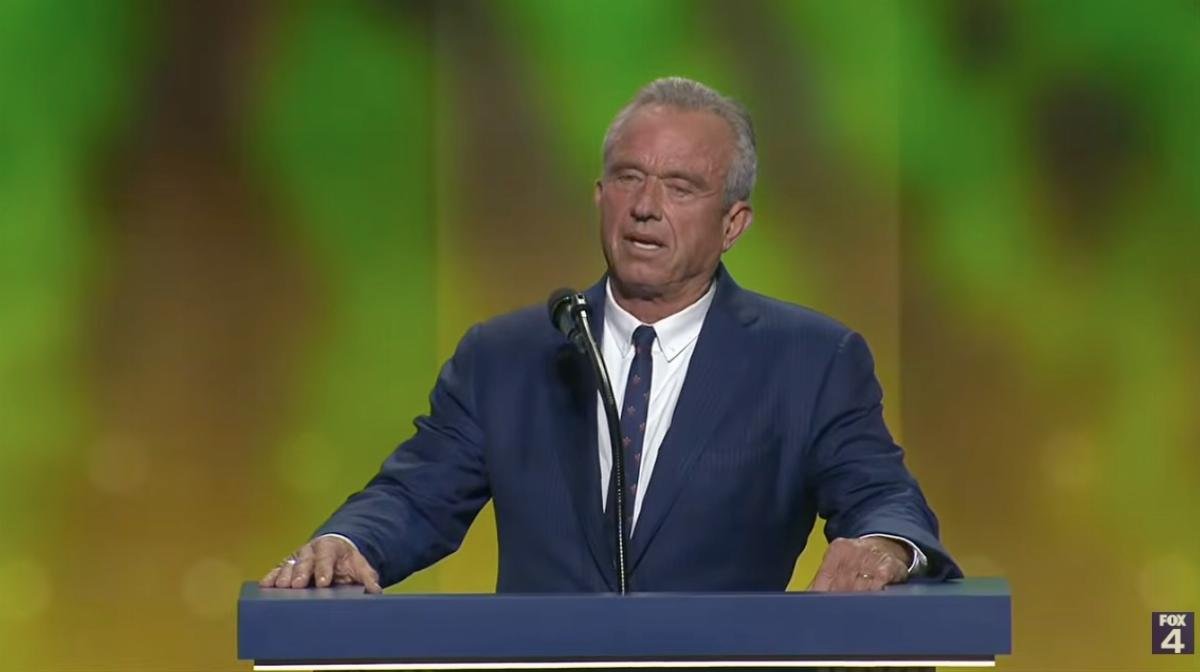
Secretary Robert F. Kennedy Jr. delivered what American Thinker’s Silvio Canto Jr. called his favorite speech of the midterm GOP convention — a speech that drew sharp lines between the Democratic Party of his family’s legacy and the party as it exists today.
According to Canto’s account, Kennedy wasted little time before landing his first blow: “Neither my father nor my uncle would recognize the Democratic Party today.” The line, Canto writes, “got some Democrats angry” — prompting his wry hope that “they still invite Bobby to the Kennedy Thanksgiving this year.”
The speech, as described by Canto, was less a policy address than an indictment of the opposition party’s identity. Kennedy argued that Democrats had jettisoned their traditional values in favor of a single unifying principle. In his words, they offered Americans “only one policy… the unbridled, sociopathic, and blind hatred of a single man, Donald J. Trump.”
Canto highlights that passage as the core of Kennedy’s argument: that Trump hatred alone was treated as sufficient to win elections, and that in the process, Democrats “abandoned accountability and made our government a predatory organism of monumental incompetence and corruption.”

A Party That Lost Its Way
The emotional center of Kennedy’s remarks, as Canto recounts them, was a lament rather than an attack. “The Democratic Party, in short, lost its way,” Kennedy said. “I mourn the fact that neither my father nor my uncle would recognize the Democratic Party of today.”
From there, Kennedy framed the current political divide as something beyond the traditional left-right spectrum — casting it instead as a contest between “sane and insane” and between “common sense and communism.”
He pointed back to his own April 2023 presidential campaign, describing it as an attempt to “summon my party back to its bedrock values.” That effort, he argued, revealed a party that had “lost faith in American voters and utterly ironically lost faith in American democracy.” Convinced they would lose at the ballot box, Kennedy claimed, Democrats “unveiled a lawfare strategy to prevent an election from occurring.”
Kennedy’s specific allegation was that the lawfare was not limited to Trump. “They sued every candidate who dared to run against Joe Biden,” he said, naming Dean Phillips, Marianne Williamson, and Cornel West. As for Trump himself, Kennedy said Democrats “sued Donald Trump 50 times in 38 states to remove him from the ballot.”
Canto acknowledges the likely reception of such claims among Democrats — some, he writes, “will avoid reality and call those the words of a traitor” — but urges readers to look past partisan reflexes and evaluate the substance.
Not Alone, Canto Argues
For Canto, Kennedy’s diagnosis of Trump Derangement Syndrome as the party’s last remaining fuel is validated by other Democratic voices. He points to Senator John Fetterman’s agreement on the party’s “growing anti-Israel posture” and former Senator Joe Manchin’s warnings about “left-wingers running the Biden administration” as evidence that Kennedy is not an isolated apostate.
Canto’s speculative conclusion is that “many other Democrats agree with Secretary Kennedy but don’t want the primary” — a nod to the political cost of dissent within the party.
He also offers a note of friendly advice to Kennedy: “Keep talking, Bobby. You touched a nerve, and you need to keep talking.”
The speech’s resonance, at least within the convention hall and among conservative commentators like Canto, lies less in any new policy proposal than in the rhetorical power of a Kennedy invoking his family’s name against the party his father and uncle once led. Whether that argument lands with Democrats — or merely hardens existing divisions — remains an open question. What Canto makes clear is that, in his view, Kennedy found the audience and the moment that his message required.
Source: www.americanthinker.com — https://www.americanthinker.com/blog/2026/09/anybody-here-seen-my-old-friend-bobby/