
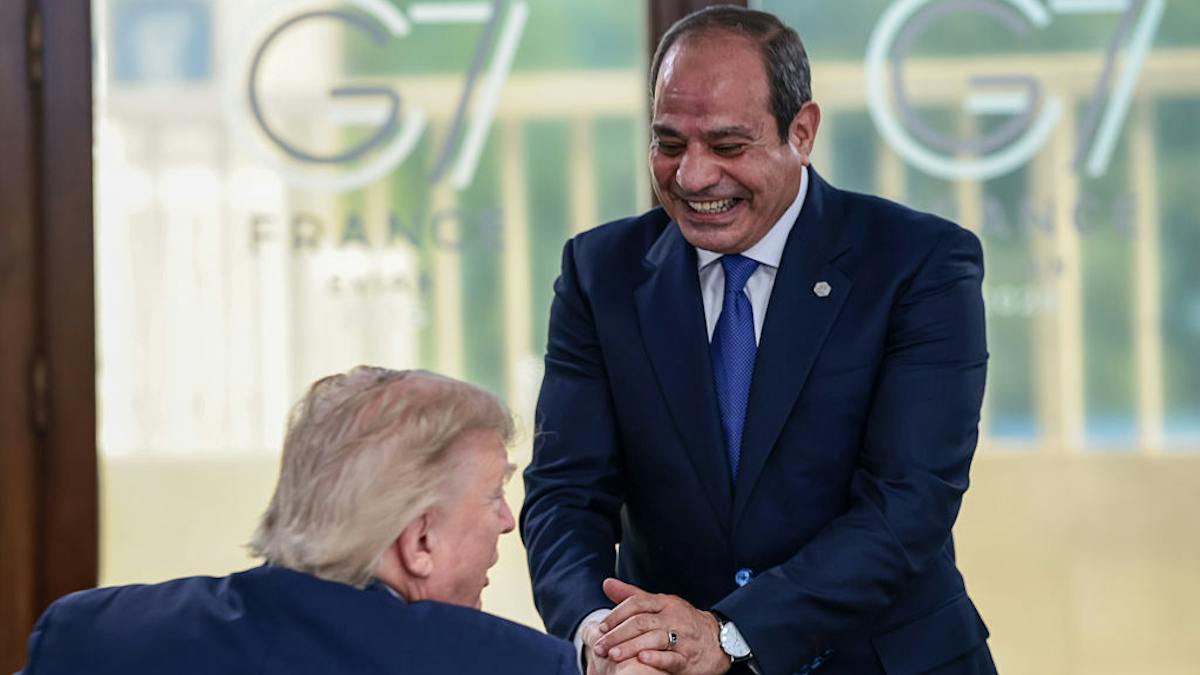
Secretary of State Marco Rubio approved $320 million in military aid to Egypt on Thursday, clearing the way for Cairo to purchase American-made weapons while waiving human rights conditions that normally govern foreign military financing, according to reporting by The Daily Wire.
The money forms part of Washington’s annual $1.3 billion assistance package to Egypt. In announcing the decision, the State Department framed the aid as essential to U.S. national security interests, crediting President Abdel Fattah el-Sisi’s government with serving as a diplomatic middleman in the regional war with Iran.
The timing, though, has drawn scrutiny. The funds are being released shortly after Egypt concluded joint air force exercises with China — a first-of-its-kind drill that ran from August 22 to September 7 and marked the initial deployment of Beijing’s heavyweight J-16 fighters to the African continent.
A reward, or a risk?
Washington’s decision effectively bypasses longstanding congressional restrictions tied to Egypt’s human rights record, allowing Sisi’s military to shop for American hardware without those conditions attached. State Department officials described the move as critical to maintaining influence in a volatile region.
Security analysts and regional experts, however, told The Daily Wire they worry the approval could boomerang. Egypt’s military has spent years building up capabilities that go well beyond a defensive posture, and the joint drills with China suggest Cairo is hedging its bets between Washington and Beijing.
The China-Egypt exercises are particularly notable because they represent an expansion of Beijing’s military footprint into a region where the U.S. has long been the dominant outside power. Egypt has historically been one of the largest recipients of American military aid, a relationship built on the 1979 Camp David peace treaty with Israel.

Smuggling tunnels and a Sinai insurgency
Critics of the aid package point to a deeper set of concerns that predate the China drills. For years, Egyptian authorities were accused of turning a blind eye to Hamas’ network of cross-border smuggling tunnels along the Philadelphi Corridor — the narrow strip of land separating Gaza from Egypt’s Sinai Peninsula. That supply chain funneled high-grade weaponry into Gaza, and analysts say it helped set the stage for the October 7, 2023, attacks on Israel.
The Sinai has also been a base for violent jihadist activity. After the 2011 Arab Spring, the region was overrun by Ansar Bait al-Maqdis, an extremist group that later pledged allegiance to ISIS under the banner ‘Wilayat Sinai.’ The group claimed responsibility for downing a Russian airliner over Sinai in 2015, killing all 224 people aboard, and for a 2017 mosque attack that left more than 300 worshippers dead.
Those episodes remain a backdrop to any discussion of Egypt’s military role in the region, and they are central to arguments that Washington should attach tighter strings to its aid.

An army built for more than defense
Military experts who spoke with The Daily Wire described Egypt’s armed forces as increasingly configured for offensive operations rather than territorial defense. Despite an economy battered by soaring inflation, fuel price hikes of up to 30%, and roughly $10 billion in lost Suez Canal revenue, Cairo has continued to acquire advanced fighter jets, heavy tanks, attack drones, and a growing Mediterranean naval fleet.
Inside Sinai, Lt. Col. Eli Dekel, a former IDF intelligence officer, has warned that Egypt has quietly violated its peace agreements with Israel by deploying tanks directly to the border and digging approximately 60 large underground military bunkers — structures that could conceal strategic offensive weapons from airstrikes.
Adding to the tension, Egyptian state media and military officials have aired videos targeting Israeli tanks and openly discussed preparing the army for a potential confrontation.
What Washington gets in return
The State Department’s stated rationale hinges on Egypt’s role as a mediator. Sisi’s government has positioned itself as a go-between in the broader regional conflict involving Iran, and U.S. officials argue that maintaining the aid relationship preserves leverage in those negotiations.
Whether that calculation holds is an open question. The $320 million release comes at a moment when Cairo is simultaneously deepening military ties with Beijing, and when its own domestic security record — from the smuggling corridors to the Sinai insurgency — remains a source of friction with both Israel and the U.S. Congress.
For now, the aid is approved and the money is on its way. The debate over whether it buys influence or emboldens a partner with other options is likely to continue well past this week’s announcement.
Source: www.dailywire.com — https://www.dailywire.com/news/u-s-ushers-320-million-in-military-aid-to-country-that-just-completed-exercises-with-china