
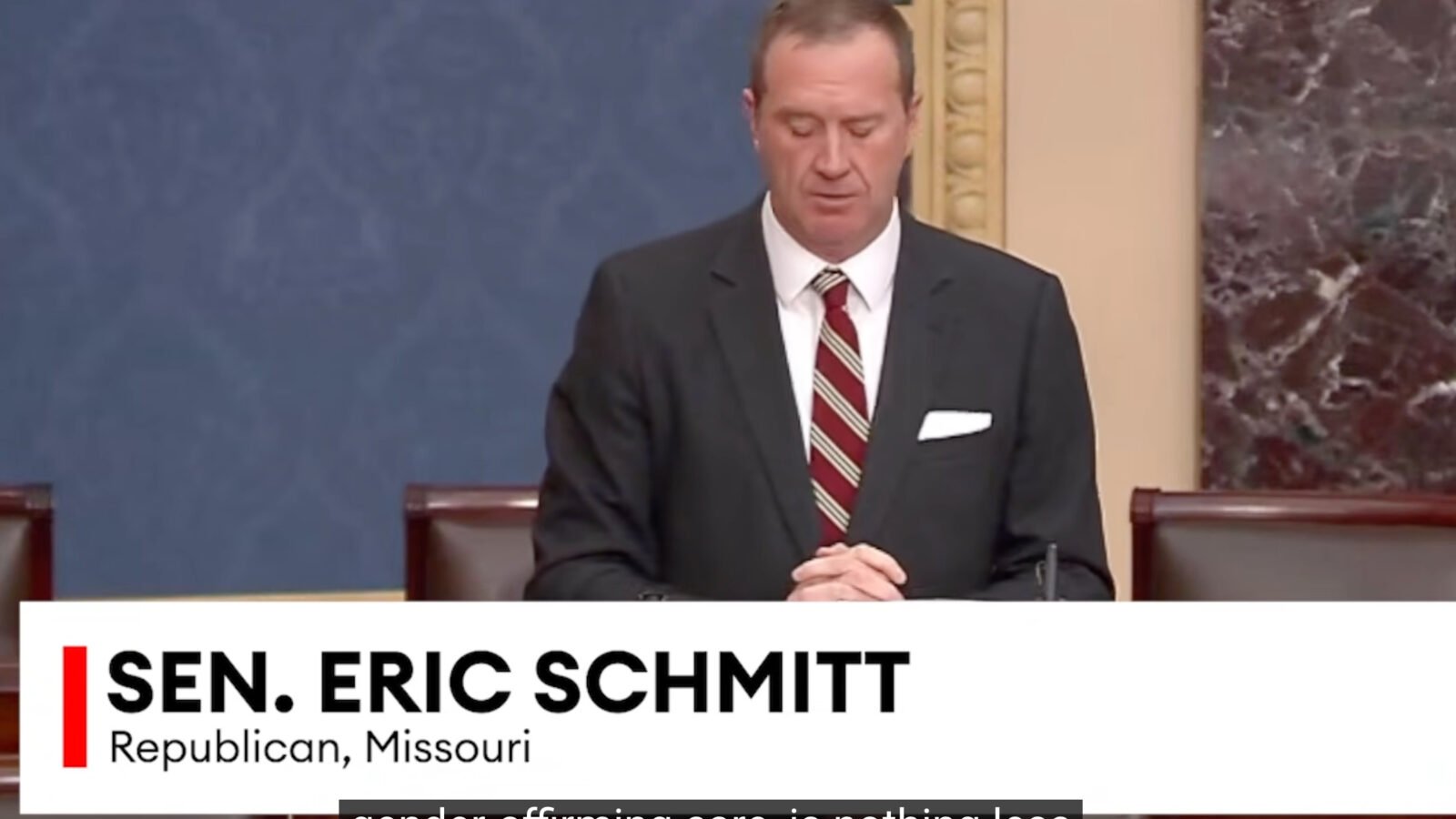
Sen. Eric Schmitt, a Missouri Republican, has introduced legislation aimed at preventing states and social service agencies from removing children from families that decline to affirm a child’s transgender identification. The bill, titled the Yaeli Martinez Child Protection Act of 2026, was first reported by The Federalist and takes its name from a 19-year-old California woman who, according to the outlet’s account, died by suicide after being socially transitioned by her public school as a minor and removed from her family home by child protection caseworkers.
The measure would bar federal funding administered under the Child Abuse Prevention and Treatment Act from flowing to states, tribes, and organizations that participate in the removal of children from parents who do not affirm what the bill language calls a child’s supposed transgender identity. CAPTA is a long-standing federal grant program that supports state child protective services and prevention efforts, giving Congress a funding lever over state agencies through the conditions it attaches to the money.
What the bill would do
Beyond the funding restriction, the text makes an explicit declaration of policy: that raising a child according to his or her sex is not abuse. It states that removal from fit parents is contrary to the best interests of children, creates trauma, damages familial bonds, and exposes children to well-documented risks in state custody. It further asserts that children have suffered great harm and even died after being separated from loving families by the state for what it describes as sex-rejecting interventions.

The legislation would add to federal law a statement that a parent has the right to affirm a child’s sex, including the refusal of the provision, facilitation, funding, authorization, or permission of any sex-rejecting intervention for the child. It would also codify a parent’s right to refuse the use of pronouns or titles that do not correspond to the child’s sex.
In addition, the bill would create a private right of action allowing parents to sue in federal court over limitations on parental rights by any entity that attempts to socially transition children or perform surgical or hormonal interventions without parental consent. The cause of action explicitly extends to the use of pronouns or titles inconsistent with a child’s sex.
Schmitt’s statement
In a statement provided by his office, Schmitt condemned what he called radical gender ideology and what he characterized as an ongoing attack by blue states on family relationships.

“This ideology is inflicting irreversible treatments and procedures on children, but parents in blue states who disagree are punished and even torn from their own kids they are trying to protect,” Schmitt said. “It’s disgusting these states want to use the welfare state to separate families and we must defend parents’ right to choose what’s best for their own children.”
The bill also includes language stating that a parent, legal guardian, caregiver, foster parent, prospective foster parent, or prospective adoptive parent has a right to be free from discrimination or adverse state action for affirming or intending to affirm a child’s sex.
Advocacy backdrop
The parental rights organization Our Duty has argued that preventing the state removal of children who declare a transgender identity from their family homes is an urgent priority. In a statement cited in the coverage, the group said ending what it describes as the ideological weaponization of child protective services is one of its most important fights.

The push reflects a broader, ongoing confrontation between Republican-led efforts to enshrine parental authority over medical and social decisions for minors and Democratic-led states that have moved in the opposite direction, adopting policies that direct agencies to affirm a child’s declared gender identity, in some cases regardless of parental objection. Those state frameworks have been the subject of litigation and legislative battles in several states, and the question of when a disagreement over a child’s gender identity should trigger state intervention is at the center of the dispute Schmitt’s bill seeks to address.
Whether the legislation can advance is a separate question. As a bill introduced by a senator in the minority party, it would need Democratic support or a change in chamber control to move through the Senate, and its private right of action and funding restrictions are the kind of provisions likely to draw immediate legal and political challenges. Similar efforts at the state level have produced court fights over parental rights statutes, with opponents arguing they invite discrimination against transgender youth and supporters contending they restore parents to their proper role.
The bill’s name gives it a specific and emotionally charged anchor. According to the reporting, Yaeli Martinez was socially transitioned by her school while a minor and later taken from her family’s home by child welfare caseworkers. She died by suicide at 19. Her case has been promoted by conservative outlets and parental rights groups as an illustration of what they describe as the harm caused when agencies override parental judgment.
That framing is contested. Advocates for transgender youth and some child welfare experts argue that parental rejection is itself a major risk factor for young people and that state agencies intervene only in cases involving abuse or neglect, not simple disagreement. The Federalist’s account, and the bill’s text, reflect the opposite premise: that removal from a fit parent over a gender-identity dispute is a form of state coercion that the federal government should no longer fund or permit.
The measure lands in a policy landscape where the federal government has limited direct authority over child removal decisions, which are generally made by state and county agencies under state law. That is why the bill’s primary mechanism is a spending condition rather than a direct prohibition, conditioning CAPTA funds on state conduct. The private right of action is the other enforcement pathway, giving parents a federal courthouse remedy rather than relying solely on agency action.
Source: thefederalist.com — https://thefederalist.com/2026/09/29/republican-senator-introduces-bill-to-protect-the-parent-child-relationship-from-trans-ideology/