
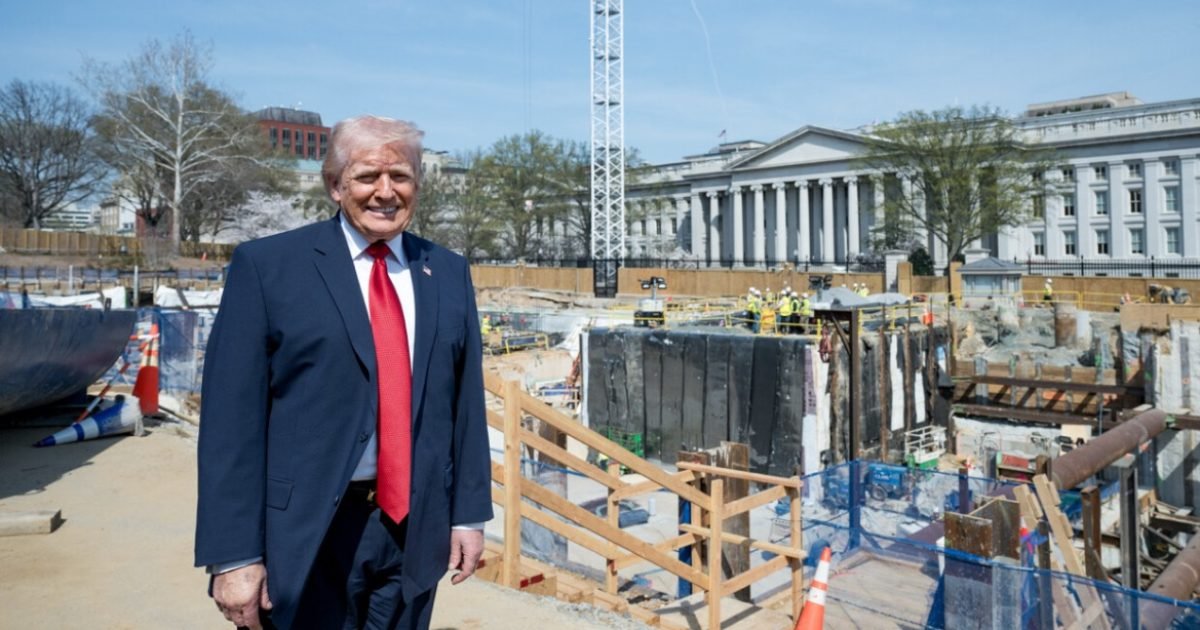
The Supreme Court on Monday cleared the way for President Trump to resume construction of the controversial White House Ballroom, rejecting an injunction request in a 5-4 ruling that split along unexpected lines.
Chief Justice John Roberts dissented, joined by the court’s three liberal justices, according to The Gateway Pundit. Roberts had earlier issued a temporary stay allowing work to continue while the full court weighed the matter, but he made clear he believes the project is on shaky legal ground, describing it as “likely unlawful.”
The decision marks the latest twist in a bitter legal battle between the Trump administration and the National Trust for Historic Preservation, which sued to halt the project earlier this year. A federal judge initially blocked construction, and the D.C. Circuit Court of Appeals subsequently ruled that Congress holds authority over modifications to federal property.
The Trump administration’s Department of Justice asked the Supreme Court to intervene earlier this month, with Solicitor General John Sauer arguing that the White House Ballroom functions as a military asset due to its subterranean bunker and rooftop drone port. The high court’s majority sided with that argument, writing in its order that “the government has also established that it will likely suffer irreparable harm from the district court’s injunction and that the balance of the equities tips in its favor.”
The ruling allows construction to move forward without further interruption, a major victory for the president, who has championed the project since its announcement last summer.
A project decades in the making
When the Trump administration unveiled the White House Ballroom initiative, it framed the project as a long-overdue solution to a persistent logistical problem. “For 150 years, Presidents, Administrations, and White House Staff have longed for a large event space on the White House complex that can hold substantially more guests than currently allowed. President Donald J. Trump has expressed his commitment to solving this problem on behalf of future Administrations and the American people,” the White House said at the time.
According to the administration, the new State Ballroom will add approximately 90,000 square feet of “ornately designed and carefully crafted space,” with a seated capacity of 650 people. That is a significant jump from the East Room’s current 200-person seated capacity. The project also aims to eliminate the need for what the White House described as a “large and unsightly tent approximately 100 yards away from the main building entrance” when hosting major state functions.
Legal fight and political fury
The National Trust for Historic Preservation filed suit against the administration after the project was announced, arguing that the construction would irreparably damage a historic property. A federal judge agreed, blocking the work, and the D.C. Circuit upheld that injunction, citing Congress’s authority over federal property modifications.

President Trump reacted with characteristic fury to the legal challenges, taking to Truth Social to attack the plaintiffs. “These are the TREASONISTS that brought the suit against the Military Complex. They revealed Top Military Secrets!” he wrote, according to The Gateway Pundit.
Trump’s reaction to the ruling
Following Monday’s Supreme Court decision, Trump issued a lengthy statement celebrating the outcome and casting the project as both a patriotic triumph and a gift to the American people.
“I am pleased to report that the United States Supreme Court has just ruled in favor of the Ballroom/Military Complex being built without any further contingency, doubt, or threat. We are living in the Golden Age of America, and this Building will be one of the Greatest ever constructed in Washington, D.C.,” Trump said.
He added that the project, expected to be completed in the summer of 2028, is “under budget and ahead of schedule” despite the litigation. The president also emphasized that the ballroom is “totally funded by Great Patriots and Corporations” and is therefore “a Gift — At no cost to the American Taxpayer.”
Trump took another swipe at the National Trust for Historic Preservation, calling it “the so-called” organization and noting it “is not in any way affiliated with the United States Government.”
What’s next
With the Supreme Court’s ruling, construction work on the White House Ballroom can proceed without the threat of the lower court’s injunction. The decision does not address the underlying legality of the project, which could still face further litigation, but it removes the immediate barrier that had halted work.
The case has drawn attention not only for its subject matter but for the unusual alignment of the justices’ votes. Chief Justice Roberts’s decision to side with the liberal wing on a case involving presidential authority over federal property signals that the legal questions surrounding the project are far from settled. Legal scholars will likely scrutinize the court’s reasoning in the coming days as the broader dispute over Congress’s role in such matters continues to unfold.
For now, the White House is moving forward, and the president is celebrating. “Thank you for your attention to this matter!” Trump concluded in his statement.
Source: www.thegatewaypundit.com — https://www.thegatewaypundit.com/2026/08/breaking-supreme-court-allows-trump-proceed-white-house/