
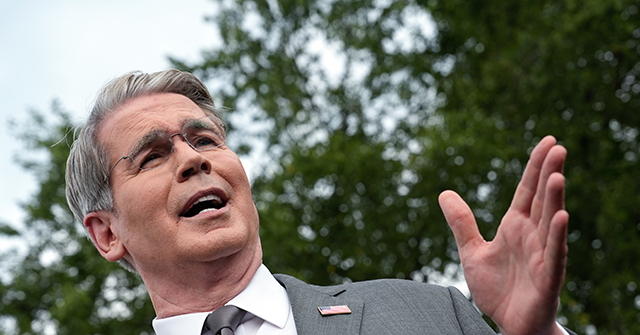
Treasury Secretary Scott Bessent calls himself the “nation’s top bond salesman,” and this week, he rolled out a classic sales tactic: a trade-in offer. The Treasury Department expanded its buyback program, letting investors swap older, less-liquid bonds for newer ones. The market responded by pushing bond prices up and yields down—but not everyone saw it as a healthy move.
Some economic commentators, fueled by what Breitbart describes as “Trump Derangement Syndrome,” quickly declared the sky was falling. But a closer look at the mechanics suggests this is routine debt management, not a desperate intervention.
What Actually Changed
On Wednesday, the Treasury announced it would raise the maximum size of its buyback operations for bonds with 10 to 30 years left to maturity. Starting September 9, the limit jumps from $2 billion to at least $4 billion per operation.
The timing raised eyebrows. The announcement came a day after the 30-year Treasury yield climbed above 5.3 percent—its highest level in 19 years—and in the same week that the U.S. government’s debt topped $40 trillion for the first time. For some, that was enough to cry crisis.
But Breitbart’s business digest pushes back, arguing that rising yields reflect economic strength, not weakness, and that the buyback expansion is simply a tweak to a program launched under Janet Yellen during the Biden administration.
Why the Word “Buyback” Misleads
The word “buyback” might be part of the confusion. When a corporation buys back its shares, the number of shares outstanding shrinks. When the Federal Reserve buys Treasuries, it creates reserves—printing money, in common parlance—and expands its balance sheet.
Neither applies here. The Treasury is retiring specific bonds while continuing to issue others. It’s managing the composition and tradability of the national debt. No new money is created, and there’s no net reduction in debt held by the public.
The Treasury market isn’t a single giant bond. It’s a sprawling ecosystem of thousands of individual securities, each with its own interest rate, maturity date, and CUSIP identifier. When a new 10-year note is issued, it becomes the “on-the-run” security—the benchmark everyone watches and trades. Older bonds become “off-the-run,” losing their status as the market’s focal point.
Liquidity as a Popularity Contest
Liquidity, in this context, is a popularity contest. Investors prefer the bond everyone else trades because they can sell it quickly. Dealers offer tighter bid-ask spreads for the same reason. The cycle works in reverse for older bonds—dealers become less eager to warehouse them, and selling a large block might require breaking it up or accepting a lower price.
The gap is staggering. On-the-run bonds account for less than four percent of Treasury debt outstanding but roughly 65 percent of average daily trading volume.
The buyback program gives the market an escape hatch. Dealers can trade in those older, illiquid bonds for brand new, liquid ones. Here’s how it works: Treasury announces which bonds are eligible, publishes a preliminary list, then a final list on the day of the operation. Dealers get a 20-minute window—typically 1:40 to 2 p.m.—to offer their bonds through the Fed’s FedTrade system.
It’s a reverse auction. In a normal auction, investors compete to buy debt. In a buyback, dealers compete to sell it back. Treasury compares offers with prevailing market prices and the relative value of similar securities, accepting the attractive ones and rejecting the rest.
Importantly, the announced $4 billion is a ceiling, not a commitment. Treasury can buy less—or nothing at all—if sellers demand too much.
Not a Yield-Control Scheme
If Bessent were truly trying to push down the headline 30-year yield, he’d target the current on-the-run benchmark. Instead, the program deliberately excludes those newest bonds, along with securities in high demand in the repurchase market and those critical to Treasury futures contracts.
Those exclusions reveal the true purpose: providing liquidity to older, less-tradable bonds. It’s a service to bond buyers, a way for the government to signal that it will keep the market in its securities liquid. “You don’t have to worry about your bonds going stale,” Breitbart explains, “because you can also go to the reverse auction and trade your old bonds.”
There’s also a potential profit angle. Older securities sometimes trade at a discount to newer ones with nearly identical maturities. Treasury can buy the cheaper old bond and finance itself by issuing a new bond for which investors are willing to pay a liquidity premium. The government’s credit risk hasn’t changed—it’s simply exploiting the market’s preference for liquid assets.
In the end, the buyback expansion is less a bold intervention and more a savvy trade-in deal. The sky, Breitbart insists, is not falling.
Source: www.breitbart.com — https://www.breitbart.com/economy/2026/08/20/breitbart-business-digest-the-sky-isnt-falling-in-the-u-s-treasury-market/