
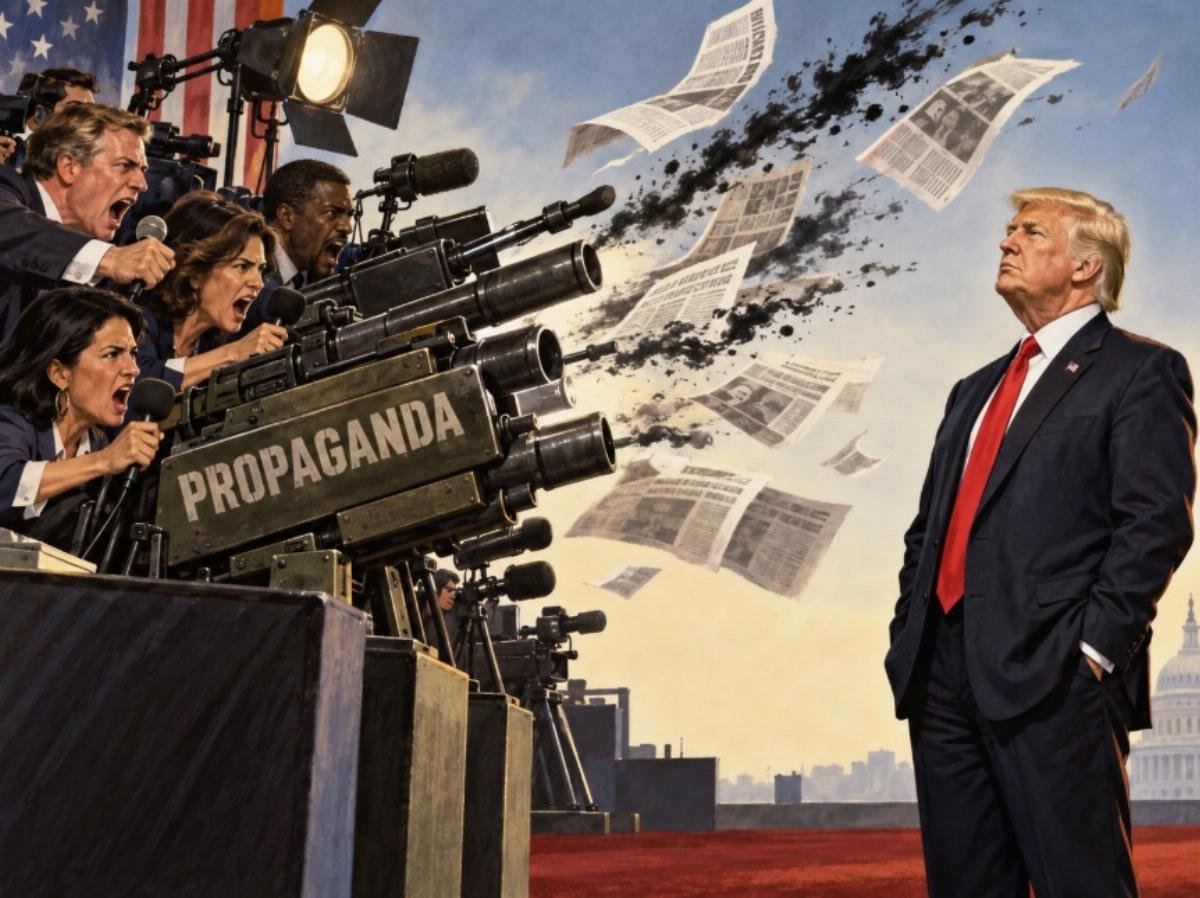
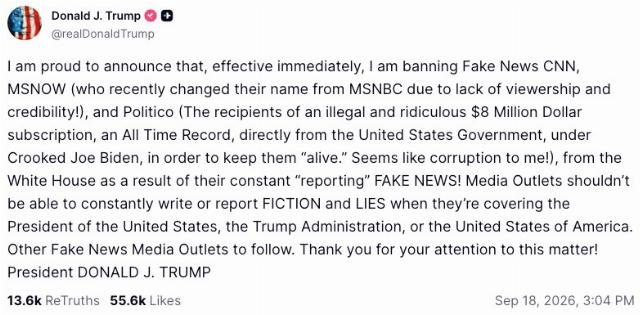
Last Friday, President Trump announced that CNN, MSNBC and POLITICO would be barred from the White House press area. According to the American Thinker’s Andrea Widburg, that announcement became reality within a day — and the immediate backlash from much of the press corps has focused on a First Amendment argument that Widburg argues does not hold up.
Widburg’s commentary, published September 20, does not pretend to be a neutral account of the episode. It is a defense of the president’s decision, and an unusually blunt one. Her core claim: the ban is not about unfavorable coverage, but about outlets she says have repeatedly gotten basic facts wrong when they knew, or should have known, better.
The First Amendment Question
Mainstream outlets responded to the ban by framing it as a constitutional violation, and Widburg dismisses that framing quickly. Her reasoning is narrow and legalistic: the Constitution, she writes, does not mention any inherent right for a specific newsroom to occupy space inside the White House to report on and comment on the news of the day.
That leaves what she calls the only colorable basis for a legal challenge — a claim of illegal viewpoint discrimination. In other words, the argument that these outlets were removed because they oppose Trump and his policies, not because of anything they published.
Widburg contends that reading fails on the facts of what Trump actually said. The president, she notes, never stated that the outlets were being removed because they disagreed with him, and she sees no indication that he is broadly blocking political opponents from White House access. What he offered instead, she writes, was a specific allegation: knowingly dishonest reporting — not the ordinary spinning of facts to suit an editorial view, but the consistent misreporting of facts where the newsroom either knew or should have known the reporting was wrong.
To back that up, Widburg points to a list distributed by Trump’s Rapid Response team, which she describes as cataloging stories that CNN in particular got very wrong. She does not reproduce the full list in her piece.
Errors, or Something More
Widburg anticipates the obvious counterargument. Some of the items on that list, she concedes, could be defended as factually correct and merely subject to heavy, opinion-driven shading. Her argument rests on the remainder — reports she characterizes as manifestly at odds with the facts, where the information was readily available and the newsroom should have caught the error.
From there she draws her conclusion: the White House position, as she reads it, is not that outlets disagreeing with Trump are being expelled. It is that newsrooms she says lie to destroy him are being expelled. She acknowledges that is a serious charge, and treats it as one — describing it as an accusation that these outlets have engaged in an open act of war against the president, leaving him to defend himself.
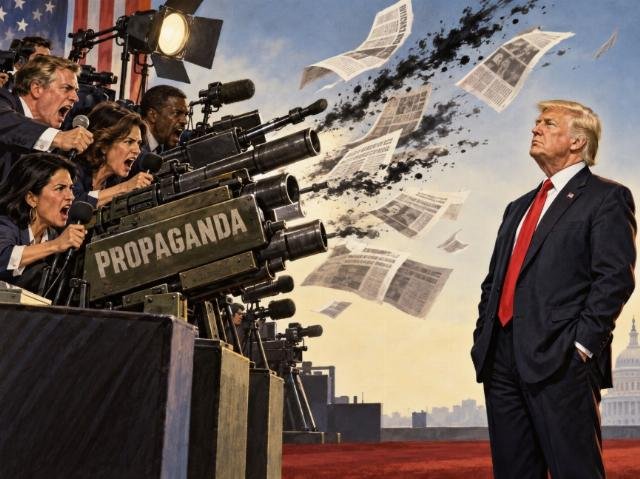
The war framing is deliberate, and Widburg builds it out. She invokes the maxim that the first casualty of war is truth, tracing its entry into English back to World War I, and argues that propaganda and warfare have traveled together ever since — a weapon used to bolster one’s own side and demoralize the other.
Her point is that the same dynamic has turned inward. A healthy skepticism toward government, she writes, is not the same thing as enmity, and she argues the American press has crossed into the latter. Through what she describes as an endless stream of reports that at best underreport good news and overreport bad news, and at worst involve outright fraud, she says the media are using propaganda to undercut a duly elected president.
She takes the argument a step further, describing that conduct as the use of a tool of war inside one’s own country — conduct she characterizes as amounting to a coup against the presidency. She is careful to distinguish that from simply holding strong anti-Trump views and trying to persuade an audience those views are right. The distinction she draws is between persuasion and what she calls a concerted effort to use propaganda to bring down the presidency itself.
Bugs Bunny and the Logic of ‘This Means War’
Having reached that conclusion, Widburg pivots to a lighter register. Rather than lean further on the wartime aphorism, she reaches for a different source of wisdom: Bugs Bunny, and his signature line, “Of course, you realize, this means war.” That, in her reading, is the posture Trump has adopted — the only response she thinks the situation permits.
She closes on an optimistic note about the cartoon rabbit, recalling that while Bugs’s methods were unorthodox, he usually won — a line clearly meant to apply to the president rather than the press.
Whatever one makes of the comparison, the underlying dispute is a real one, and it is not new. Presidents and the press have fought over access, credentials and the rules of the briefing room for decades, and courts have generally treated White House press access as something closer to a privilege granted by the executive than a right the First Amendment guarantees to any particular outlet.
What is new here is the scale and the stated rationale. Banning specific outlets by name, and grounding that ban in an allegation of knowing falsehood rather than mere bias, moves the fight from the familiar terrain of spin and complaint into a claim about intent — one that is much harder to prove and, for that reason, much harder to resolve. CNN, MSNBC and POLITICO have not been given the last word in Widburg’s account; her piece is the argument for the other side, made without hedging.
For readers trying to sort the episode out, the practical question may be less about the Constitution than about standards. If the White House can exclude outlets on a finding of dishonesty, who makes that finding, and by what process? Widburg does not address that question directly. She argues only that the exclusion is justified — and that the outlets in question forfeited their claim to the room the moment, in her telling, they stopped reporting the news straight.
Source: www.americanthinker.com — https://www.americanthinker.com/blog/2026/09/trump-s-valid-take-on-kicking-fake-news-out-of-the-white-house/