
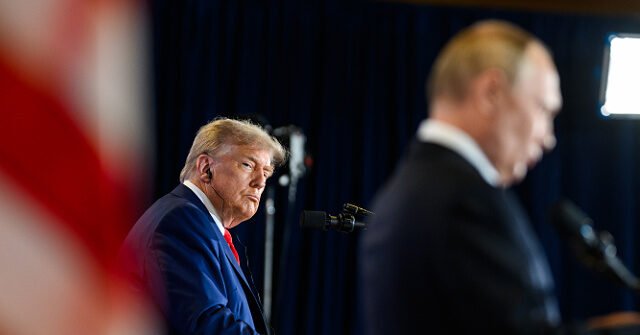
President Donald Trump said Friday that Russia has agreed to supply millions of tons of diesel fuel to the American and global marketplace, following a call with Russian President Vladimir Putin. The announcement, made in a post on Truth Social, lays out an escalating delivery schedule that begins immediately and runs through the fall.
According to Breitbart News, which first reported the announcement, Trump described the conversation as “highly successful” and said the first tranche would total more than 300,000 tons of diesel. Another 500,000 tons are slated for November, followed by 1,000,000 tons “immediately thereafter.” The president added that Russia would then deliver up to 3,000,000 additional tons, a figure he said would depend on the condition of Russian refineries.
The deal arrives at a charged moment. Diesel prices are hovering near a record of roughly $6.50 a gallon, according to the report, and the November midterms are only weeks away. Energy costs have been a persistent political liability for the White House, and the announcement gives Trump a concrete deliverable to point to on the campaign trail.
Tying the Deal to the Strait of Hormuz
Trump framed the arrangement as an extension of American leverage in the Persian Gulf, where U.S. forces have operated throughout the war with Iran. In his post, he pointed to control of the Strait of Hormuz as one half of a two-part strategy to bring down fuel prices.
“Between our TOTAL CONTROL of the Strait of Hormuz, and this great announcement on Russian Energy, Diesel Prices for Americans and, indeed, the World, will be COMING DOWN, IN RECORD NUMBERS, AND FAST!” Trump wrote.
The president singled out farmers, ranchers, and truckers as the constituencies he was prioritizing, groups that rely heavily on diesel for equipment, hauling, and day-to-day operations. He closed the announcement with a line aimed at Tehran: “Iran will not have a Nuclear Weapon!”
The national security and energy dimensions of the deal are difficult to separate. The Strait of Hormuz remains a critical chokepoint for global oil shipments, and any disruption there tends to ripple through fuel markets worldwide. By pairing the Russian diesel commitment with a claim of military control in the Gulf, Trump is presenting the arrangement as a stabilizing force for global energy supply rather than simply a bilateral purchase.
A Sanctions Law Looms
The timing of the announcement is notable because it comes just days before a new sanctions statute takes effect. The Lindsey O. Graham Sanctioning Russia and Iran Act of 2026, which Trump signed into law last month, is set to activate on Oct. 19. The law directs tariffs of up to 500 percent on Russian goods and permits secondary sanctions on countries that purchase Russian fuel.
Many of those provisions, however, can be waived by the president. That flexibility may prove essential: importing Russian diesel at scale would otherwise run directly into the statute’s penalties. The White House has not said publicly whether Trump intends to invoke waiver authority to accommodate the new deliveries.
The sanctions law bears the name of Sen. Lindsey Graham, a longtime advocate for tougher measures against Moscow and Tehran. Its passage reflected congressional pressure to punish Russia for its ongoing war in Ukraine and Iran for its nuclear program. Trump’s new diesel arrangement with Putin, announced before the law even takes effect, underscores the tension between that congressional push and the administration’s desire to manage energy prices.
This is not the first time Trump has adjusted Russian oil policy in response to market conditions. He imposed major oil sanctions on Russia last October but issued waivers this year, citing disruptions from the Iran conflict that drove up energy costs and inflation. Friday’s announcement effectively extends that waiver posture into a formal supply arrangement.
A Week of Energy Moves
The Putin call is the latest in a flurry of energy-related actions from the administration. Last week, Trump said Europe had agreed to release diesel reserves “immediately.” Days later, he signed an order expanding access to tax-exempt red-dyed diesel during a rally in Nebraska.
The red-dyed diesel order is aimed at off-road users such as farmers and construction operators, allowing them to avoid the taxes applied to highway fuel. The Nebraska setting signaled the political audience the White House has in mind as November approaches.
Together, the moves sketch a strategy of pulling supply from multiple directions — European reserves, Russian refineries, and U.S. tax policy — to ease a diesel market that has been squeezed by war and sanctions. Whether the promised tonnage materializes on schedule is another matter. The final 3,000,000 tons remain conditional on the state of Russia’s refining capacity, a caveat that leaves a significant portion of the total contingent on factors outside Washington’s control.
Russian refining infrastructure has been a target of strikes and sabotage during the war, and its output has fluctuated accordingly. Analysts have cautioned that Moscow’s ability to ramp up exports quickly may be limited, though the administration has not addressed those concerns publicly.
For now, the announcement gives Trump a headline ahead of the midterms and a direct counter to Republican and Democratic critics who have argued that the administration has not done enough to bring down fuel costs. It also raises questions about how the new sanctions law can coexist with a live diesel deal, questions the White House will likely face in the days before the Oct. 19 effective date.
The president’s post did not specify pricing terms, the identity of the purchasers, or the mechanism by which the fuel would reach U.S. markets. Breitbart reported that the first shipments would begin immediately, with larger deliveries scheduled through November and beyond.
Source: www.breitbart.com — https://www.breitbart.com/politics/2026/10/09/trump-putin-deal-russian-diesel-fuel-u-s/