
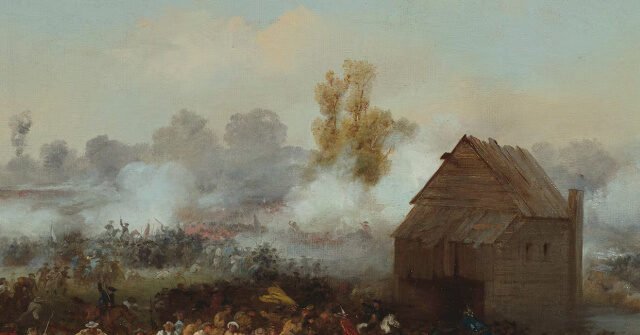
On the night of August 26, 1776, British scouts creeping near the Red Lion Inn in Brooklyn stumbled upon something irresistible: a patch of ripe watermelons. As they descended on the fruit, American riflemen stationed nearby spotted them and opened fire with their Pennsylvania Long Rifles. Those shots, fired in the early hours of August 27, alerted the Continental Army to the British movement and kicked off what would become the largest battle of the Revolution up to that point—the Battle of Brooklyn.
The story, recounted in historian Patrick K. O’Donnell’s forthcoming book Revolutionary Snipers: Washington’s Frontier Commandos Whose Marksmanship Forged A New Way of War and Helped Win the Revolution, highlights how a chance encounter over stolen watermelons set the stage for one of the most consequential fights in American history—a fight that nearly ended the rebellion just weeks after the Declaration of Independence was signed.
A New Nation on the Brink
In August 1776, the United States had existed for barely a month. After driving the British out of Boston, General George Washington marched his army to New York, hoping to block a British takeover of the city. But British General William Howe arrived with more than 20,000 troops—part of the largest invasion force ever sent to North America—determined to crush the uprising.
Howe’s plan was a classic hammer-and-anvil maneuver. A portion of his men would launch a frontal assault on American defenses, pinning them in place, while the main body—10,000 troops, including elite units—looped around to strike from behind and cut off any retreat.
The flanking movement began around 9 p.m. on August 26. British troops left their tents pitched and campfires burning to deceive the Americans, then moved as quietly as possible through the countryside, detaining civilians to keep their approach secret. The watermelon-patch gunfire, however, gave away part of the plan—though not enough to save Washington’s army from near-catastrophe.
The Marylanders’ Suicide Charge
Within hours, the British had Washington’s forces trapped on the Heights of Gowanus, with their only escape route crossing Gowanus Creek through a gap in the British line. That gap was held open by a group of Maryland soldiers who would become known as the “Immortals” or the “Maryland 400”—a nod to the 300 Spartans who held Thermopylae.
The Marylanders faced a daunting obstacle: a stone house occupied by British General Lord Cornwallis and thousands of Redcoats, plus a light cannon and musket fire. In a suicidal preemptive bayonet charge, Major Mordecai Gist led his men toward the Vechte-Cortelyou house.
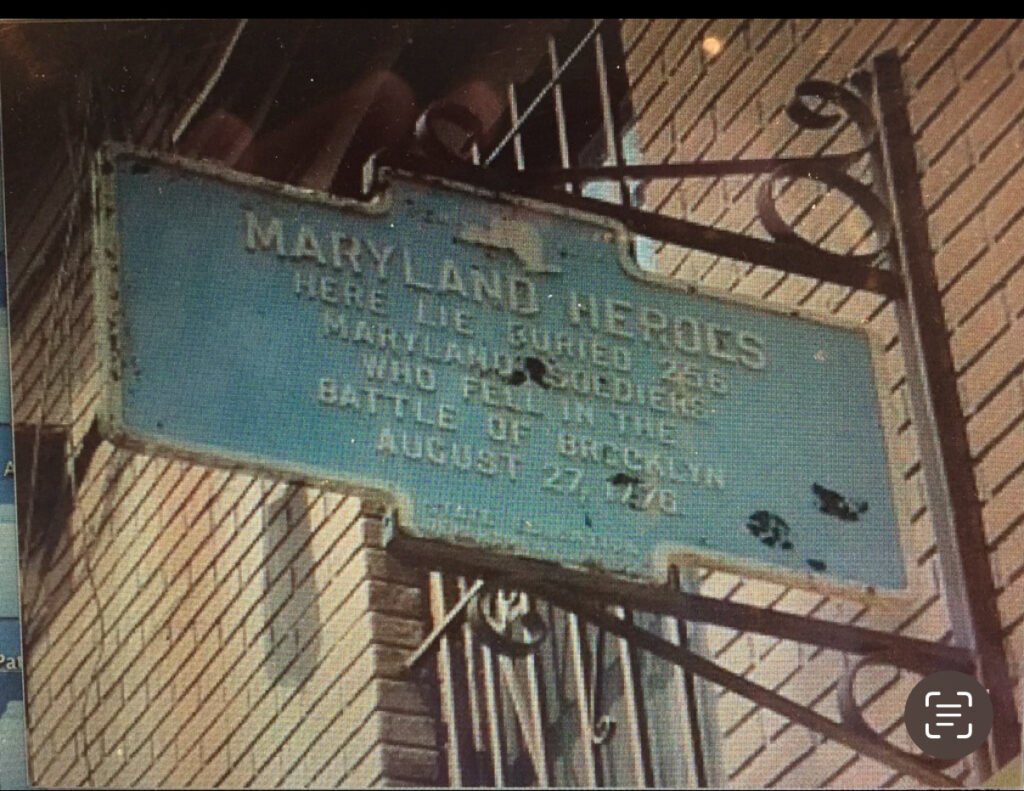
British fire dropped many of them instantly, severing limbs and heads. Officers shouted “Close up! Close up!” as the survivors reformed their lines and charged again into the hail of canister and grape shot. According to contemporary accounts, “the flower of some of the finest families of the South [were] cut to atoms,” yet the Marylanders “closed their ranks over the bodies of their dead comrades, and still turned their faces to the foe.”
The attack was renewed several times, each wave buying precious time for Washington’s retreating army.
An Hour More Precious Than Any Other
The Marylanders’ sacrifice was not in vain. Their stand chewed up daylight on the afternoon of August 27, preventing the British from uniting their forces for a final assault on the American fortifications at Brooklyn Heights. One American historian later called the time they bought “an hour, more precious to American liberty than any other in its history.”
Had Howe pressed his attack that afternoon, historians argue, the British likely would have captured the bulk of the American army—and possibly Washington himself. The war might have ended that day. Instead, the Marylanders’ bravery gave Washington enough time to withdraw his forces across the East River under cover of darkness, preserving the Continental Army for future battles.
Few of the Marylanders survived. The location of their mass grave remains one of the enduring mysteries of American history, though it is suspected to be near the Michael A. Rawley Jr. American Legion Post in Brooklyn.
Commemorating the 250th Anniversary
O’Donnell, a bestselling military historian and senior fellow at Mount Vernon, will present on the Battle of Brooklyn on August 26 at the Society of the Cincinnati in Washington, D.C., and deliver a keynote address on August 27 at 5:30 p.m. near the suspected mass grave site at the American Legion Post, with a commemoration and barbecue hosted by the Brooklyn GOP to honor the Immortals.
The watermelon patch may seem an unlikely starting point for a battle that shaped the fate of a nation, but as O’Donnell’s new research shows, sometimes history turns on the smallest of moments—and the bravest of stands.
Source: www.breitbart.com — https://www.breitbart.com/politics/2026/08/26/exclusive-odonnell-american-thermopylae-one-of-the-most-important-battles-in-american-history-started-in-a-watermelon-patch-250-years-ago/