
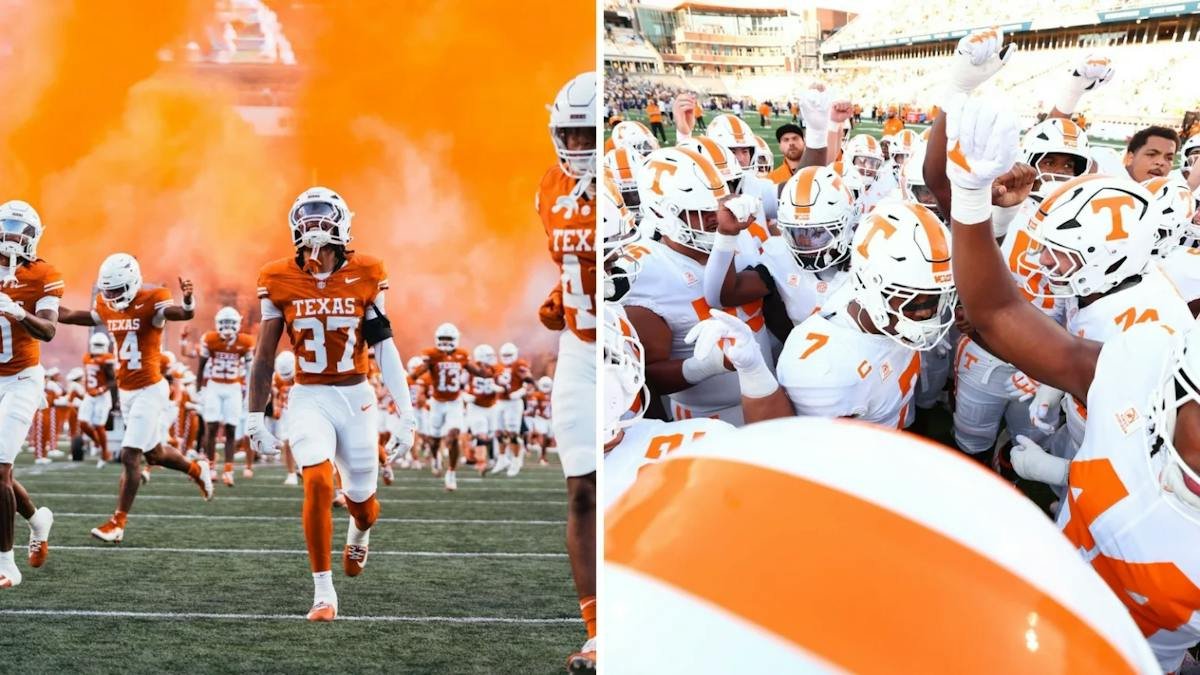
A new column at Sport & State is turning a branding squabble between two college football powers into a workplace drama, with the writer suggesting his job may be on the line for taking a side.
Mark J. Burns, a University of Michigan graduate who describes himself as the resident Big Ten alumnus on the editorial team, wrote that his argument that the University of Texas at Austin is the “real UT” — not the University of Tennessee — may have been his final piece for the outlet founded by Clay Travis. The article was published on Sport & State, a new media company Travis launched around sports, culture, original voices and live conversation, according to the site.
The immediate hook is Saturday’s game in Knoxville, where the Longhorns visit the Volunteers at Neyland Stadium, a matchup ESPN’s marketing apparatus has branded as the “Battle of the UTs.” Burns wrote that the game also marks the return of ESPN sideline reporter Holly Rowe, who he said is reuniting with Texas football, head coach Steve Sarkisian and quarterback Arch Manning after a highly publicized viral postgame incident two weeks earlier in Austin.
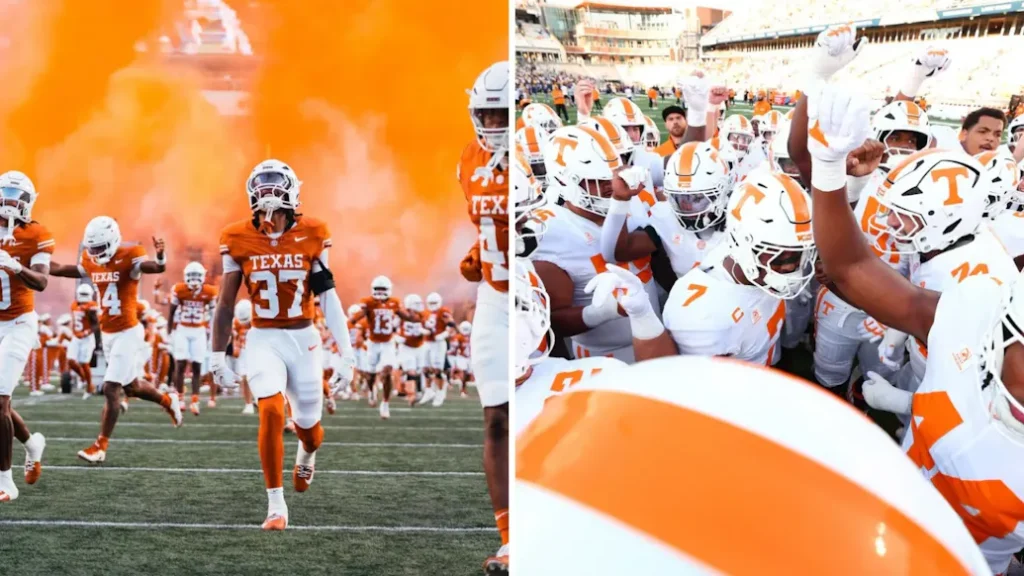
The argument: trademarks, brand value and global reach
Burns frames the debate as something he stumbled into rather than chose, recounting how classmates at Belmont Law in Nashville — a 1L class he said was filled with more native Tennesseans than he had ever been in a room with at once — informed him, roughly 15 years ago, that Tennessee was the real UT.
His rebuttal leans on what he calls a history lesson. Texas first federally registered the UT logo in 1983, with a first use cited back to 1906, he writes. A later legal dispute between the two schools, he adds, resulted in shared commercial use of the moniker on both sides of the Mississippi River, with the Texas Board of Regents opting to settle rather than spend money on a potentially lengthy court case.
From there, Burns pivots to program valuation. He cites a 2025 ranking of the most valuable collegiate athletic programs, presented by AD_University and CNBC, in which Texas placed No. 1 nationally at nearly $1.5 billion and Tennessee came in at No. 7. College sports programs, he notes, are not just about wins and losses but billion-dollar brands powered by media rights, fan demand and scale.

Brand recognition beyond state lines does the rest of the work in his telling. Burns, who says he has lived in nine states, writes that he has seen Texas hats and shirts in London, São Paulo and Lisbon — places where, in his estimation, Tennessee apparel is unlikely to turn up. Perception, he argues, is reality.
ChatGPT, a wife from Brazil and Peyton Manning
For backup, Burns turns to two sources unlikely to appear in a legal brief. He says he asked ChatGPT what college football team is commonly referred to as UT, and that the model answered that the acronym “most commonly” refers to the University of Texas at Austin, adding that the program’s global brand presence and financial standing drive the association. He also asked his wife, who is from Brazil and follows soccer more closely than American football, what program comes to mind when she hears “UT” — and got the same answer.
Burns concedes ground on on-field history where Tennessee holds an edge: the Volunteers claim six football national titles to Texas’s four. But he counters that the Longhorns have more all-time wins and more Heisman Trophy winners, and that Texas holds a 2-1 lead in the all-time head-to-head series.

He also takes a parting shot at South Carolina for calling itself USC, calls that an “egregious error of epic proportions,” and needles Tennessee fans over Michigan legend Charles Woodson beating Peyton Manning for the 1997 Heisman — a slight for which he explicitly declines to apologize.
In the end, Burns offers the Volunteers a narrow concession: within state borders, Tennessee can claim the UT name. Beyond the Volunteer State, he writes, that right belongs to the real UT.
The column closes on a note of self-aware resignation. Burns references a text message from his boss earlier in the week, thanks Travis for the chance to return to sports media, and signs off with “Hook ’em” — possibly, he allows, for the last time at the outlet.
The piece is written as opinion and framed around a long-running cultural argument among fans rather than any official NCAA or university designation, and no decision about Burns’s employment status was reported in the article itself.
Source: www.dailywire.com — https://www.dailywire.com/news/the-real-ut-debate-texas-or-tennessee-could-result-in-this-writer-being-fired