
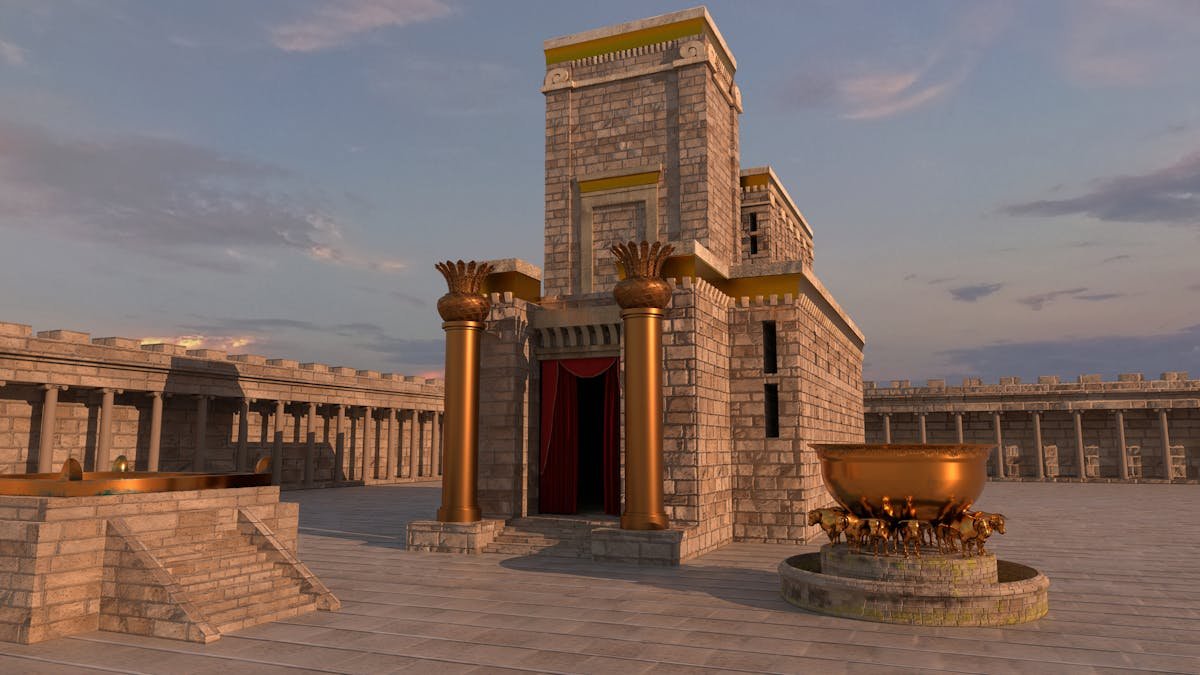
Archaeologists excavating beneath Jerusalem’s streets have uncovered charred wooden beams from the destruction of Solomon’s Temple, preserved for more than 2,600 years in the ruins of ancient Jerusalem. The discovery was announced by the Israel Antiquities Authority and Tel Aviv University just days before Tisha B’Av, the Jewish fast day commemorating the destruction of both ancient temples.
The massive timbers, blackened and twisted by fire, were part of a roof structure over an inner courtyard near the Temple when Babylonian forces destroyed Jerusalem in 586 BCE. The beams survived because melted plaster sealed them beneath rubble as the building collapsed, creating conditions that prevented their complete disintegration over the millennia.
The excavation took place in the City of David, an archaeological site located just outside Jerusalem’s Old City walls. According to researchers, the find represents a rare opportunity to study organic material from this period of ancient history.
Potential for Precise Dating
The preserved timber contains numerous growth rings that could allow researchers to date Jerusalem’s destruction with far greater accuracy than previously possible, according to Dr. Johanna Regev of the Israel Antiquities Authority and Weizmann Institute of Science.
“It is very rare in Israel to find wood with such a large number of growth rings,” Regev stated in the announcement. “Here, in the City of David, we found beams with many rings, offering significant research potential – with more growth rings enabling higher dating resolution.”
Until recently, archaeologists could only date finds from this era within a range of hundreds of years. The new discovery could potentially narrow that window to as little as a decade, as researchers separate and analyze individual growth rings from the beams.
A Landscape of Memory
The discovery reveals an unexpected detail about how Jerusalem was rebuilt after the Babylonian exile. Rather than clearing away the devastation completely, returning exiles chose to construct the new city directly on top of the ruins, allowing the wreckage to remain as evidence of what had occurred.
Archaeologists describe this practice as creating a “landscape of memory” — a phenomenon observed across numerous cultures where communities preserve physical evidence of catastrophic loss rather than erasing it entirely.
Historical Significance
According to biblical tradition, King David purchased the site known as Mount Moriah in the tenth century BCE, and his son Solomon constructed the First Temple there. The structure served as the center of Jewish worship and national life for nearly four centuries before Babylonian forces razed it in 586 BCE.
A Second Temple was later built on the same location after the return from exile. King Herod the Great later transformed it into a monumental complex before Roman legions destroyed it in 70 CE. The two destructions occurred 656 years apart and are both commemorated on Tisha B’Av.
Israeli Heritage Minister Amichai Eliyahu connected the discovery to contemporary discussions about Jerusalem’s history. “Jerusalem’s soil continues to provide tangible evidence of the city’s ancient past,” Eliyahu said. “The wooden beams burned in the destruction of the First Temple stand as a powerful reminder of the Jewish people’s presence in Jerusalem some 2,600 years ago.”
Eliyahu added that the find demonstrates how “our connection to Jerusalem is rooted not only in faith, but also in history, archaeology, and collective memory,” and emphasized the importance of preserving such discoveries for future generations.
Enduring Connection to the Site
Even after the Second Temple’s destruction, Jewish attachment to the Temple Mount continued through successive periods of foreign rule. Throughout Roman prohibitions, Byzantine restrictions, Crusader conquest, and Ottoman governance, Jews maintained connections to the site whenever circumstances permitted. Israel gained control of the Temple Mount in 1967 during the Six-Day War.
For the archaeologists involved in the excavation, the charred beams represent more than historical artifacts. They provide a tangible link between modern observers and the events of 2,600 years ago, offering physical evidence of the conflagration that consumed one of ancient Judaism’s most important structures.
The timing of the announcement, coming just before the annual fast commemorating these ancient destructions, adds particular resonance to the discovery for those who observe the traditional day of mourning.
Source: www.dailywire.com — https://www.dailywire.com/news/miracle-2600-year-old-wooden-beams-emerge-from-the-ashes-of-the-first-temple