
The Lindsay Clancy trial, already a lightning rod for bitter debates over punishment versus mental health, has ended in a mistrial—but the fallout is now centered on the conduct of the defense attorney and the judge who let him get away with it.
Writing for American Thinker, retired police officer and legal commentator Mike McDaniel describes the proceedings as a “travesty” and “another marker in the ongoing deterioration of our public culture and our judicial system.” The mistrial came as no surprise to McDaniel, who notes that the case—in which Clancy admitted to strangling her three infant children—was always likely to produce a hung jury given how polarized public opinion has become.
But the real focus of McDaniel’s ire is not the deadlocked jury. It’s the behavior of Clancy’s lawyer, Kevin Reddington, and the apparent passivity of trial judge William Sullivan.
Defense lawyer’s ‘unheard of’ attacks on juror
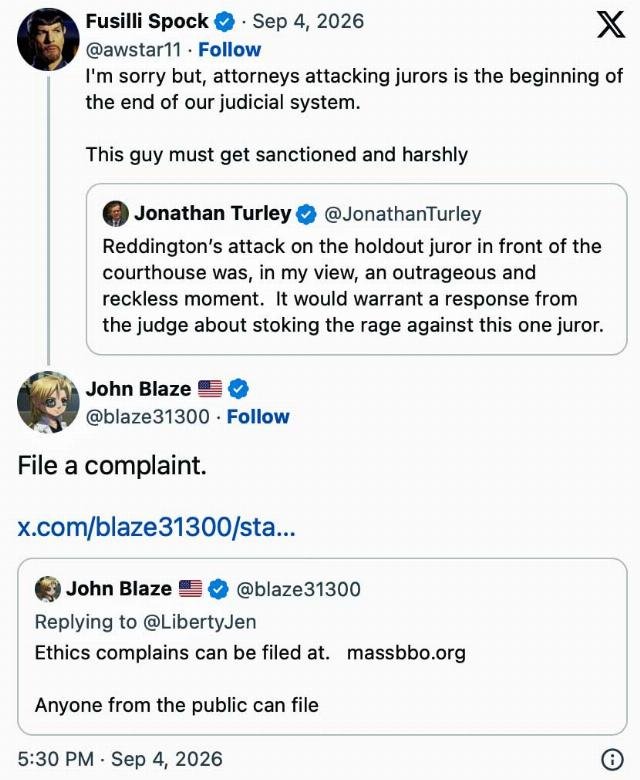
According to McDaniel, Reddington repeatedly attacked the holdout juror in open court and on television—both while the jury was still deliberating and after the mistrial was declared. During deliberations, Reddington accused the juror of “lying to the court” and refusing to follow instructions.
McDaniel, citing attorney John Hinderaker of the blog Powerline, writes that he has “never seen anything like this.” As a former trial lawyer himself, Hinderaker noted that in his decades of practice, no judge would have tolerated a lawyer publicly attacking a juror mid-trial. Such arguments are supposed to happen privately, in the judge’s chambers—not in front of television cameras.
Yet Judge Sullivan allowed Reddington to continue, even holding hearings in open court at Reddington’s insistence that should have been conducted behind closed doors. McDaniel argues this behavior will make it nearly impossible to find impartial jurors for a potential retrial.
‘Going native’ in the defense bar
McDaniel, drawing on his own police career, offers a broader critique of what he calls the “defense bar’s” tendency to “go native.” He likens it to diplomats who begin to identify so strongly with the country they serve in that they fight for that country’s interests rather than America’s.
He distinguishes between two types of defense lawyers: the young ones driven by an “irrational, TDS-like grudge against the system” who are willing to break any rule to defend their clients, and the more experienced ones who simply let their zeal get away from them, sometimes crossing into unethical conduct.
McDaniel writes that most judges—especially those who don’t share the lawyer’s ideology—quickly rein in such behavior. But in this case, Judge Sullivan failed to do so.
What was Reddington thinking?
McDaniel speculates about Reddington’s motives, suggesting he may be nearing retirement and wanting to “go out with a bang,” or that the late-in-life celebrity has overwhelmed him. He also raises the possibility that Reddington is trying to build an appeal record—though McDaniel notes that such tactics could instead provide evidence for his own disbarment.
“Who knows? Who cares?” McDaniel writes, expressing frustration more than curiosity.
A trial that may not be worth retrying
McDaniel questions whether the case should be retried at all. He acknowledges his own bias toward criminal punishment for Clancy, but argues that the damage the trial is doing to America’s judicial system and public culture may outweigh the benefits of a conviction.
“I almost wish they wouldn’t,” he writes of a potential retrial. “This debacle has punished America enough.”
The trial has become a flashpoint not just for the specific facts of the case—a mother accused of killing her children—but for broader concerns about whether the justice system can function when partisan passions run so high. McDaniel’s critique, while pointed, taps into a worry shared by many legal observers: that when lawyers and judges abandon traditional norms, the entire system loses credibility.
For now, the question of whether Lindsay Clancy will face another trial remains open. But for McDaniel, the damage may already be done.
Source: www.americanthinker.com — https://www.americanthinker.com/blog/2026/09/clancy-the-defense-goes-native/