
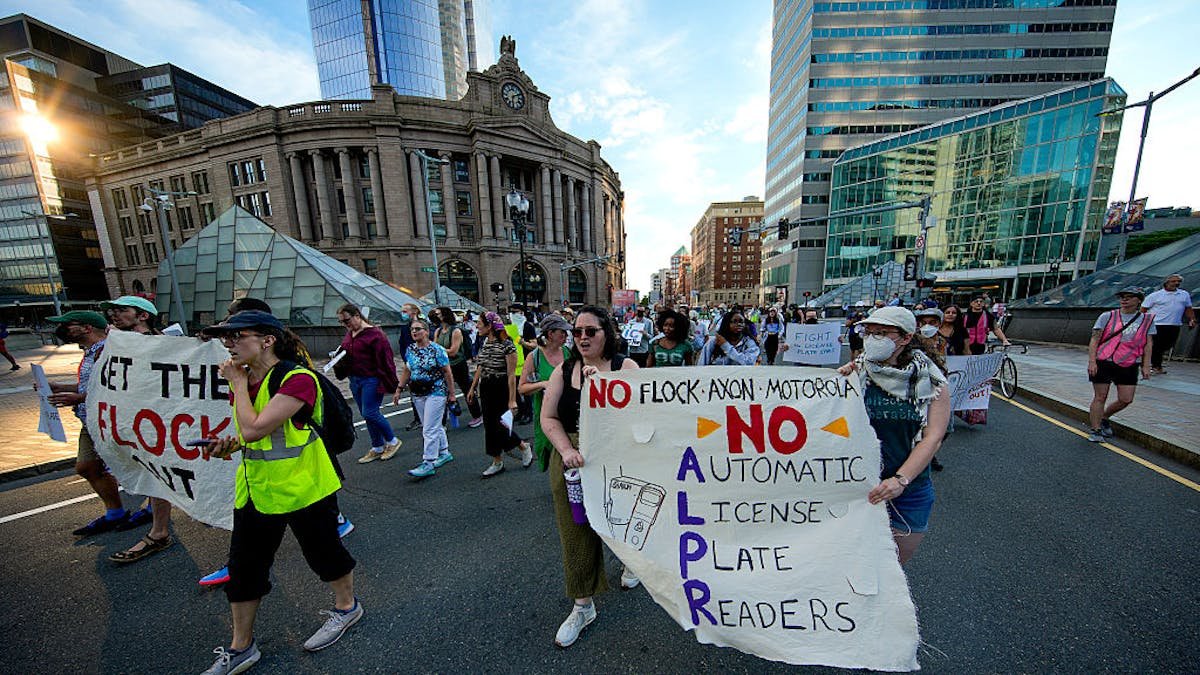
It’s a familiar hum of modern life: the phone in your pocket logs your route, the doorbell camera pings when a package lands, the algorithm knows which movie will keep you up past midnight. But a new front in America’s long-simmering surveillance debate has opened on a far less glamorous piece of tech — the automatic license-plate reader, and in particular the rapidly expanding network deployed by Atlanta-based Flock Safety.
According to a report by the Daily Wire’s Cameron Abrams, a policy analyst at the Texas Public Policy Foundation, Flock’s cameras — roughly 120,000 of them spread across the country as of 2026 — have become the target of a coordinated, grass-roots rebellion that blends libertarian distrust of government with broader anxieties about the erosion of privacy.
The rallying cries are hard to miss: “Flock off” and “De-flock now.” Activist websites have popped up to help citizens locate the automated license-plate readers (ALPRs) in their communities, and the resulting scrutiny has, Abrams writes, “undoubtedly led to numerous incidents of vandalism.” The ACLU has thrown its weight behind the cause, with a campaign webpage that calls the surveillance “unprecedented spying” and offers a “local advocacy toolkit” for anyone ready to “join the movement to tell Flock and other ALPR companies: ‘Get The Flock Out!’”
The backlash is notable not just for its volume but for its reach. In an era of hyper-partisan division, opposition to Flock’s cameras has found common cause across the political spectrum.

From Red-State Governors to City Councils
Politicians, Abrams notes, “who much too often rely on public polling for decision making, are getting nervous.” Even popular red-state governors like Greg Abbott of Texas and Ron DeSantis of Florida have pledged to crack down on cameras lining city streets. In major metropolitan areas, mayors and city councils have passed measures to keep Flock and similar ALPR systems out of their law enforcement’s public-private camera networks.
Flock CEO Garrett Langley has attempted to reframe the opposition, hoping that the controversy might “lead to fruitful debates” about the company’s value. “We don’t let a loud minority dictate us moving toward a less safe society,” Langley said, casting the company’s defenders as voices of public safety and its critics as a vocal fringe.
But Abrams argues that the resistance is anything but fringe. It taps into a deep vein of public unease about the expanding surveillance state — an unease that has historical precedent, from the defeat of President Lyndon B. Johnson’s proposed National Data Bank in 1965 to the civil-liberties battles that followed the Patriot Act after September 11 and the contentious “contact tracing” apps and speech crackdowns of the COVID-19 era.
What’s Different This Time?
Unlike past surveillance expansions, Abrams observes, the Flock backlash has no single inciting incident — no terrorist attack, no public-health emergency. The cameras simply “seem to have sprung out of nowhere.”

That may be precisely the problem. Americans have grown accustomed to corporate surveillance — the smartwatch that nudges you to move, the streaming service that seems to read your mood, the Ring doorbell that gives you a heads-up about your latest algorithmically induced purchase. But Flock’s cameras represent something more explicitly governmental. They are private cameras, often purchased by neighborhood associations and businesses, but integrated into law enforcement networks, creating a patchwork of license-plate data that police can access in real time.
“This new tech has definitely struck a nerve,” Abrams writes, quoting his Texas Public Policy Foundation colleague David Dunmoyer.
The distinction may lie in the crumbling foundation of trust. Abrams points to startling data: 77% of Americans in the pre-1960s era said “most people can be trusted”; today, that figure has collapsed to just 35%. In that environment of skepticism — toward institutions and toward neighbors alike — surveillance becomes both a symptom and a driver of alienation.
“Predictability is the foundation of trust,” Mortensen and Gardner wrote in a 2021 Harvard Business Review piece, cited by Abrams. “We’re willing to be vulnerable — to expose ourselves to potential risk — when we have reason to believe that someone will not take advantage of us or disappoint us.”

A Social Contract Under Strain
Abrams frames the Flock controversy as, at bottom, a question about the American social contract. The Founders built a political order that guaranteed rights preceding government; technology, he argues, now upends that bargain by creating systems of constant observation that blur the line between public safety and private life.
The proliferation of Flock cameras — and equally telling, the rise of privately purchased Ring doorbells — reflects a citizenry that no longer trusts its government or its neighbors. “A society that no longer trusts its government or its neighbors will eventually demand more surveillance,” Abrams writes, “whether it be from the state above or the camera next door.”
The rebellion against Flock, in this telling, is not an anti-technology Luddite revolt. It is a demand for a renegotiated bargain — one that acknowledges the desire for safety without surrendering the privacy that makes liberty meaningful.
For now, the “De-flock” movement appears to be gaining ground. Whether it can force a broader rethinking of America’s surveillance infrastructure — or whether it will end, as so many privacy battles have, in a negotiated compromise that leaves the cameras blinking on — remains to be seen.
Source: www.dailywire.com — https://www.dailywire.com/news/why-americans-are-unplugging-flocks-new-wave-of-surveillance