
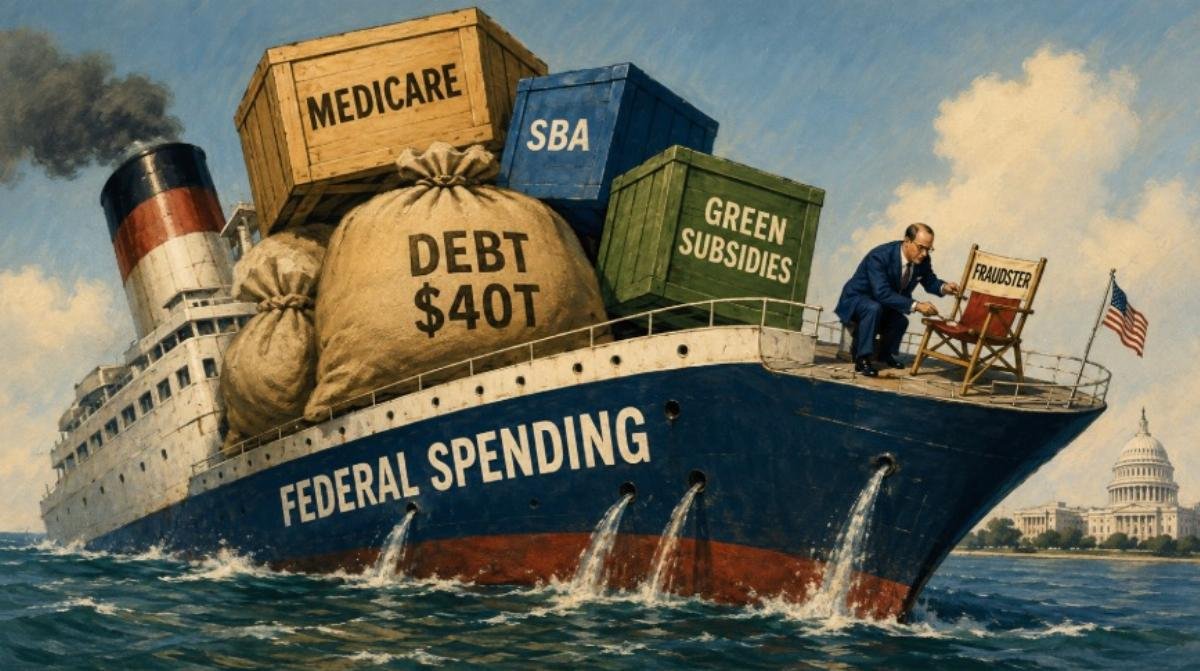
A provocative new analysis from American Thinker’s Ted Noel argues that the United States is facing a fraud-driven fiscal crisis that can only be solved by a fundamental constitutional reckoning. Noel, a retired physician who writes under the pen name ‘Doctor Ted,’ contends that most federal spending is unconstitutional and that the Supreme Court’s 1930s rulings that expanded congressional power were based on a flawed reading of the Constitution.
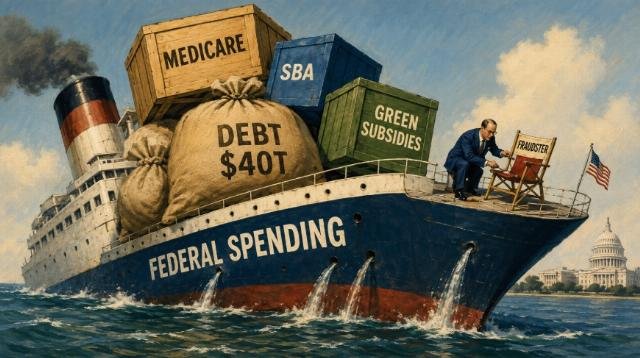
The piece opens with a stark warning: ‘What we’re doing now to fight massive fraud—shifting a program here or arresting someone there—is nothing more than rearranging deck chairs on the Titanic.’ Noel points to daily reports of fraud in Medicare, election systems, Small Business Administration loans, and ‘green’ subsidy programs. He cites Elon Musk’s earlier estimate that fraud could be ‘~20% of the Federal budget, which would mean $1.5 trillion per year. Probably much higher,’ a figure Noel now says is being proven conservative.
Noel invokes the late Senator Everett Dirksen’s famous quip—’A billion here, a billion there. Pretty soon you’re talking about real money’—as the national debt passes $40 trillion. He argues that criminal enforcement is a losing battle: ‘Every time we catch a fraudster, we take one bad actor off the field…out of thousands. That’s like fixing one dent on your car that you left out in a hailstorm.’
The Constitutional Argument Against Broad Spending
The heart of Noel’s thesis is that the General Welfare Clause does not give Congress unlimited spending power. He traces the term back to colonial documents, including the 1643 Articles of Confederation of the United Colonies of New England, which he says used ‘general welfare’ to mean mutual defense, not social welfare in the modern sense. The same understanding carried into the 1777 Articles of Confederation and the Constitution, he argues.
Noel contends that the Framers and key figures like James Madison and Alexander Hamilton consistently defined ‘general welfare’ as the well-being of the United States as a polity, not as a grant of broad spending authority. He quotes Justice Joseph Story’s 1833 Commentaries as supporting the view that the Clause is a purpose clause, not an independent grant of power. The Anti-Federalist fears about the Necessary and Proper Clause, he says, were answered by Federalist assurances that Congress could only exercise powers explicitly enumerated in Article I, Section 8.
The problem, Noel claims, came with the Supreme Court decisions in United States v. Butler (1936) and Helvering v. Davis (1937), which upheld the constitutionality of New Deal programs on General Welfare grounds. Those rulings, he argues, created a circular logic: congressional spending is constitutional because Congress chose to spend. He goes as far as to suggest that Justices Owen Roberts and Benjamin Cardozo ‘either did not know this history, ignored it, or lied about it,’ selectively quoting to justify near-plenary federal power. He references the famous ‘switch in time that saved nine,’ when Justice Roberts changed his position on minimum wage legislation to blunt President Franklin Roosevelt’s court-packing threat.
What Noel Wants Done
Noel’s prescription is drastic: a Supreme Court ruling that effectively eviscerates most federal ‘welfare’ programs, including Medicaid, Social Security, Medicare, SBA loans, job training programs, and green subsidies. ‘It’s time for the Supreme Court to call a flagrant-2 foul on Congress and kick it out of the welfare game,’ he writes. He acknowledges that retirees rely on Social Security and Medicare but argues the ‘reliance interest’ must be tackled carefully, without compounding the injury.
The piece ties the constitutional argument to the fraud problem: ‘Every welfare or subsidy program is a magnet for fraud. And every one of them is properly off-limits for Congress.’ Noel argues that eliminating programs that don’t strictly follow enumerated powers would right the ship fiscally and reduce fraud by cutting off the flow of easy money.
Critics may point out that Noel, a physician and not a constitutional scholar, is presenting a minority view in legal academia. The Supreme Court’s post-1937 jurisprudence has consistently upheld broad congressional spending powers. But Noel’s argument taps into a growing public frustration over fraud, debt, and the perceived overreach of the federal government.
Whether or not one agrees with his constitutional interpretation, the piece raises a question that is resonating with many voters: If the federal government is spending trillions it doesn’t have, on programs that are rife with abuse, at what point does the constitutionality of the whole enterprise become the central issue?
Source: www.americanthinker.com — https://www.americanthinker.com/articles/2026/08/congress-s-unconstitutional-spending-spree-must-end-to-stop-fraud/