
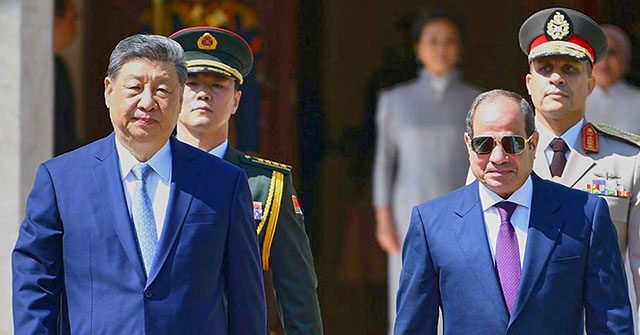
Chinese President Xi Jinping capped a frenetic month of Middle East diplomacy with a two-day stop in Cairo this week, where he rolled out yet another open-ended peace plan that analysts read as a thinly veiled bid to loosen America’s grip on the region’s security order.
Speaking Wednesday alongside Egyptian President Abdel Fattah al-Sisi, Xi unveiled what Chinese state media dubbed a “four-point proposal” to build a “new security architecture” for the Middle East. The pitch, according to a report from China’s official Xinhua News Agency, leaned heavily on a familiar refrain: regional countries should be “masters of their own affairs,” and “external interference should be rejected.”
“The international community, especially external powers, should abandon double standards in the Middle East, respect the sovereignty and territorial integrity of regional countries, and safeguard regional peace and stability,” Xi was quoted as saying.
What was left unsaid, however, spoke volumes. The proposal never named the United States, but Beijing’s targets are clear enough. China has not publicly grumbled about Russia’s long-running backing for the deposed Assad regime in Syria, nor about Iran’s sponsorship of Yemen’s Houthi militants. The one outside player Beijing consistently opposes is Israel’s principal ally — Washington.
Xi’s comments arrived as part of a broader diplomatic sprint that began in late August with a Beijing welcome for Jordan’s King Abdullah II, followed by a stop at the Shanghai Cooperation Organization summit in Bishkek, Kyrgyzstan, where he huddled with Russian President Vladimir Putin and Iranian President Masoud Pezeshkian. The optics of that last meeting suggested Beijing may be losing patience with Tehran’s continued disruptions of commercial shipping in the Strait of Hormuz, according to observers.
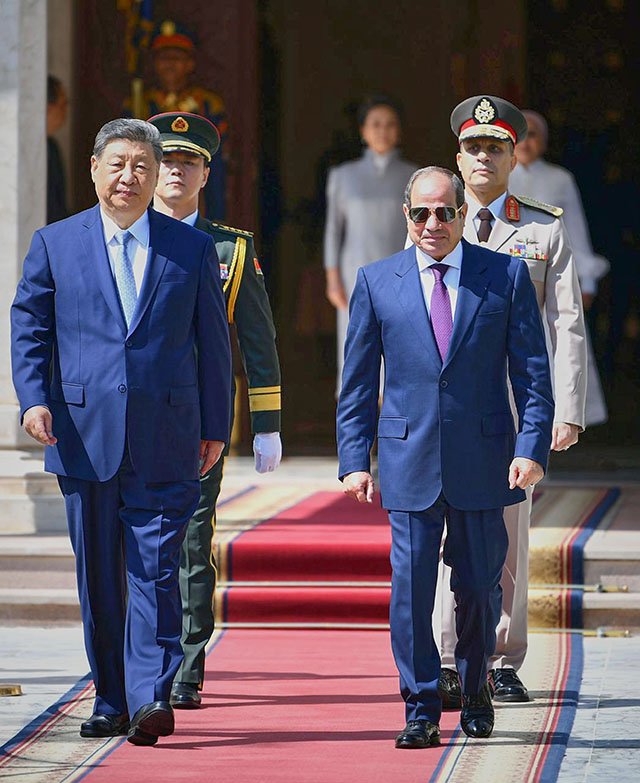
The Egypt visit itself came wrapped in lavish ceremony — a red-carpet welcome from al-Sisi’s government and a tour of the newly opened Grand Museum, a showcase for some of the world’s oldest civilizational artifacts. But behind the pageantry lay a strategic calculation: with Beijing’s signature Middle East diplomatic win — the 2023 normalization deal between Iran and Saudi Arabia — crumbling under the weight of Iranian strikes on Saudi territory, Xi is searching for a new foothold in the region.
China’s ‘Development’ Pitch Masks Infrastructure Ambitions
Buried in Xi’s proposal was a telltale economic hook. “The foundation for common security should be strengthened through development,” he said — a line analysts quickly read as an invitation for more Chinese investment, likely under the umbrella of Beijing’s Belt and Road Initiative (BRI), the global infrastructure program that critics have derided as a vehicle for predatory lending and overpriced Chinese-built projects.
“China stands ready to work with Middle East countries to safeguard the security of international shipping lanes, advance development cooperation, promote the convergence of interests of regional countries, gradually enhance mutual trust, and eliminate the root causes of the conflict,” Xi added, per Xinhua.
That promise drew a skeptical response from observers. Beijing has neither leaned on Iran to stop harassing commercial traffic in the Strait of Hormuz — despite publicly urging restraint — nor offered People’s Liberation Army assets to protect civilian ships transiting those waters, as Breitbart News noted.
China’s own state-run mouthpiece, the Global Times, declared Thursday that the proposal aimed to send “a clear message that Middle Eastern countries should pursue greater strategic autonomy in security affairs rather than rely excessively on external powers.” The newspaper, echoing Xinhua, conspicuously omitted which “external powers” it had in mind — though a regime-approved expert complained that regional states had “spent heavily on Western weapons.”
Hong Kong’s South China Morning Post cut through the vagueness. “Chinese President Xi Jinping has urged Middle Eastern nations to build a self-led security model, nudging them to cut reliance on Washington following further US-Iran military clashes,” it reported Tuesday.
The Morning Post framed Xi’s remarks as an “implicit, if thinly veiled, reminder of the limits of the US role as the region’s security guarantor,” citing John Calabrese, a non-resident senior fellow at the Washington-based Middle East Institute. Calabrese also saw the proposal as “an affirmation of emerging localised arrangements such as the Mecca Defence Pact, and an alignment with Iran’s long-standing call for external security powers to reduce their presence in the region.”
Sisi Signs On, Eyes Deeper Ties
For his part, al-Sisi thanked Xi for the visit and signed a series of trade agreements with China, many linked to the BRI. Xinhua reported the Egyptian leader hoped to “deepen cooperation in trade and investment, manufacturing, infrastructure development, finance, science and technology, and new energy.” He also floated “strengthen[ing] military and security exchanges” and promoting closer people-to-people ties.
The warm words from Cairo obscure a grimmer backdrop for Xi’s diplomacy. Beijing’s efforts to cultivate influence across the Middle East have yielded meager results, a string of vague peace proposals and outreach to Iran-backed proxies like Hamas and Hezbollah notwithstanding. Even China’s most touted achievement — brokering the Iran-Saudi rapprochement in 2023 — has largely unraveled amid Iranian bombardments of Saudi territory in response to U.S. military action inside Iran.
Xi departed for Beijing on Thursday, but his travel calendar is far from empty. He is expected to head to the United States in late September for a meeting with President Donald Trump, a session likely to test whether his new Middle East pitch carries any weight beyond the region’s borders.
For now, though, the message from Cairo appears aimed at a different audience. As the MEI’s Calabrese put it, Xi’s words align neatly with Iran’s long-running call for outside security forces to leave the region — a position that stops just short of urging the United States to pack up and go home.
Source: www.breitbart.com — https://www.breitbart.com/asia/2026/09/03/xi-jinping-proposes-elbowing-u-s-out-of-middle-east-on-egypt-trip/